
Most people shopping for the best shadow work journals do not need the deepest book on the shelf. They need the one they will actually open after a hard day, write in honestly, and keep using once the novelty wears off.
If you want the short version, The Shadow Work Journal by Keila Shaheen is the safest default for most beginners because it is structured, mainstream-friendly, and easier to stick with. If you want something more immersive and artful, Wisdom of Wholeness is the stronger pick. If you want an exercise-driven workbook that feels more like guided inner work than a pretty journal, Mindful Shadow Work earns that spot.
That quick answer only gets you halfway there though. A shadow work journal is not like buying a blank notebook or a gratitude diary. Prompt density, emotional tone, and even how much room the page gives you to write can change whether you keep going or quietly slide the thing into a drawer.
- Which journal fits beginners, deeper readers, and self-love focused readers
- What makes a prompt useful instead of vague or overwhelming
- How to choose between a workbook, a blank journal, and an app
- How to start without frying your nervous system
- When journaling is a good tool and when it is not enough on its own
Best Suggestions Table (Products were editorially reviewed against the same fit criteria below. Click a button to jump to the matching review.)
| Product | Best for | Action |
|---|---|---|
| The Shadow Work Journal | Most beginners who want structure | Check Price Review |
| Wisdom of Wholeness: Shadow Work Journal | Deeper, more embodied reflection | Check Price Review |
| Mindful Shadow Work | Readers who want exercises, not just prompts | Check Price Review |
| Into The Wild Shadow Work Journal: Reclaim Your Wholeness | Straight prompts with more room to write | Check Price Review |
| Shadow Work Journal for Self-Love | A softer entry point rooted in self-love | Check Price Review |
Tip: if you freeze at blank pages, start with the most guided option, not the prettiest cover.
Quick fit filter
Ask yourself three things:
- Do you want prompts to lead you, or do prompts make you bristle?
- Do you need a gentle tone, or are you ready for more direct confrontation?
- Will you write better on paper, or does a phone-based habit stand a better chance?
That little triage matters more than hype. The journal that gives you emotional containment will beat the one that promises the deepest transformation every time.
How we tested them
For this category, “testing” is less about paper stock and more about fit. I compared each journal on five things that change whether people keep using it: prompt quality, teaching or context, emotional gentleness, writing space, and plain old usability. I also checked official product details, sample-page cues where available, and how each book handles pacing. A journal can be lovely and still be the wrong tool for a rough Tuesday night. Thats the real test here.
Best Shadow Work Journals at a Glance
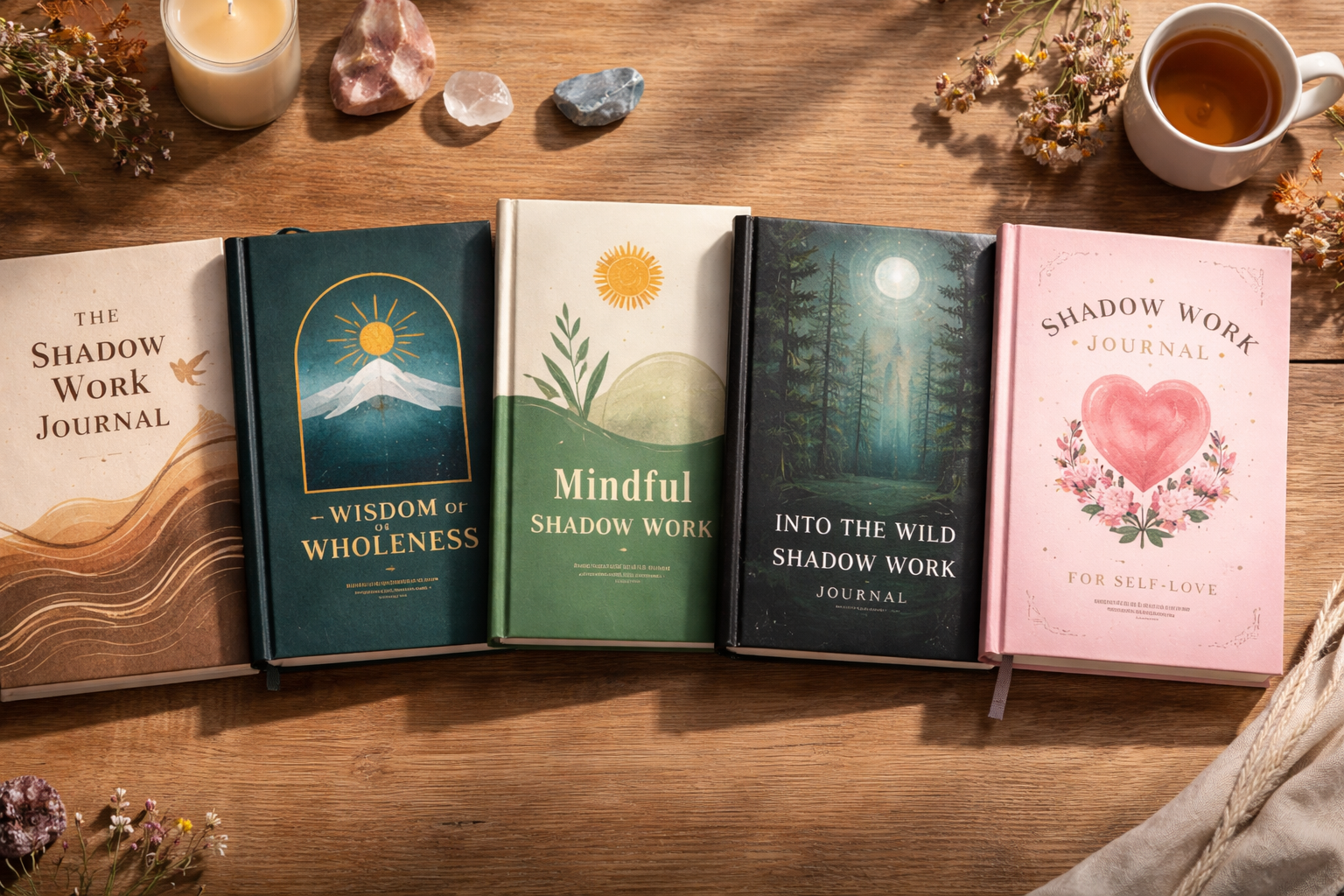
Before you get buried in product blurbs, here is the fast read.
| Journal | Best for | Format | Intensity | Editorial fit rating |
|---|---|---|---|---|
| The Shadow Work Journal | Beginners | Guided journal/workbook | Moderate | 4.5/5 |
| Wisdom of Wholeness | Deeper embodied work | Guided journal | Moderate to deep | 4.5/5 |
| Mindful Shadow Work | Exercises and structure | Workbook-style guide | Moderate to deep | 4/5 |
| Into The Wild Shadow Work Journal | More writing room | Prompt journal | Moderate | 4/5 |
| Shadow Work Journal for Self-Love | Gentle self-love entry point | Guided journal | Gentle to moderate | 4/5 |
The shortest honest answer: if you are brand-new and want the least guesswork, start with The Shadow Work Journal. If you already know you want more depth, richer imagery, and a slightly more embodied feel, go with Wisdom of Wholeness. If you want something that teaches and guides more actively, Mindful Shadow Work makes more sense.
Remember: “Best” is not a trophy here. It means “best for the version of you who is going to sit down and actually do the work.”
How to Choose the Right Shadow Work Journal for Your Mind, Not Your Mood
A good shadow work journal does not just hand you dramatic prompts. It creates enough structure that you can keep going when the writing gets uncomfortable.
That starts with five filters.
1. Prompt quality. The best prompts are specific enough to unlock memory, pattern, or emotion. Weak prompts sound interesting and then leave you staring at the page. Strong prompts do one job at a time. They ask about resentment, people-pleasing, shame, boundaries, or projection in plain language.
2. Teaching layer. Some journals assume you already understand the shadow self. Others explain what you are doing and why. That teaching matters more than people think. When you know why a prompt is pushing on a sore spot, you are less likely to misread the discomfort as failure.
3. Emotional tone. This one gets ignored far too often. A journal can be technically good and still be wrong for you right now. If you are new, or you have a habit of flooding yourself emotionally, start gentle. A journal that feels a little too soft is still usable. A journal that feels like a trapdoor is not.
4. Writing space. This sounds cosmetic. It is not. Tight lines create short, tidy answers. Generous space invites messier truth. I have seen people dismiss this as a small detail and then realize they are writing summaries instead of reflections.
5. Format fit. Paper, printable, or digital is not just about preference. It is about friction. If you always process better with a pen in hand, do not buy an app because it seems efficient. If your real problem is consistency, a digital tool might beat a beautiful hardcover that never leaves your nightstand.
Simple decision rules
- If you are brand-new, choose explanation plus moderate prompts.
- If you hate being told what to write, pick a journal with more space and less scripting.
- If shame, guilt, or inner child work is your entry point, pick a gentler tone.
- If you already know you avoid feelings by intellectualizing them, choose prompts that force specifics.
- If your nervous system already runs hot, slow down and read the safety section before buying the most intense option.
It also helps to separate the psychology from the social media noise. Encyclopaedia Britannica’s overview of Carl Jung grounds the basic idea: Jung’s analytic psychology explored hidden parts of the psyche, archetypes, and the unconscious. Modern shadow work journaling borrows that language, but these books are not Jung in hardcover. They are guided self-reflection tools inspired by that tradition.
That is not a bad thing. It just means you should buy for usability, not mythology.
Best Shadow Work Journals by Use Case

The Shadow Work Journal
Editorial fit rating: 4.5/5
Simon & Schuster describes this one as an interactive journal built around prompts and advice, and the newer edition adds therapist-curated exercises and learning material. That matters because the hardest part for beginners is rarely willingness. It is what to do when a page starts poking at something real. A journal with more handrails gives you a better shot at staying with it.
This is why I keep landing on it as the safest default. The tone is accessible without feeling syrupy. It gives you enough guidance to move, but not so much that you feel talked at. For readers who have seen shadow work on TikTok, bought into the idea, and now need a structured place to begin, this journal makes the on-ramp feel normal.
Its biggest strength is the balance between prompting and containment. The questions tend to push, but they do not fling you straight into the emotional deep end on page two. That pacing is a big deal. When a journal starts too intense, people do not become braver. They stop using it.
The tradeoff is that readers who want more room to free-write, sketch, or roam may find it a little managed. If you already journal well without much help, you might outgrow its structure faster than a true beginner will.
Best for: beginners, prompt-freezers, and readers who want a guided journal that feels approachable.
Skip if: you want a more spacious, less workbook-like experience.
Wisdom of Wholeness: Shadow Work Journal
Editorial fit rating: 4.5/5
The official product page lists more than 150 prompts across more than 220 pages, and it leans into art, ritual, embodiment, and themes such as rage, boundaries, shame, grief, and people-pleasing. That stack of details tells you what kind of experience this is going for. Not stripped-down. Not merely functional. It is trying to be a fuller container.
For the right reader, that is exactly the appeal. Some shadow work journals feel like a worksheet in a nice cover. This one appears built for people who want texture, atmosphere, and a little more depth around the prompts. I would steer embodied, intuitive, or creatively inclined readers here before I sent them to a minimalist workbook. They are more likely to click with it and actually write with honesty.
Where it wins is emotional richness. Where it can lose, for some people, is sheer volume. A journal with this much material can feel nourishing, or it can feel like you bought a retreat and put it on your desk. If you are easily overwhelmed by abundance, start with a tighter format.
So no, this is not the clean default for everybody. But if a plain, clinical-looking workbook makes you go flat and you want shadow integration to feel more alive, this is the one I would put in your hands first.
Best for: readers who want a deeper, more immersive journal with embodied and creative elements.
Skip if: you want something sparse, quick, and low-friction.
Mindful Shadow Work
Editorial fit rating: 4/5
LonerWolf’s official page frames this as a beginner-friendly guide with shadow work exercises, ground rules, and warnings. That instantly sets it apart from journals that act as if one dramatic prompt and a lined page are enough. Readers who want more than journaling, and want guided practices that help them make sense of what comes up, will probably find that extra structure useful.
This reads more like a workbook-book hybrid than a classic journal. That can be a plus. If you tend to ask, “Okay, but what do I do with this feeling now?” a format with exercises and framing can feel less floaty and more practical. It also suits readers who like learning as they go instead of being dropped into introspection cold.
The catch is right there in the format. If you want a dedicated journal you can dip into quickly, this may feel more like a study session. You are not just responding. You are being led. Some people love that. Some people feel boxed in by it.
I would pick this for someone who wants shadow work explained while they do it, especially if they are trying to understand patterns like shame, secrecy, or self-sabotage in a slightly more deliberate way. I would not pick it for someone who wants a softer, more aesthetic, more free-flowing journaling ritual.
Best for: readers who want instruction, exercises, and a strong guide-voice.
Skip if: you want a looser or prettier journaling experience.
Into The Wild Shadow Work Journal: Reclaim Your Wholeness
Editorial fit rating: 4/5
Goodreads metadata and reader notes point to roughly 60 prompts and a lighter page count than some of the more elaborate options here. That can sound modest, but it signals something useful. This journal is not trying to be your whole philosophy of healing. It is trying to get you writing.
That simplicity is the reason it makes the list. Some people do better with fewer moving parts. Give them a prompt, real writing space, and no overbuilt framework, and they go deeper than they ever would in a book full of teaching sidebars. There is a kind of honesty that only shows up when the page is not crowded.
This is where “room to write” stops sounding trivial. A lot of guided journals ask hard questions and then hand you a few lines, which is like asking someone to empty a closet into a lunchbox. This one seems more generous, and that alone makes it a better fit for readers who already have a journaling habit and do not need constant hand-holding.
The weaker point is context. If you are brand-new to shadow work and want more explanation, you may find it a little light on teaching. But if you already know the broad idea and mainly need a strong prompt journal that does not suffocate your writing, it is a very fair pick.
Best for: people who dislike cramped pages and want prompt-led freedom.
Skip if: you need a lot of psychological framing or step-by-step guidance.
Shadow Work Journal for Self-Love
Editorial fit rating: 4/5
Penguin Random House describes this one as a step-by-step shadow work journal centered on self-love, inner child work, and guided exercises aimed at guilt, shame, and fear. That is a very particular lane, and for the right reader it is a smart one. Not everyone needs the hardest prompt first. A lot of people need enough self-compassion that they can stay in the room with what comes up.
I like this as an entry point for readers who know they respond better to a gentler tone. If a more confrontational journal makes you tighten up, defend yourself, or start performing wisdom instead of telling the truth, a self-love rooted book can actually get you further. Soft is not always shallow. Sometimes soft is what makes the work possible.
It also gives a more obvious doorway into inner child work, which many readers find easier to relate to than abstract Jungian language. That is practical. “What part of me learned this?” is often a more usable question than “Which shadow aspect is being activated?”
The tradeoff is that readers who want heavier confrontation, broader theme coverage, or a more psychology-forward tone may find it a little too nurturing. Fair enough. But for shame-prone readers, or anyone who tends to weaponize self-analysis against themselves, this is the better buy.
Best for: shame-prone readers, inner child work, and a gentler entry into shadow journaling.
Skip if: you want a tougher, more direct, more stripped-back tone.
One thing most lists miss: the “deepest” journal is not automatically the best one. The better journal is the one that gets honest pages out of you without making you shut down.
Guided Workbook vs Blank Journal vs App: Pick the Container That Keeps You Writing

If you freeze at a blank page, a guided workbook is not training wheels in a bad way. It is just a better fit.
Guided workbook or journal. Best for beginners, overthinkers, and people who need a nudge. You are given prompts, sometimes short exercises, and often a sequence. That reduces friction. It also cuts the classic beginner problem of writing around the issue instead of into it.
Blank journal. Best for experienced reflectors, people who already understand their own patterns, or readers who hate being steered. Blank pages give maximum freedom. They also give maximum room to avoid the actual thing that needs saying. That is the trade. Freedom can turn into drift fast.
App. Best for consistency and low-friction habit building. If the barrier is “I forget,” a phone-based journaling tool can help. If the barrier is emotional honesty, an app may not. There is something about pen on paper that slows the mind just enough for harder truths to catch up.
I have watched this go wrong in a very predictable way. Someone who hates prompts buys a tightly structured workbook and feels bossed around. Someone who panics at open-ended writing buys a blank notebook and writes titles, not truth. Someone who loves the idea of journaling buys an app, taps out two clever paragraphs, and never returns.
The right container is the one that removes your most likely quitting point.
Fast format picker
- Choose guided if blank pages make you stall.
- Choose blank if prompts make you argue with the book.
- Choose app if consistency is the real problem, not depth.
Start Shadow Work Journaling Without Overwhelming Yourself

Shadow work itself is not a formally standardized treatment. Cleveland Clinic describes shadow work as self-exploration, often done in therapy, that helps uncover hidden or repressed parts of yourself. That framing is useful because it puts the practice in the right lane. This is exploration. It is not a race, and it is not a replacement for care.
So start smaller than your dramatic side wants to.
Pick one theme and reduce the noise
Choose one lane for a session: shame, people-pleasing, resentment, jealousy, boundaries, fear of conflict, or self-sabotage. One prompt. One theme. That is enough. The people who burn out on journaling often do ten shallow prompts and call it depth. It is not. It is just scatter.
Write one prompt and go deeper
A simple beginner rhythm works well: 10 to 15 minutes, one prompt, once or twice a week. If the answer starts feeling flat, keep drilling with follow-ups such as “What am I not saying yet?” or “When have I felt this before?”
There is good reason to keep it contained. A 2022 review in the National Library of Medicine’s PubMed Central archive notes that expressive writing can help in mental health settings, but the evidence is mixed and instruction matters. That last part is the piece people skip. More emotion is not automatically more benefit.
Close the session and get your feet back under you
Do not snap the journal shut and bolt back into your day. Take one minute and regulate. Mayo Clinic’s mindfulness guidance points to simple breathing and attention practices that can lower stress and help you steady yourself. That can be as plain as both feet on the floor, a slow exhale, and naming five things in the room.
A beginner-safe session formula
- Pick one prompt.
- Write for 10 to 15 minutes.
- Stop while you still feel grounded enough to name what came up.
- Close with one regulating question: “What do I need right now to feel steady again?”
And if you want one very practical reason journaling can help, NAMI’s journaling guide makes it plain: writing can help you track triggers, symptoms, and patterns. That is a much saner goal than trying to have a cinematic breakthrough every session.
The Mistakes That Make People Quit Shadow Work Journaling
Buying the most intense journal first. This is the big one. People assume deeper means better. Usually it just means earlier overwhelm. Buying an advanced shadow journal as a beginner is like buying climbing shoes before you know whether you even like heights.
Confusing emotional intensity with progress. If a prompt wrecks you, that does not automatically mean it was productive. Sometimes it just means it went too far, too fast. Progress usually looks quieter than people expect. A clearer pattern. A cleaner boundary. An honest sentence you used to dodge.
Choosing aesthetics over usability. A gorgeous cover can hide weak prompts, cramped pages, or a tone that makes you roll your eyes. A journal is not decor. It is a working tool. Harsh truth, but there it is.
Doing too many prompts at once. Ten prompts in one sitting is the emotional version of trying to deadlift on day one. You do not build trust with yourself that way. You build avoidance.
Using the journal to self-diagnose. A shadow work journal can reveal patterns, but it is not there to label you, fix you, or act as your only source of mental health support. When people start treating every uncomfortable reaction as proof of some hidden defect, the writing turns mean and brittle.
Skipping the aftercare. This sounds soft until you watch what happens without it. You write about shame or childhood anger, close the book, scroll your phone, and then wonder why the rest of the evening feels jagged. A minute of grounding is not fluff. It is part of the work.
What to do instead
- Start one level gentler than your ego thinks you need.
- Pick one prompt and stay with it.
- Notice whether the journal helps you tell the truth, not whether it sounds deep.
- End every session with grounding, even when the session felt fine.
When a Journal Is Not Enough
This is the line worth drawing clearly.
Self-reflection is one thing. Trauma processing is another.
Cleveland Clinic’s guidance on shadow work makes the point gently but plainly: the practice can bring up painful emotions, and many people do it most safely with a therapist, especially when deeper wounds are involved. That is not fearmongering. It is just adult advice.
If journaling leaves you flooded, dissociated, panicky, sleepless, or sharply self-loathing, the answer may not be a different journal. The answer may be slower pacing, more support, or both. Same if you already deal with heavy anxiety, depression, trauma symptoms, or a pattern of spiraling after emotional work.
There is no prize for muscling through that alone.
A journal can be a strong companion for self-awareness, pattern recognition, and shadow integration. It can help you spot where shame shows up, where resentment keeps leaking through, and where your so-called authentic self gets replaced by performance. That is all useful. But if your nervous system is already lit up, a lined page is not always the right container.
Pause signals: panic spikes, numbness, feeling unreal, a wrecked night’s sleep after journaling, or a steady rise in self-attack. If that is the pattern, step back and get more support around the work.
FAQ
Do I need a guided shadow work journal, or can I use a regular notebook?
You can use a regular notebook, but most beginners do better with a guided journal. A blank notebook gives freedom, and freedom turns into avoidance pretty fast when the topic gets tender. Once you know your own patterns, a regular notebook can work very well.
How do I know if a shadow work journal is too advanced for me?
If the prompts feel so intense that you shut down, perform answers, or avoid the book for days, it is too advanced for right now. The better journal is the one that gives you honest pages without making you brace before every session.
Can a shadow work journal replace therapy?
No. It can support self-awareness and pattern recognition, but it is not a substitute for therapy, especially if journaling stirs up panic, trauma symptoms, dissociation, or intense self-attack. In those cases, a journal works better as one tool inside a bigger support system.
So where would I start? If you want the cleanest beginner pick, start with The Shadow Work Journal. If you want a more immersive, embodied journaling experience, pick Wisdom of Wholeness. If what you really need is teaching plus exercises, go with Mindful Shadow Work. Buy for fit, not for hype, and your odds of actually doing the work go way up.