The odd thing about most crystal guides is not that they recommend the same stones. It is that they talk about anxiety and depression like they are one mood with one fix. They are not. “Wired and spiraling” is a different job from “flat and heavy.”
If you want the best crystals for anxiety and depression, start with amethyst, rose quartz, lepidolite, smoky quartz, black tourmaline, citrine, and clear quartz. But the right first pick depends on what you actually want help with: calming racing thoughts, feeling emotionally held, getting grounded, or nudging yourself out of that grey, low-battery slump.
That distinction matters more than most lists admit. I’ve seen people buy a pretty seven-stone starter pack, line it up on a shelf, and then only use one smooth palm stone because that was the only piece that fit the moment they were actually struggling. The crystal that gets used beats the crystal that looks mystical in a product photo. Every time.
What you’ll get from this guide
- Which crystal fits overthinking, panic, emotional rawness, low mood, and social overwhelm
- The seven stones most worth starting with and where each one falls short
- How to pick the right form, from a palm stone to a bracelet to a bedside piece
- A simple routine that makes a crystal useful instead of decorative
- How to spot regret buys, dyed junk, and vague listings
- When a crystal is a nice support tool and when it is nowhere near enough
Quick Match
| If this is the feeling | Start here | Why it fits | Best first form |
|---|---|---|---|
| Racing thoughts, bedtime tension, overthinking | Amethyst | Feels cooling and mentally quieter | Palm stone or bedside piece |
| Harsh self-talk, grief, feeling emotionally scraped raw | Rose quartz | Gentle, soft, and comforting | Worry stone or bracelet |
| Shaky, frazzled, stretched thin | Lepidolite | Often chosen for emotional steadiness | Palm stone |
| Overstimulated, ungrounded, too open to everything | Smoky quartz or black tourmaline | Grounding, heavier, steadier | Pocket stone or desk piece |
| Flat, dull, stuck, hard to begin | Citrine | Brighter and more activating | Small polished stone |
Best Crystals for Anxiety and Depression at a Glance
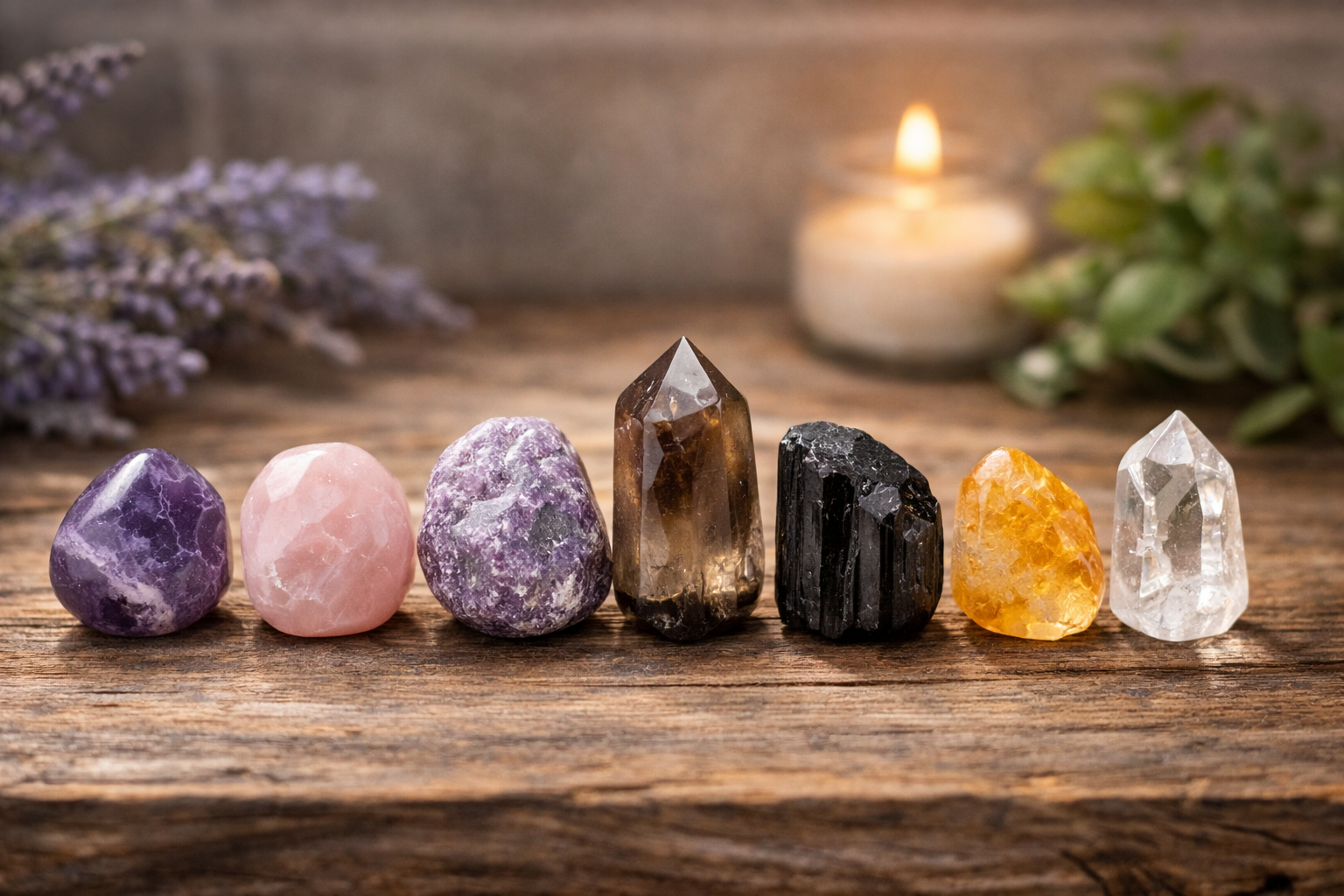
If you want the short version, here it is.
Amethyst is the safest default for anxious overthinking and bedtime spirals. Rose quartz makes more sense when the hard part is self-criticism, heartbreak, or feeling emotionally bruised. Lepidolite is the one many people reach for when they want emotional balance rather than deep sedation. Smoky quartz and black tourmaline are stronger fits for grounding, especially when anxiety feels buzzy, scattered, or socially draining. Citrine is the pick for low drive and heavy mood. Clear quartz is useful, but it is more of a flexible sidekick than the sharpest first answer.
My default rule is simple: if you only want one no-regret beginner crystal, pick amethyst for calm or smoky quartz for grounding. Those two cover a lot of territory without feeling too abstract. Rose quartz is close behind if what you need is tenderness rather than quiet.
Fast pick: choose the stone that matches the feeling, not the stone with the prettiest story. Calm, comfort, grounding, and lift are four different jobs.
Can Crystals Help with Anxiety and Depression?
A 2025 randomized controlled trial indexed on PubMed followed 138 adults for 14 days. Some used rose quartz. Others used a visually matched placebo. Anxiety went down only in believers, and it did not matter which object they held. The researchers concluded that healing crystals did not show anxiolytic effects beyond placebo.
So no, crystals do not have good evidence as a stand-alone treatment for anxiety or depression.
That does not make them pointless. In the National Center for Complementary and Integrative Health’s summary of mindfulness research, large reviews found that mindfulness-based approaches can help with anxiety and depression, though results vary and not every study is clean. That matters because a crystal often works less like medicine and more like a cue. It can remind you to breathe, ground, slow down, journal, or stop feeding the spiral for sixty seconds. That is not magic. It is still useful.
I think this is the healthiest way to hold both ideas at once: crystals are not evidence-based treatment for depression or anxiety, but a tactile ritual can still be calming, organizing, and emotionally anchoring. A smooth stone in your hand can interrupt momentum. It can make you pause long enough to do the thing that actually helps.
Remember: supportive is not the same as curative. A crystal can be a companion object. It is not a substitute for treatment.
How to Match a Crystal to the Feeling You Want to Shift
This is where most lists fall apart. They tell you what a stone “means” but not what to do with that meaning.
A better way is to sort crystals by the emotional job you want them to do.
If your mind is loud and wired
Pick amethyst. It is the classic calming crystal for a reason. People who describe their anxiety as mental static, late-night overthinking, or a brain that will not land usually do better with amethyst than with a heavy grounding stone.
If you feel emotionally scraped raw
Pick rose quartz. This is not the stone for every kind of anxiety. It is for the days when self-talk is brutal, grief is sitting on your chest, or you feel like you need something gentler than “protection.”
If you feel shaky, frazzled, or stretched thin
Pick lepidolite. Many people put it in the emotional balance lane. I would not call it a miracle stone. I would call it a smart middle ground when you do not want the sleepy feel of amethyst and you do not want the heavier vibe of tourmaline either.
If you feel scattered, overstimulated, or too porous around people
Pick smoky quartz or black tourmaline. This is the grounding lane. Smoky quartz tends to feel steadier and softer. Black tourmaline can feel more boundary-heavy, which is great in chaotic spaces and a bit much if you wanted comfort.
If your mood feels flat and dull
Pick citrine. Not because it is sunshine in mineral form. That sales copy gets old fast. Pick it because it is one of the few beginner stones that fits the “I need a little lift” category better than the “I need calming” category.
If you feel anxious and low, do not double down on two calming stones. That is a common miss. Pair one calming or comforting stone with one grounding or lifting stone. For example, amethyst plus smoky quartz makes more sense than amethyst plus another sleepy-feeling stone.
Where people get stuck: they pick by popularity. The better question is “What feeling am I trying to interrupt?” That answer narrows the field fast.
The 7 Crystals Most Worth Starting With
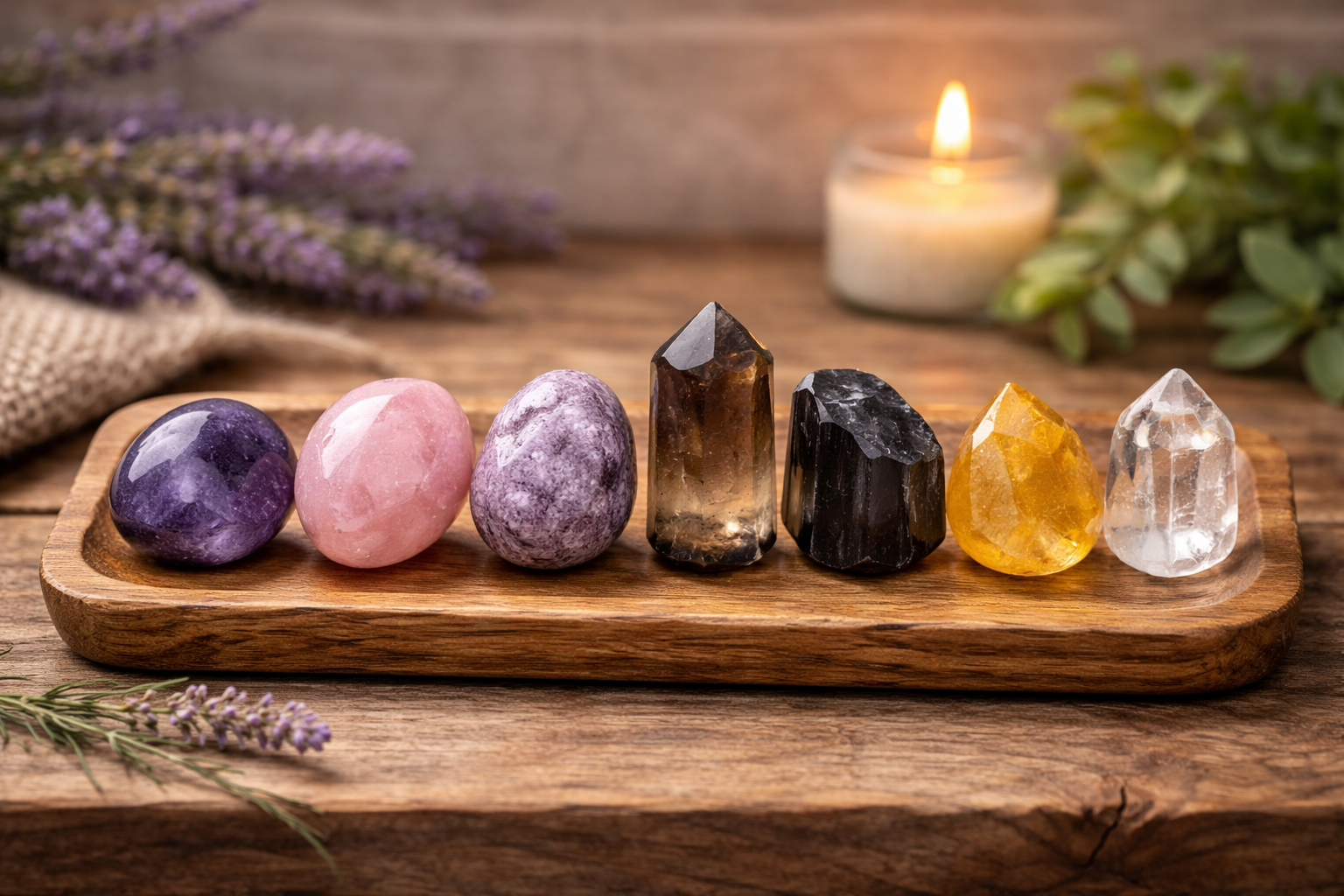
You do not need twenty stones. You need one or two that suit the way you actually wobble.
Amethyst
Best for: racing thoughts, bedtime tension, mental clutter, and that “my brain is still running at 1 a.m.” feeling. Amethyst is often the best crystal for anxiety if the problem lives mostly in your head. It feels cooler, quieter, and less emotionally mushy than rose quartz.
Where it falls short: it is not always the best pick for low mood. If you already feel flat, amethyst can feel lovely at night and a bit too still during the day.
Best first form: a palm stone by the bed or a small bedside cluster. For actual use, I like a smooth piece better than a spiky display chunk.
Rose Quartz
Best for: heartbreak, self-criticism, emotional tenderness, and the kind of depression that comes with feeling unloved or cut off from yourself. Rose quartz is often framed as a love stone. That is true but a bit too neat. Its real strength is softness.
Where it falls short: it will not do much for the person whose main issue is overstimulation, panic, or mental static. Comfort is not the same as grounding.
Best first form: a worry stone, bracelet, or small palm stone. It shines when you can touch it quickly during rough moments.
Lepidolite
Best for: emotional shakiness, transitional stress, and that strained feeling where everything seems a little too close to the surface. Lepidolite gets talked about a lot in conversations about anxiety, stress relief, and emotional balance because it sits in a useful middle zone.
Where it falls short: it is not the strongest grounding crystal in a chaotic environment and it is not the clearest “lift” stone for low motivation.
Best first form: a polished palm stone. Lepidolite has a softer, sometimes flaky look in rough form, so polished pieces tend to be easier to live with.
Smoky Quartz
Best for: grounding, decompressing after a noisy day, and getting out of that floaty, disconnected headspace. Smoky quartz is one of my favourite stones for anxiety that feels physical, buzzy, or socially draining.
Where it falls short: it is not especially cuddly. If what you need is warmth or self-compassion, rose quartz does that better.
Best first form: a tumbled stone in your pocket or a palm stone on your desk. It is also one of the best fits if you want to explore grounding crystals in a more focused way.
Black Tourmaline
Best for: boundary-heavy days, overstimulating spaces, and “I absorb everyone else’s mood and I hate it” moments. Black tourmaline is often the first name people hear in the protection category and that tracks.
Where it falls short: it can feel too armored if you are already shut down. When depression feels heavy and inward, black tourmaline is not always the first place I would start.
Best first form: a rough chunk for the desk, entryway, or work area. It also works well as a pocket stone, though rough edges are not for everyone.
Citrine
Best for: low momentum, dull mood, and the kind of emotional fog that makes starting feel harder than doing. Citrine is a better fit for “I need a bit of spark” than for pure anxiety relief.
Where it falls short: it is not the stone I would hand someone during a panic spike. It is brighter than that use case calls for.
Best first form: a small polished piece where you will actually see it in the morning. Keep it simple. Citrine works best as a nudge, not a shrine.
Clear Quartz
Best for: general clarity, intention-setting, and pairing with another stone. Clear quartz is the all-rounder. It is often included in healing crystals lists because it can sit next to almost any practice, from meditation to journaling to bedtime rituals.
Where it falls short: it is not as emotionally specific. If you want one sharp answer for overthinking, grief, or low mood, other stones usually do a better job.
Best first form: a point or palm stone if you already know you enjoy ritual work. If you are brand new, I would still rank amethyst or smoky quartz above it as a first single buy.
A better beginner rule
If you are buying one stone only, pick the one you will touch most often. That is why a plain amethyst palm stone often beats a dramatic tower. One gets used. One gets admired.
Which Crystal Form You’ll Actually Use
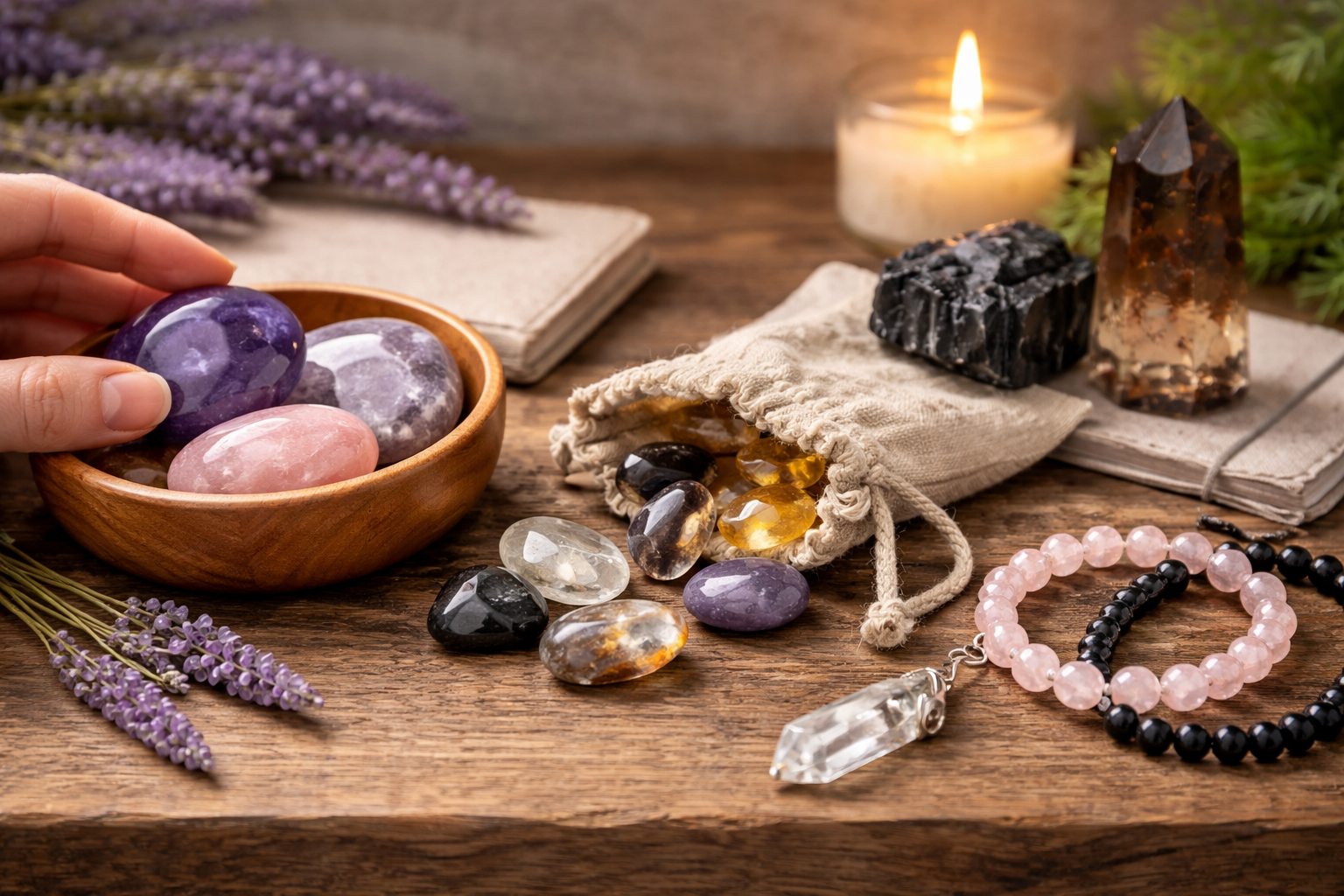
The form matters more than people think. A crystal can be perfect in theory and useless in practice if it lives across the room when you need it.
Palm stones and worry stones are the best fit for tactile calming. If touching something smooth helps you slow down, these win. They suit amethyst, rose quartz, and lepidolite especially well.
Tumbled stones are great for pockets, bags, and jeans. Smoky quartz and clear quartz work nicely here. They are low fuss and easy to carry, which is a bigger deal than it sounds.
Bracelets and pendants are best for forgetful people. If you know you will never remember to move a stone from room to room, jewelry is not a lesser choice. It is a smarter one. Rose quartz and black tourmaline bracelets are popular for good reason. They stay with you.
Rough chunks are strong desk, bedside, and entryway pieces. Black tourmaline shines here. So does smoky quartz. Rough stones can feel more grounded and less precious, which some people really like.
Towers and display pieces look beautiful but they are often poor first buys. They do more for the room than for the moment. If the hard parts happen in the car, at work, or on the sofa then a shelf piece is not solving the real problem.
Good shortcut: buy for the wobble point. Nightstand for sleep anxiety. Pocket for daytime spirals. Desk for work stress. Bracelet for “I know myself, I will forget the stone.”
How to Use Crystals in a Simple, Supportive Routine
The best crystal routine is boring enough to repeat.
Try this for a week before you add anything fancy:
Step 1. Hold the stone and slow the body.
Hold the crystal for three slower breaths. Not deep theatrical breathing. Just slower than the breath you came in with.
Step 2. Name the feeling and shrink the blur.
Say what is happening in plain English. “I am spiraling.” “I feel raw.” “I feel flat.” Naming the feeling makes the next choice easier.
Step 3. Give the crystal one job.
Keep it short. “Calm my mind.” “Help me soften.” “Help me come back into my body.” This is not about convincing the stone to do anything. It is about giving your own attention a direction.
Step 4. Pair it with one physical anchor.
Feet on the floor. Hand on chest. Sip of water. Short walk to the window. The crystal becomes more useful when it is tied to something your body can actually do.
Step 5. Use the same stone for seven days.
This part gets skipped all the time. Beginners bounce from stone to stone and then wonder why nothing feels clear. Stick with one for a week. If you want a second stone, add one that does a different job, not the same job louder.
This is also where a wider healing crystals guide can help if you want to branch into stress, sleep, love, and protection after you have found your first steady fit. Just do not turn the search into a shopping spree. That road gets silly fast.
A tiny routine that actually gets used
Pocket stone before a stressful meeting. Bedside amethyst before sleep. Rose quartz in the hand while journaling. Black tourmaline on the desk during a draining workday. Keep the routine attached to life as it is, not life as it looks in a ritual reel.
How to Buy Genuine Crystals and Avoid Regret Buys
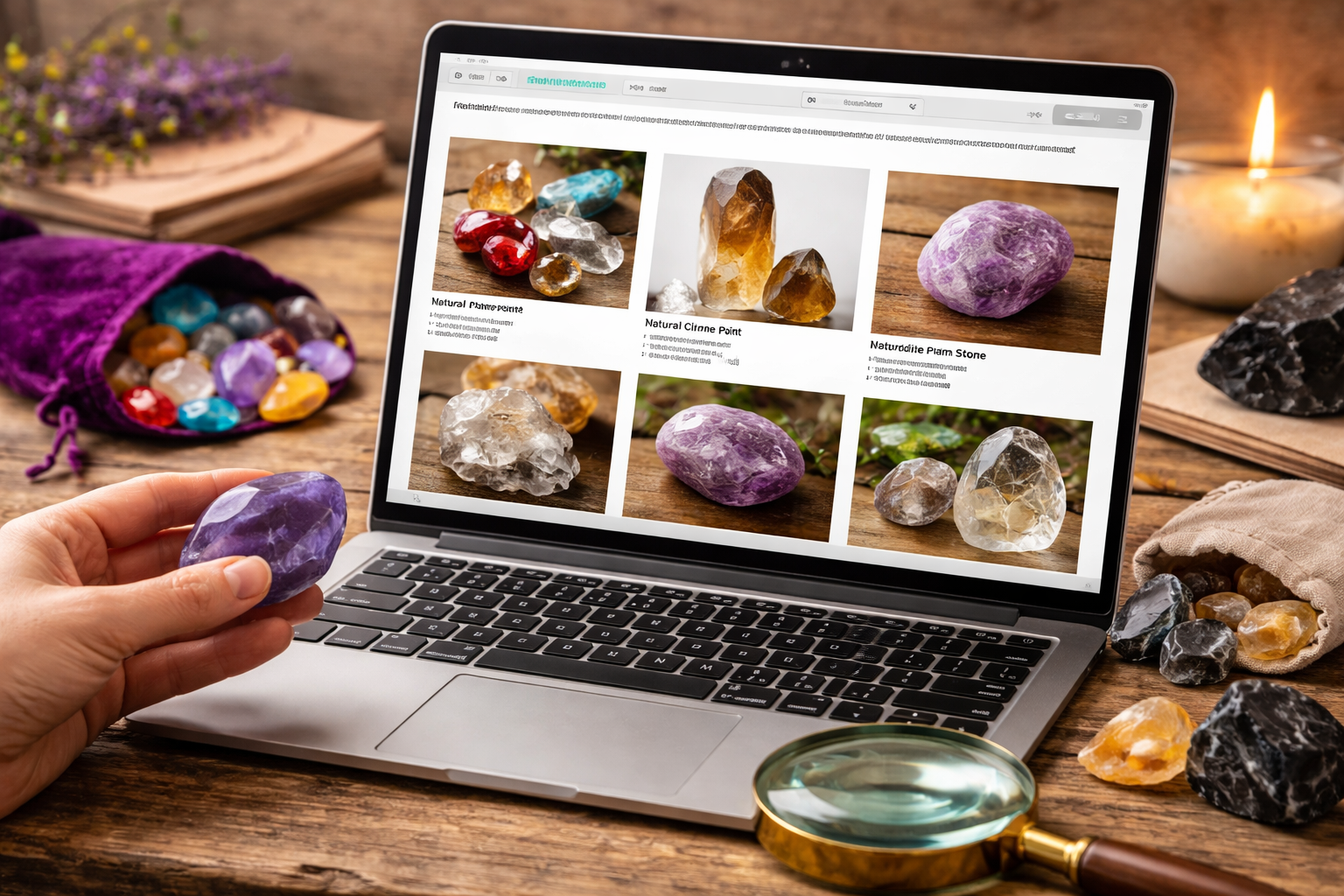
Most regret buys happen before the stone even arrives.
Look for five things in a listing: the exact mineral name, the form, an approximate size, more than one photo, and treatment disclosure when it matters. If a product page only says “healing crystal for positive vibes” and never tells you what the stone is, skip it.
The Gemological Institute of America notes that natural citrine is rare and that most citrine on the market is heat-treated. That does not make treated citrine fake, but it does make disclosure a trust test. When a seller is vague about a stone that is commonly treated, I get suspicious about the rest of the listing too.
Dyed crystals are another common snag, especially in the bright pink, electric blue, and suspiciously neon category. Some people do not mind dyed stones for decor. For emotional support work, I would rather buy something simple and honest.
Starter bundles are tempting because they look like value. Often they are just volume. If you do not yet know whether you need calming crystals, grounding crystals, or something for low mood then ten tiny random tumbles are not a bargain. They are clutter in a velvet bag.
What to buy first: one smooth palm stone if you want tactile support, one pocket tumble if you want quiet portability, or one bracelet if you know loose stones vanish in the wash.
When a Crystal Is Supportive, and When It Is Not Enough
The National Institute of Mental Health says anxiety symptoms can interfere with daily life and routine activities. It also notes that severe anxiety can affect work, school, relationships, and even leaving the house. That is bigger than a wellness ritual.
The same institute explains that depression can affect sleep, eating, working, and other daily activities. It also links depression with suicidal thoughts and behaviors. So if you feel hopeless, shut down, or unsafe, the right next step is human support. Not a stronger crystal. Not a rarer one. Human support.
That line matters because crystal culture can sometimes blur support with treatment. I like crystals best when they stay in their lane. They can sit beside therapy, medication, meditation, better sleep, or journaling. They can help you slow down long enough to use those things. They cannot carry the whole load.
If the stone helps you breathe, pause, or soften a notch then good. Keep it. If you find yourself treating the crystal like a test of whether you are “doing healing right,” put it down for a minute. That pressure is not helping.
Use crystals as companions. Do not ask them to be paramedics.
FAQ
Can you use two crystals at the same time?
Yes, but keep the pairing clean. One crystal should do one job and the second should do a different one. Amethyst plus smoky quartz makes sense because one calms and one grounds. Amethyst plus another sleepy-feeling stone often just muddies the signal.
What if a crystal makes you feel more agitated?
Stop using that stone for a bit and switch the job. Sometimes the issue is not the crystal itself. It is the wrong fit, the wrong time of day, or too much ritual pressure around it. If citrine feels jangly, move it to the morning or swap to rose quartz or smoky quartz. If black tourmaline feels too heavy, try smoky quartz instead.
Is jewelry as useful as a palm stone?
It can be. Jewelry is better for constant access. Palm stones are better for tactile grounding. The useful one is the one that shows up when the hard moment hits. For many people, that means a bracelet during the day and a palm stone at night.