
Most people start the same way. They buy a rainbow chakra set, line up seven stones, lie down for a few minutes, and then think, “Okay… now what?” I’ve done that too, and the problem usually is not the crystals. It is the lack of a clear way to choose, place, and use them.
If you want the fast answer, the most common crystals for chakra alignment are black tourmaline or red jasper for the root chakra, carnelian for the sacral chakra, citrine or tiger’s eye for the solar plexus chakra, rose quartz or green aventurine for the heart chakra, blue lace agate or lapis lazuli for the throat chakra, amethyst or sodalite for the third eye chakra, and clear quartz or selenite for the crown chakra and broad all-chakra work.
That stock answer is useful, but only up to a point. Root chakra stones can be red or black. Heart chakra crystals can be pink or green. And a full seven-stone layout sounds tidy, but in daily life one well-chosen stone often beats a little pile of pretty confusion.
Britannica’s description of chakras as psychic-energy centres in Indian traditions gives the practice its proper frame, and Cleveland Clinic’s overview of the modern seven-chakra model shows why people pair each chakra with a body area, color, and emotional theme. That map helps. Still, the part that trips people up is choice. Not “what is the root chakra?” but “Which stone should I actually use when three of them seem right?”
What you’ll learn
- Which chakra crystals are the most common starting picks
- How to choose when several stones fit the same chakra
- When one all-chakra stone is enough
- How to do a simple crystal layout without making it a whole production
- Where to place, wear, or carry stones so they actually fit daily life
- How to clean and store softer crystals without wrecking them
Start here in 30 seconds
Use this quick filter before you pick any stone.
- If life feels shaky or over-stimulating, start with the root chakra and a grounding stone like black tourmaline or red jasper.
- If the issue feels emotional, relational, or grief-heavy, start with the heart chakra and a softer stone like rose quartz.
- If your mind is foggy or your speech feels stuck, start with the throat or third eye and use blue lace agate, lapis lazuli, sodalite, or amethyst.
- If nothing stands out, use clear quartz as an all-round starter and keep the routine very simple.
The Best Crystals for Chakra Alignment at a Glance
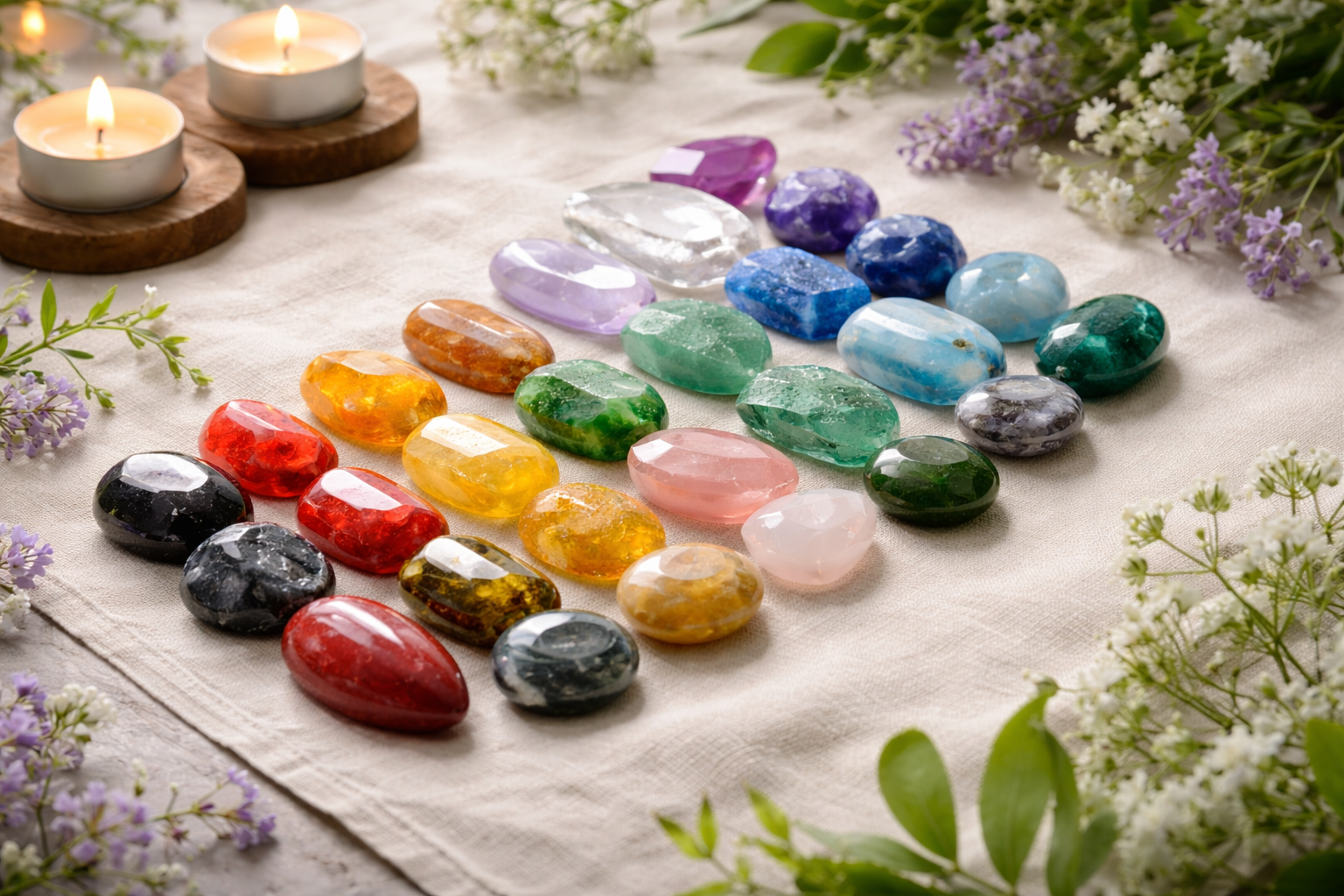
You do not need an encyclopedia of chakra stones to get started. You need a short list that makes a decision easier.
| Chakra | Common crystals | Best for | Easy first use |
|---|---|---|---|
| Root | Black tourmaline, red jasper, hematite | Grounding, steadiness, boundaries | Carry in a pocket or place by the front door |
| Sacral | Carnelian, orange calcite, moonstone | Creativity, warmth, emotional flow | Hold during journaling or a short morning sit |
| Solar plexus | Citrine, tiger’s eye, yellow jasper | Confidence, motivation, follow-through | Keep at your desk or hold before a hard task |
| Heart | Rose quartz, green aventurine, malachite | Softness, connection, emotional repair | Place near the chest during quiet breathing |
| Throat | Blue lace agate, lapis lazuli, aquamarine | Expression, honesty, calm speech | Wear as a pendant or hold before a conversation |
| Third eye | Amethyst, sodalite, fluorite | Clarity, reflection, intuition | Hold during meditation or place nearby while resting |
| Crown | Clear quartz, selenite, amethyst | Spaciousness, quiet, spiritual focus | Place on a tray by your meditation space |
If you are brand new, start with one chakra, not all seven. That one change keeps the practice from becoming vague and messy right out of the gate.
Good starting rule: pick the chakra that feels loudest this week, then choose one stone that matches the kind of support you want. Grounding and calming are not the same thing, and your crystal choice should reflect that.
Pick the Chakra First, Then Pick the Kind of Support You Actually Need
A lot of confusion disappears once you stop asking, “Which crystal is for this chakra?” and start asking, “What kind of support am I after?”
Here is the three-question filter I keep coming back to.
- Where is the friction showing up most? In your sense of safety, your emotional life, your confidence, your voice, your focus, or your spiritual practice?
- What kind of support feels right? Grounding, soothing, clarifying, or energizing?
- How will you use the stone? Carry it, wear it, place it in a room, or use it in meditation?
This matters because chakra color charts are a shortcut, not a law. The root chakra often gets matched with red stones like red jasper, but black stones like black tourmaline and hematite are just as common because they feel heavier, steadier, and more boundary-oriented. The heart chakra is another good example. Pink stones such as rose quartz tend to feel soft and affectionate. Green stones such as green aventurine often feel more restorative and growth-focused.
The modern chakra map helps you narrow the field. But then your actual need makes the pick.
Quick chooser
- Choose grounding stones when you feel scattered, overexposed, or a bit floaty.
- Choose soothing stones when you feel tender, sad, or reactive.
- Choose clarifying stones when your mind feels foggy or your speech feels jammed.
- Choose energizing stones when the main issue is low drive or flatness.
One more thing. “Blocked chakra” is a useful reflection phrase, but it is not a diagnosis. If you say, “My throat chakra feels off,” what you usually mean is that speaking honestly feels harder than it should. That’s a good working signal. It is not a medical label, and treating it like one sends the practice off the rails.
A Chakra-by-Chakra Crystal Guide That Explains the Tradeoffs
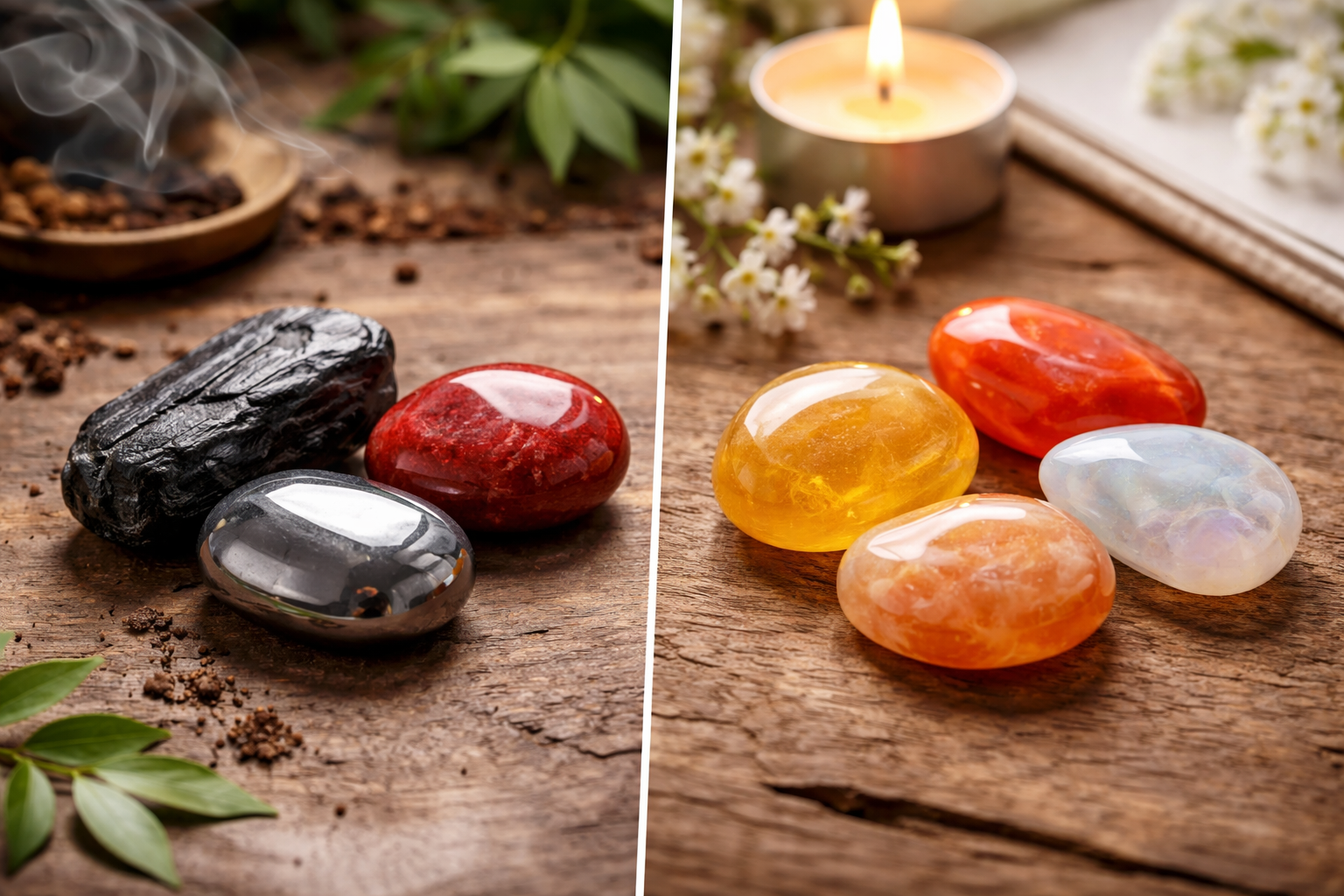
This is where most articles turn into a giant list. Lists are fine. Tradeoffs are better.
Root chakra: black tourmaline, red jasper, hematite
The root chakra is about safety, steadiness, and being in your body. If your week feels noisy and jangly, black tourmaline is often the easiest pick because it has that “boots on the floor” quality. Red jasper feels warmer and more quietly steady. Hematite can feel dense and focused, almost like putting a paperweight on a racing train of thought.
For a beginner, black tourmaline is usually the safest first root stone. If grounding work is the main thread, a deeper look at grounding crystals helps sort the difference between black tourmaline, hematite, smoky quartz, and red jasper.
Sacral chakra: carnelian, orange calcite, moonstone
The sacral chakra gets tied to creativity, pleasure, emotion, and movement. Carnelian is the classic pick because it feels warm, lively, and a touch brave. Orange calcite usually feels lighter and less pushy. Moonstone is not orange at all, which is a nice reminder that color matching only gets you so far. People often reach for moonstone here when the goal is emotional softness rather than raw momentum.
If you want one sacral crystal that nudges you into motion, choose carnelian. If you want one that takes the edge off and opens space, moonstone is often the gentler call.
Solar plexus chakra: citrine, tiger’s eye, yellow jasper
The solar plexus chakra is where confidence, will, and personal fire usually enter the chat. Citrine is bright and forward-moving. Tiger’s eye feels steadier and more practical, like confidence with shoes on. Yellow jasper tends to feel less flashy and more even.
When someone says, “I need motivation,” citrine sounds perfect. When the real issue is shaky confidence before a meeting, tiger’s eye often fits better. That’s the sort of distinction most chakra crystal guides skip, and it is exactly where your choice starts making sense.
Heart chakra: rose quartz, green aventurine, malachite
The heart chakra gets flattened into “love” all the time, which is a bit thin. It is also about grief, trust, tenderness, and staying open without spilling everywhere. Rose quartz is the soft landing. Green aventurine feels fresher, more restorative, and less sentimental. Malachite gets talked about as a stronger heart stone because it can feel deeper and more confronting.
If you are bruised and tired, rose quartz is usually the kinder pick. If you want heart work that feels like healing rather than comfort, green aventurine often lands better. Malachite is one I would not hand to a total beginner on day one unless they already know they like stronger-feeling stones.
Throat chakra: blue lace agate, lapis lazuli, aquamarine
The throat chakra is not just about talking more. It is about saying the true thing cleanly. Blue lace agate is calm and gentle. Lapis lazuli feels more direct and self-possessed. Aquamarine often sits somewhere in the middle, with a clearer, cleaner feel.
If you freeze before hard conversations, blue lace agate is usually the easier start. If you already know what you need to say and the missing piece is conviction, lapis lazuli may suit you better.
Third eye chakra: amethyst, sodalite, fluorite
The third eye chakra tends to pull in language like intuition and inner knowing, but in practice people often reach for these stones when they want clearer thought and a quieter mind. Amethyst is the old standby, and for good reason. Sodalite feels more mental and structured. Fluorite is often chosen for focus and mental sorting.
I’ve found amethyst great for a reflective evening sit. Fluorite, by contrast, is the one I like near a notebook or a desk when the mind feels cluttered rather than spiritual. That is a small but useful distinction.
Crown chakra: clear quartz, selenite, amethyst
Clear quartz is the flexible all-rounder. Selenite has a cleaner, quieter feel and often gets used in meditation spaces. Amethyst bridges crown and third eye nicely, which is handy if you do not want separate stones for both.
The crown chakra is where people can get airy in a hurry. Keep it simple. If you want a broad, adaptable stone, clear quartz is hard to beat. If you want a calm ritual stone for the top of your practice, selenite is a lovely pick. Just handle it more gently, which we will get to in a minute.
Cleveland Clinic’s explanation of the seven chakras is a good reminder that the modern model links each chakra to a body region, element, and color. That broad map works. Your actual crystal choice gets better when you add function and feel on top of it.
Use a Simple Crystal Layout Without Turning It Into a Whole Performance

A chakra layout can be helpful. It can also get silly fast if you treat it like a stage production. Keep the method boring enough that you will repeat it.
There are two easy ways to do this. A full layout uses one stone for each chakra. A focused layout uses one to three stones for the chakra that feels most relevant right now. For most people, the second option works better at first.
Step 1. Pick fewer stones and get clearer
Choose one stone for a single chakra, or at most three stones if you have a reason. Seven stones on day one often turns into fussing with placement instead of actually settling down.
Step 2. Place the stone where the practice becomes concrete
If you are lying down, place the crystal on or just above the body area linked to that chakra. If that feels awkward, hold the stone in your hand. No rule says the crystal has to sit perfectly on your sternum like a tiny paperweight. Comfort matters because it keeps you there long enough to notice anything.
Step 3. Breathe for 5 to 10 minutes and stop chasing fireworks
Set a short timer. Breathe. Pay attention. That is enough. The sessions that have felt most useful for me were not dramatic. They were quiet, repeatable, and almost plain. You notice a shift in your body, your mood, or the way your thoughts loosen. Or you notice nothing at all, and that is fine too.
Step 4. End with one sentence and one next move
After the sit, write one line: “I felt more grounded,” “I kept thinking about that conversation,” or “Nothing much happened.” Then decide whether the same stone deserves another round tomorrow. That little note helps more than trying to decode every sensation on the spot.
If a broader beginner routine would help, how to use crystals for healing pairs well with chakra work because it keeps the whole thing grounded in repeatable habits.
Note: The National Center for Complementary and Integrative Health notes that mindfulness and meditation can help some people with stress and sleep. That matters here because part of what feels calming in chakra crystal work may come from the pause, the breathing, and the repetition, not only the stone itself.
Choose One All-Chakra Stone When Seven Separate Crystals Feel Like Too Much
Sometimes you do not need a chakra crystal chart. You need one stone that covers enough ground to help you start.
Clear quartz is the classic all-chakra choice because it is flexible. People use it with almost every part of a crystal practice, and that makes it a sensible starter. Selenite is another common all-chakra option, but it feels quieter and more ritual-oriented. If you like a crystal that sits on a tray near your meditation spot and gently signals “slow down now,” selenite fits that role well.
Fluorite and kyanite also show up in all-chakra conversations. Fluorite usually gets chosen when the goal is mental sorting. Kyanite gets a reputation for alignment work because it feels streamlined and clear to many practitioners. Still, if you are choosing a first all-chakra stone, clear quartz is the least fussy place to begin.
Use this rule. If your goal is broad, beginner-level support, choose one all-chakra stone. If one theme keeps repeating, like shaky boundaries, a hard conversation, or heartbreak, pick a chakra-specific stone instead.
And no, you do not need a premade seven-chakra set just because it looks complete. Sometimes buying less gives you a better practice. For a wider shortlist of beginner-friendly stones by life situation, best healing crystals is a handy next stop.
One-stone, three-stone, or seven-stone?
- One stone: best for a first week, daily carry, or a single issue.
- Three stones: good when one chakra overlaps another, such as heart and throat.
- Seven stones: fine for a full layout, but not needed for a useful practice.
Place, Wear, or Carry Chakra Crystals Based on Where the Friction Shows Up
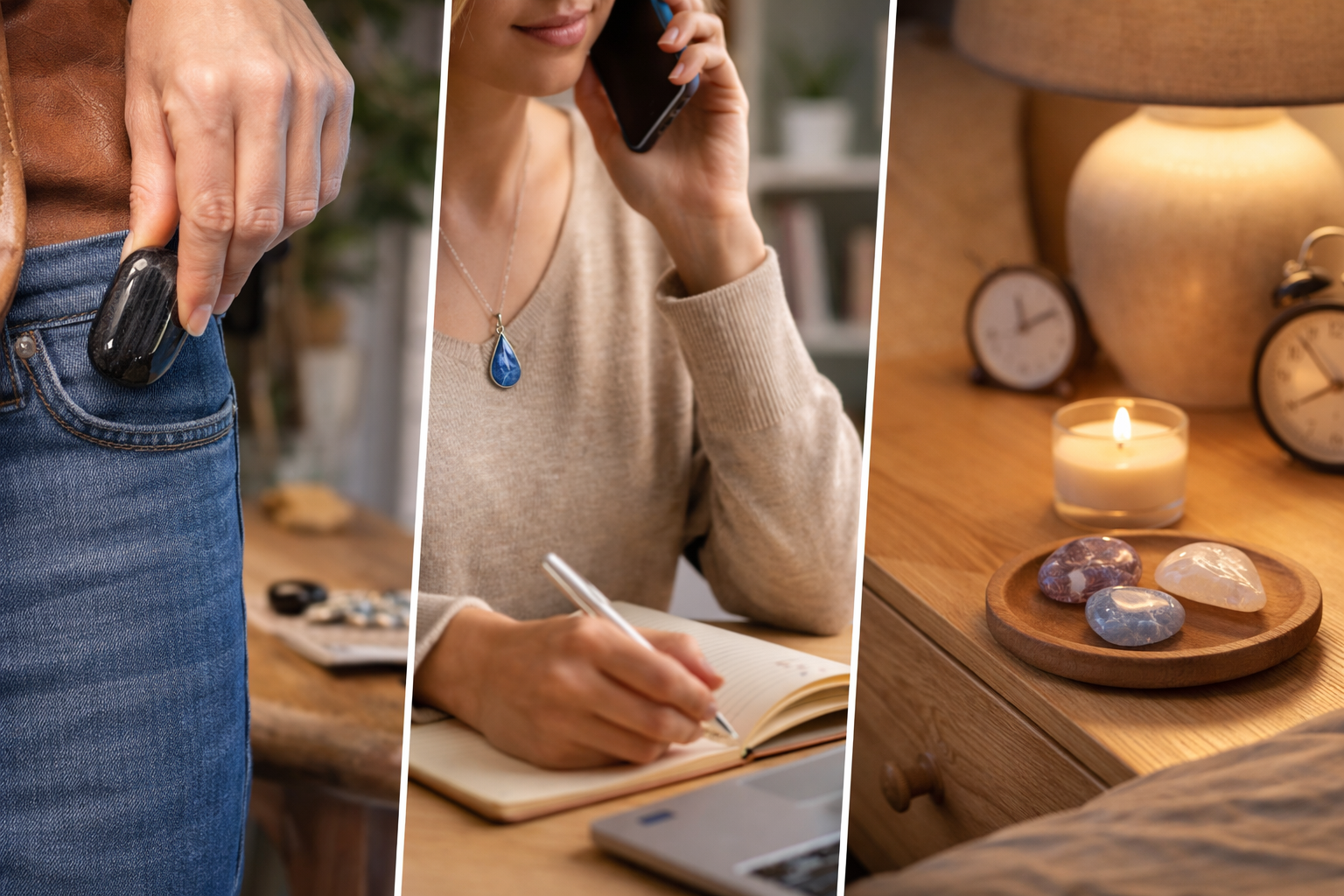
Placement matters because it changes how often the crystal enters your awareness. A stone in a drawer is basically decor. A stone where the pattern happens has a job.
| Use-case | Best placement | Why it works |
|---|---|---|
| Grounding and boundaries | Pocket, bag, entry table | The stone meets you while you move through the day |
| Heart work and emotional repair | Pendant, journal desk, bedside tray | It stays close to moments of reflection and softness |
| Communication and speaking clearly | Pendant, pocket, work desk | You notice it before calls, meetings, and difficult talks |
| Meditation and spiritual focus | Meditation tray, cushion, altar shelf | The place itself becomes part of the cue |
| Sleep and wind-down | Nightstand, not under the pillow | Less fussy, less likely to annoy you at 2 a.m. |
If the issue travels with you, carry the stone. If the issue belongs to a place, such as a tense desk setup or a restless bedtime routine, place the crystal there.
For root chakra support and stronger boundary work, a protection crystal near the entryway or in a bag often makes more sense than a stone tucked under a pillow. For sleepier, softer night use, a small tray of sleep crystals on the nightstand is usually nicer than sleeping on top of one. That under-the-pillow advice sounds romantic until the stone digs into your face. Ask me how I know.
Remember: put the stone where the pattern breaks. A throat chakra crystal on your desk before a hard meeting beats the same stone hidden in a drawer because it actually meets the problem at the right time.
Cleanse and Store Chakra Crystals Without Damaging Softer Stones
Crystal cleansing gets overcomplicated fast. The safe beginner version is simple: use moonlight, sound, breath, or a dry cloth. Then store the stones so softer ones do not get scratched, chipped, or slowly ruined by casual handling.
Water is where people get sloppy. The Gemological Institute of America lists amethyst as a variety of quartz with a Mohs hardness of 7, so quartz-family stones are fairly durable. The Minerals Education Coalition lists gypsum at around 1.5 to 2 on the Mohs scale, and selenite belongs to that family. That is why a quartz tumble can handle more everyday roughness while selenite needs a lighter touch.
If you remember one care rule, make it this: when in doubt, keep softer stones dry.
- Safe cleansing for almost everyone: moonlight, sound, breath, intention, dry wiping
- Good storage: separate softer stones, use a tray or cloth pouch, do not toss selenite into a mixed crystal pile
- Good timing: cleanse after intense use, after a rough week, or when the stone simply feels a bit stale to you
You do not need a strict cleansing calendar. Event-based care works better than pretending there is one perfect interval for every crystal and every life.
A short care cheat sheet
- Quartz family, like clear quartz and amethyst: tougher, easier daily stones
- Selenite: softer, better for shelves, trays, and gentler handling
- Pocket use: fine for durable tumbles, not ideal for fragile wands or soft carvings
What Chakra Crystals Can Support, and What They Should Never Replace
Chakra crystal work sits in the spiritual and reflective lane. That is where it makes sense, and that is where it can be useful.
The National Center for Complementary and Integrative Health says mindfulness and meditation can help with things like stress and sleep for some people. That matters here because many chakra crystal rituals include stillness, breathing, repetition, body awareness, and intention. Those parts are not fluff. They are often the structure that makes the practice feel steadying.
What crystals should not do is replace medical care, therapy, or actual treatment. If you are using a heart chakra stone because you feel tender after a breakup, fair enough. If you are using one instead of getting help for a worsening mental health issue, that is a different story.
You do not have to be a true believer to get something from the practice either. A lot of skeptical people still find value in the ritual because it slows attention down and gives a feeling a place to land. That alone can be worth something. Not everything useful has to arrive wearing a lab coat.
Good boundary: let chakra crystals support reflection, meditation, and emotional check-ins. Do not ask them to do the work of a clinician, a medication, or a real treatment plan.
Common Chakra Crystal Mistakes That Make the Practice Feel Vague, Overloaded, or Pointless
This is the part that saves the most frustration.
Most chakra crystal routines fail for ordinary reasons, not mystical ones. The setup is too busy. The stone is a bad fit. The method changes every other day. Or the person expects a thunderbolt and misses the smaller, steadier shifts that actually matter.
- Starting with seven stones and no plan. It looks complete, but it is hard to feel what any one stone is doing.
- Buying by color only. Black tourmaline and red jasper can both suit the root chakra, but they do not feel the same in practice.
- Using “stronger” as if it means better. A gentler stone is often the better call, especially for heart or throat work.
- Moving the stones around too fast. Give one setup a few days before you decide it is doing nothing.
- Putting everything under the pillow. This tip survives because it sounds cozy. It is often annoying.
- Treating blocked chakra language like a medical label. That adds drama and removes clarity.
When the practice feels flat, try this
- If you feel nothing: use one crystal for one chakra for a week.
- If the stone feels too intense: switch to a softer option, or move it from body placement to room placement.
- If the routine feels cluttered: stop the full layout and go back to one short 5-minute session.
- If you keep second-guessing: write one line after each session and look for patterns after a few days, not after five minutes.
The simplest rule in the whole article is still my favorite: one chakra, one intention, one easy method. It is not glamorous, but it works.
FAQ
Can one crystal really help align all seven chakras?
Yes, many people use clear quartz or selenite as all-chakra support stones. Clear quartz is usually the easier all-round starter. Selenite is lovely for a calm ritual setup, but it needs gentler handling because it is much softer.
Do chakra crystals have to match the chakra color?
No. Color helps you narrow the options, but it is only a starting filter. The root chakra can use red or black stones, and the heart chakra often uses green or pink stones. The better question is what kind of support you want from the stone.
What if I use chakra crystals and feel nothing?
Simplify the routine. Pick one chakra, one stone, and one short method for a few days. Hold it, place it, or carry it in the same way each time. A lot of people get more out of consistency than they do from piling on extra crystals.