The odd part about shopping for love crystals is that every list makes the choice look easy right up until you try to make one. If you want the short answer, rose quartz is still the best starting pick for the best crystals for love. But that stock answer gets thin fast. A crystal for self-love is not always the right crystal for heartbreak, honest communication, or bringing warmth back into a relationship that feels a bit flat.
That is where most guides go fuzzy. They hand you a pile of pink stones, call them all “heart-opening,” and leave you to guess. In practice, the better question is not “Which crystal means love?” It is “What kind of love problem am I actually trying to work on?”
If you’ve ever bought a rose quartz heart because it felt like the obvious answer, then found yourself staring at it a week later thinking, “Okay… now what?”, you’re not alone. I’ve seen that happen more than once. The crystal was not the wrong pick. The job was just never named clearly.
What this guide will help sort out
- Which crystal fits self-love, new romance, heartbreak, truth-telling, or passion
- When rose quartz is enough and when it is not
- How to use crystals for love without turning it into a fussy ritual
- Which forms actually fit daily life, from palm stones to pendants
- What crystals can support and what they cannot promise
Love crystal chooser
| If your real goal is… | Start with… | Skip this common mistake |
|---|---|---|
| Self-love and softness | Rose quartz | Buying a fiery stone when you really need gentleness |
| Healing after heartbreak | Rhodonite | Treating attraction and repair like the same job |
| New love and emotional openness | Moonstone or green aventurine | Choosing only by color |
| Better communication | Lapis lazuli | Expecting rose quartz to do all the talking for you |
| More warmth and passion | Garnet | Using a comfort stone when what you want is spark |
Best Crystals for Love at a Glance
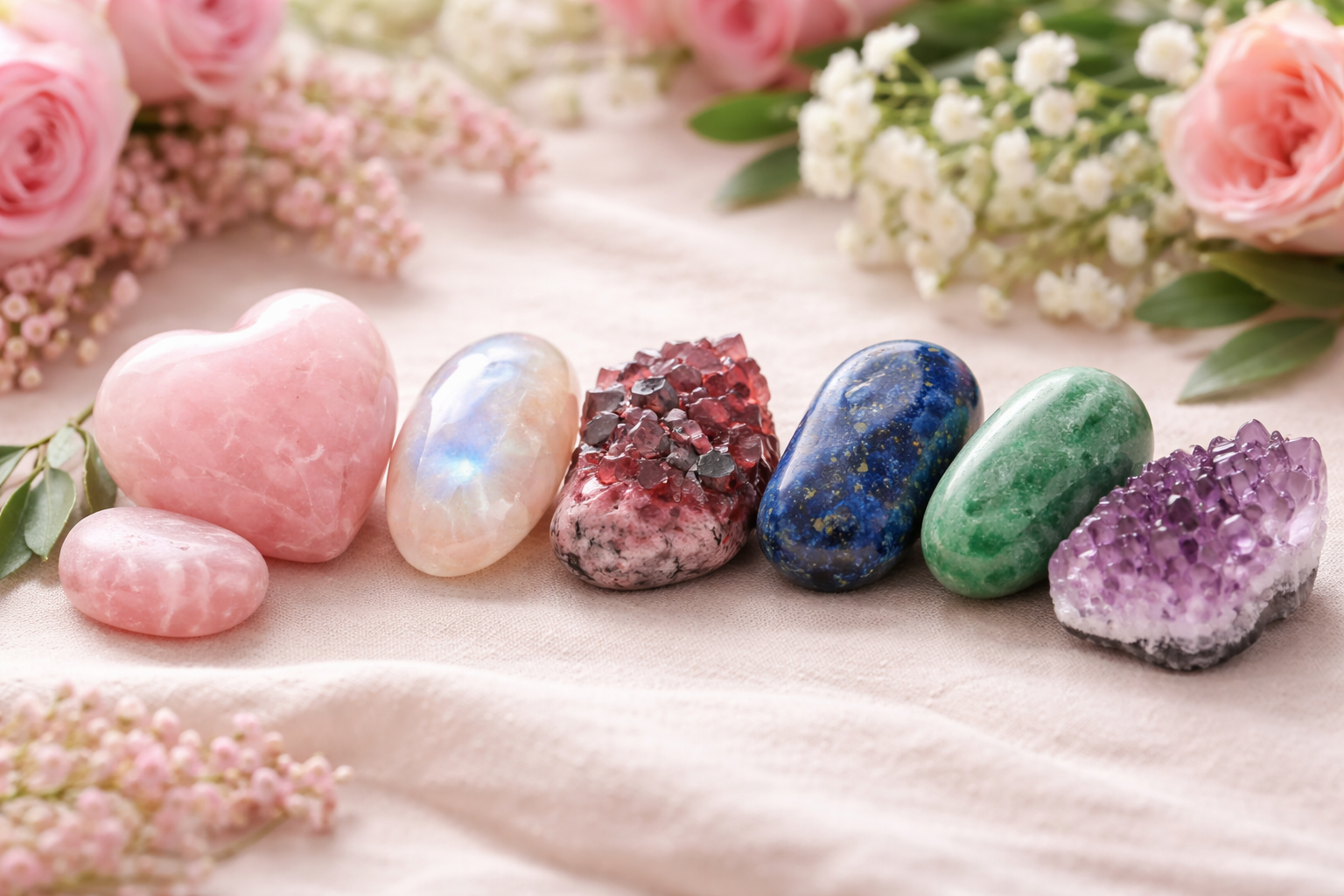
If you want one clean answer, start with rose quartz. It is the most dependable first choice because it fits the broadest version of the question. It works for self-love, emotional softness, easing back into vulnerability, and adding a calmer tone to an existing relationship.
But “love” is too big a bucket to stop there. When people search for crystals for love and romance, they are usually asking one of five smaller questions: How do I soften toward myself? How do I move on from hurt? How do I open up to new love? How do I speak more honestly? How do I get some warmth back?
| Crystal | Best for | Less ideal for | Easy first form |
|---|---|---|---|
| Rose quartz | Self-love, tenderness, harmony | Hard truth or strong spark | Palm stone or bracelet |
| Moonstone | Emotional openness, new beginnings | Rough daily wear in ring form | Pendant |
| Rhodonite | Heartbreak, forgiveness, emotional repair | Pure attraction work | Tumbled stone |
| Garnet | Passion, warmth, magnetism | Very raw emotional recovery | Pendant or ring with care |
| Lapis lazuli | Communication, honesty, truth | Soft comfort | Pocket stone |
| Green aventurine | Fresh starts, openness, gentle optimism | Deep repair after heavy hurt | Tumbled stone |
| Amethyst | Calm before emotional work | Direct romance symbolism | Bedside stone |
If you only want one stone, choose rose quartz unless your real snag is communication, heartbreak, or passion. That one rule will save most beginners from buying a random handful of overlapping stones and then feeling oddly more confused.
For a wider starter set beyond love-specific picks, the guide on best healing crystals is a good next stop.
Match the Crystal to Your Love Goal, Not the Prettiest Stone
The biggest mistake with love crystals is not buying the “wrong” stone. It is buying a stone for the wrong job.
A crystal for attracting love is not always the same as a crystal for healing a bruised heart. A crystal for romance is not always the same as a crystal for telling the truth in a hard conversation. Once you split those apart, the list gets much easier to use.
Try this quick sort
- Name the job. Softness, repair, openness, honesty, or spark?
- Name the stage. New love, current relationship, or recovery after hurt?
- Name the format. Do you need something to wear, hold, or place in a room?
Here is the short version.
If you need self-love, go with rose quartz. If you need repair after heartbreak, reach for rhodonite. If you want new love or emotional openness, moonstone or green aventurine makes more sense. If the relationship issue is communication, use lapis lazuli. If you want warmth, attraction, or passion, choose garnet. If your emotions are all over the place and you need to steady them before any of that, start with amethyst.
That last point matters more than it sounds. Sometimes what looks like a love problem is actually a nervous-system problem. You’re raw, scattered, overreading texts, replaying old arguments, and then buying a “romance” crystal when what you needed first was a little calm. In those cases, adding one of the grounding crystals alongside a heart stone usually makes the practice feel far less muddy.
My own bias here is simple: pick one main stone first. Two at most. Once you start carrying three pink stones and a blue one “just in case,” the symbolism turns to static.
Rose Quartz Is the Best Starting Point, But Not the Only Good Answer
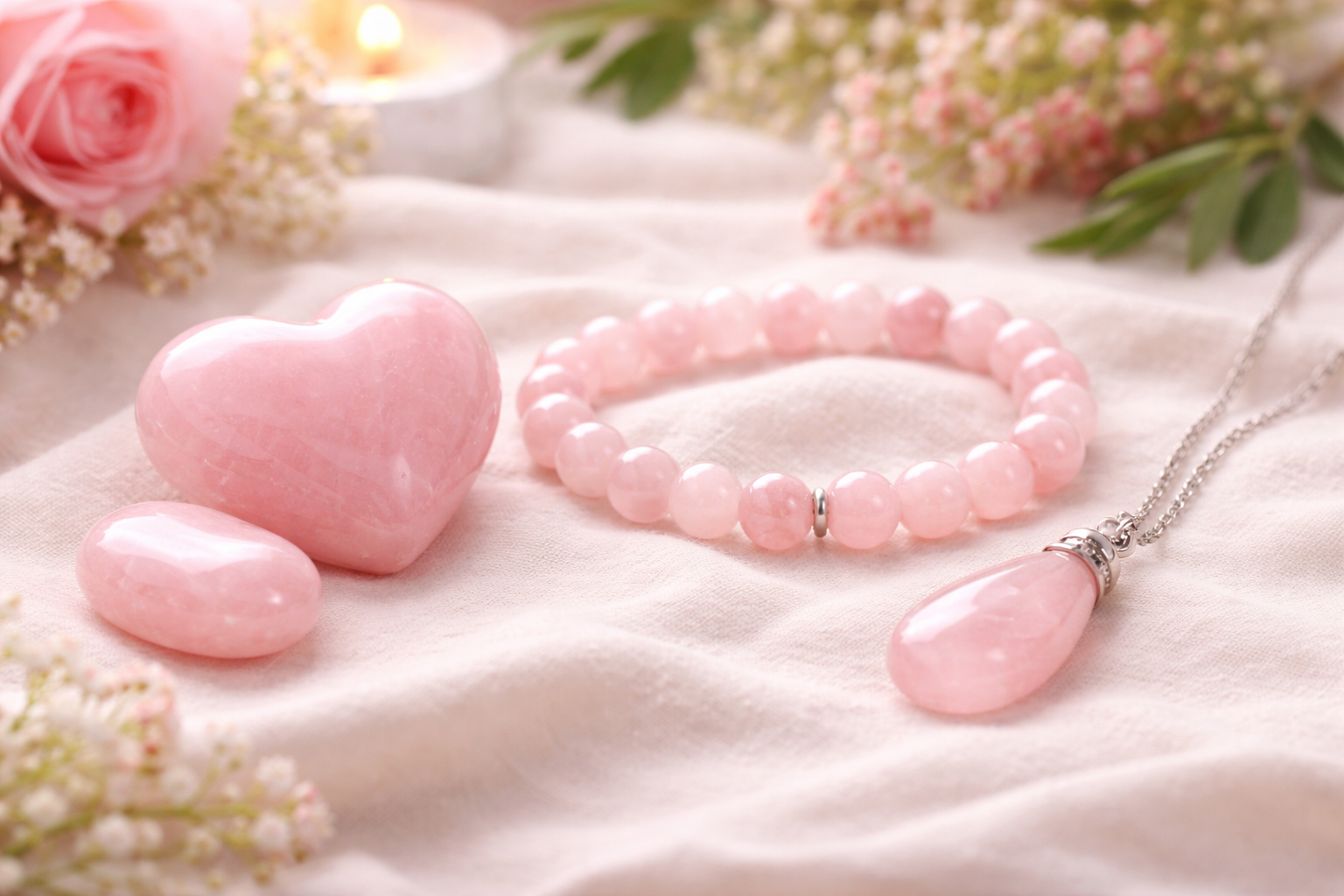
Rose quartz shows up in almost every love-crystal conversation for a reason. The gem itself is usually soft pink, commonly translucent, and often shaped into easy everyday forms. The Gemological Institute of America notes that rose quartz is commonly translucent and generally cut into beads and cabochons, which is exactly why it shows up so often as bracelets, palm stones, hearts, and pendants. It suits touch. It suits routine. It is easy to live with.
That practical side matters. A stone only helps as a ritual anchor if you actually see it, hold it, or wear it.
Spiritually, rose quartz has become the default self-love crystal because it points toward warmth rather than pressure. It is the “soft sweater” of this category. Not flashy. Not pushy. Just easy to return to. If you have been hard on yourself, suspicious of your own needs, or hesitant to open back up after being hurt, it is still the smartest first pick.
But it is not magic duct tape for every relationship issue. Rose quartz is not my top choice when the real need is blunt honesty, stronger chemistry, or repairing a wound that feels jagged rather than tender. That is where people get disappointed. They pick the most famous stone and quietly expect it to cover communication, desire, grief, boundaries, and timing all at once.
A good beginner rule: try one rose quartz piece for 7 days before adding another love crystal. If it feels soothing but too vague, that tells you something useful. You likely need a more specific second stone, not a bigger pile of rose quartz.
The Best Love Crystals by Scenario: Self-Love, New Love, Communication, Passion, and Heartbreak
This is where the list starts behaving like a tool instead of wall decor.
| Scenario | Best crystal | Why it fits | Tradeoff |
|---|---|---|---|
| Self-love | Rose quartz | Gentle, comforting, easy to keep close | Can feel too subtle if the issue is clarity or passion |
| Heartbreak and forgiveness | Rhodonite | Often chosen for emotional repair and steadier re-entry after hurt | Not the first stone for flirtation or magnetism |
| New love and openness | Moonstone or green aventurine | Feels lighter, fresher, less inward than heartbreak stones | Can feel airy if you need deep repair first |
| Communication and honesty | Lapis lazuli | Good symbolic fit for speaking clearly and listening better | Not as comforting as a heart stone |
| Passion and warmth | Garnet | Richer, hotter, more magnetic feel | Can feel too intense right after heartbreak |
| Emotional calm before relationship work | Amethyst | Settles the room before the heart work starts | Not specifically a romance crystal |
For self-love: Rose quartz still wins because it is forgiving. It asks you to soften, not perform.
For heartbreak: Rhodonite usually makes more sense than rose quartz alone. Rose quartz comforts. Rhodonite feels more like stitching. That difference matters after betrayal, messy endings, or the kind of grief that leaves you oddly brittle.
For new love: Moonstone and green aventurine both work well when the question is openness rather than repair. Moonstone tends to feel more intuitive and inward. Green aventurine feels more like a fresh window cracked open.
For communication: Lapis lazuli is the sharper pick. It does not replace the conversation, obviously, but it is a better symbolic match when you need to say the hard thing without dressing it up in pink fog.
For passion: Garnet is the one I reach for first. And it is worth being precise here. Britannica describes garnet as a group of silicate minerals, not one single uniform stone, so “garnet” is broader than the deep-red shorthand most people picture. Still, as a love crystal, its symbolic lane is the warmer, bolder side of connection.
If your relationship has gone quiet rather than broken, garnet plus rose quartz is a cleaner pairing than two different pink stones. One warms the room. One softens it.
Use Love Crystals in a Way You Will Actually Repeat
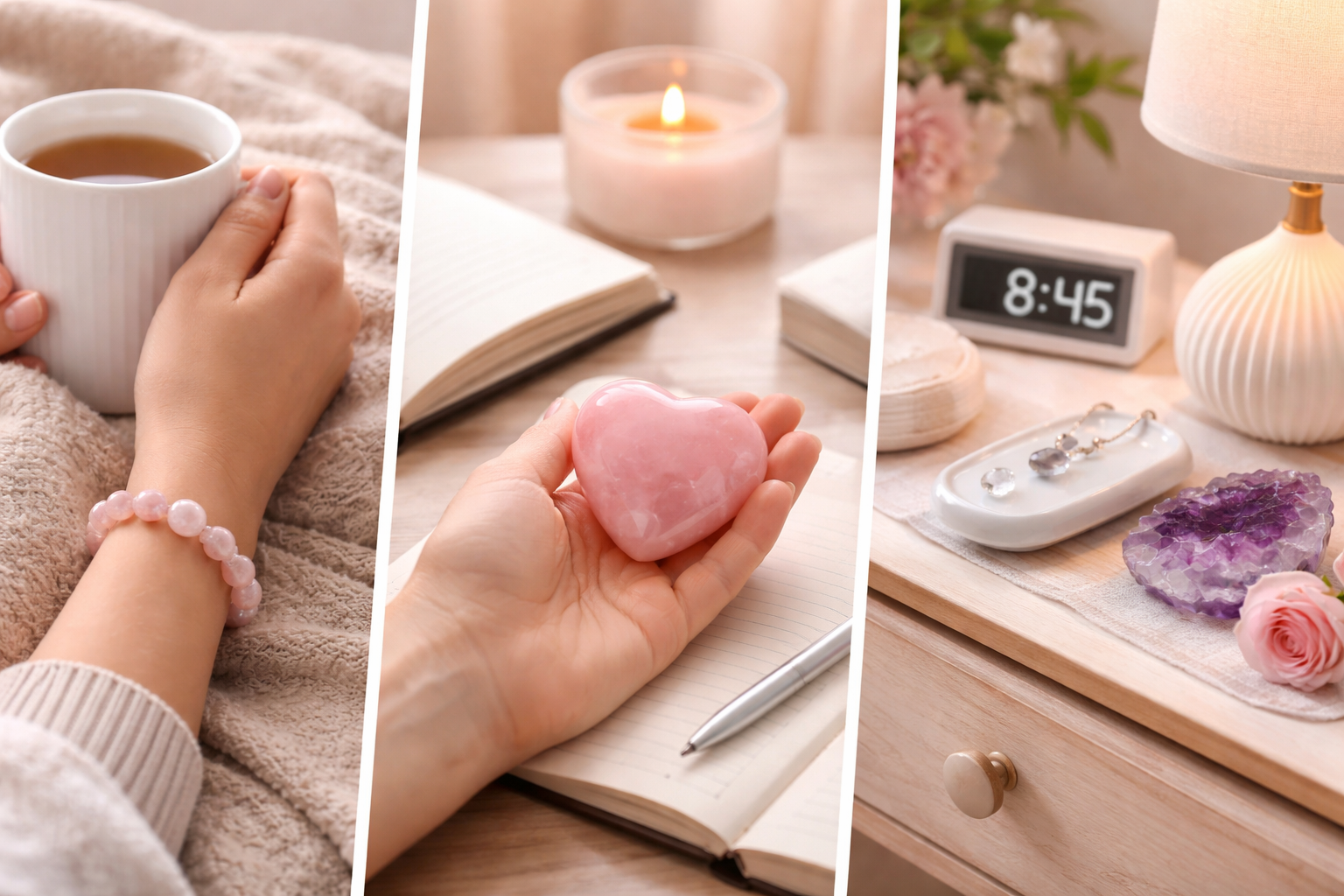
The best ritual is not the prettiest one on social media. It is the one that slips into your day without needing a full moon, six candles, and an hour you do not have.
There are three low-friction ways to use crystals for love that people actually keep doing.
Wear it and forget about it. This works well for rose quartz, moonstone pendants, and simple bracelets. If you know you will not remember a loose stone in your pocket, jewelry is the easy answer.
Hold it during a small check-in. A palm stone, heart stone, or tumbled piece is perfect for this. Sit down, hold the crystal, name one feeling, then name one action. Not ten actions. One. Send the text. Set the boundary. Apologize cleanly. Stop stalking the old photos. Whatever the real thing is.
Place it where the emotional friction lives. Bedside works. A vanity or mirror works for self-love. A desk works if the issue is saying what needs saying. The crystal does not need a dramatic altar. It needs a place you actually notice.
A 60-second ritual that does not get weird
- Hold one crystal.
- Name the intention in one sentence.
- Take three slower breaths.
- Choose one real-world action for the day.
That final step is the whole game. No crystal for relationships does much if it stays trapped on the spiritual side of the room while the practical side stays untouched.
Choose the Right Form So the Crystal Fits Your Life
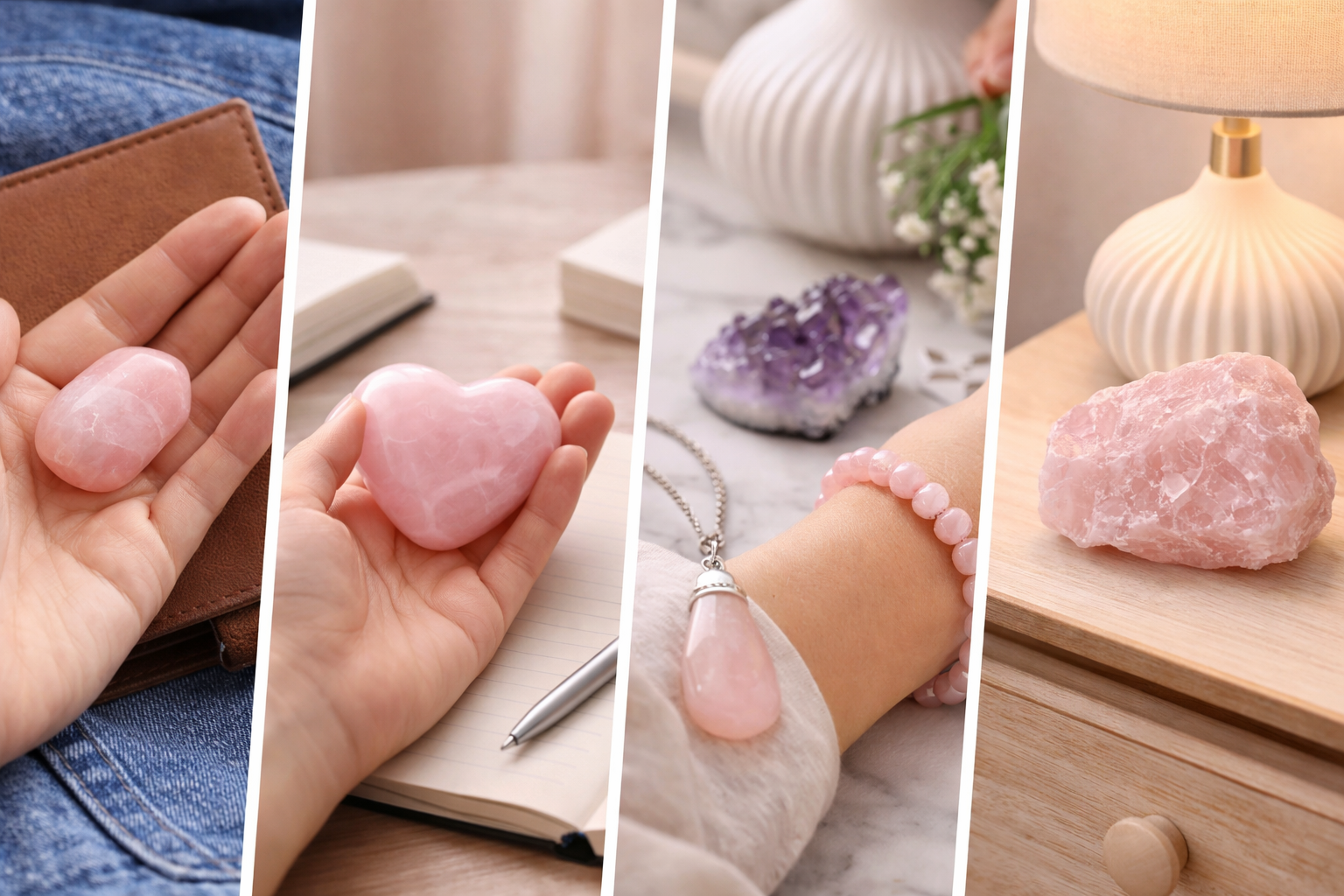
Form changes everything. A stone you can wear daily behaves differently in your life from a polished chunk that lives on a shelf and mostly collects dust.
| Form | Best use | Watch for |
|---|---|---|
| Tumbled stone | Pocket carry, simple ritual, low cost | Easy to forget in a bag or drawer |
| Palm stone or worry stone | Touch-based calming and journaling | Not always convenient outside the house |
| Bracelet or pendant | Daily use, better visibility, easy habit | Durability depends on the stone |
| Raw chunk | Room placement, bedside, shared space | Looks nice, gets ignored |
| Ring | Only if the stone handles daily knocks well enough | Fragile gems can chip or crack |
Rose quartz is easy here. The Gemological Institute of America notes that rose quartz is generally cut into beads and cabochons, so bracelets, pendants, and palm stones are a natural fit. That lines up well with the way most people actually use a self-love crystal.
Moonstone takes more thought. GIA’s moonstone care guidance says moonstone falls between 6 and 6.5 on the Mohs scale, has poor toughness, and is usually set into pendants, earrings, and pins rather than rings. So if moonstone is your pick for new love or emotional openness, a pendant makes more sense than a ring you plan to wear through chores, gym sessions, and door-handle collisions.
A good starter rule is one wearable stone and one room stone, max. That is enough to build a habit without turning the whole thing into clutter.
The Love Crystal Mistakes That Waste Money and Muddy the Practice
Most disappointment with love crystals does not come from the stones. It comes from sloppy selection.
Buying by color instead of by mineral. Pink does not mean the same thing across every stone. Rose quartz, rhodonite, pink opal, and rhodochrosite may all look vaguely heart-coded on a table. They do not land the same.
Buying too many at once. This one is sneaky. A seven-stone “love bundle” sounds generous, but it usually strips away the part that helps most, which is deciding what you actually need.
Picking passion when the real need is repair. Garnet can be great, but not when the heart is still limping. If the breakup is fresh and your chest still goes tight at random times, jump straight to repair before spark.
Expecting the crystal to do the emotional labor. A crystal for relationships can support intention. It cannot apologize for you, make someone honest, or rescue a connection that runs on avoidance.
Choosing a form you will never use. This happens all the time with big statement pieces. They look gorgeous in the shop or on a product page. Then they sit on a shelf while the cheaper, simpler tumbled stone would have been in your hand every day.
Simple fix: buy one named stone for one named goal. If you cannot finish the sentence “I chose this because…” in under ten seconds, the choice is still too vague.
What Love Crystals Can Support, and What They Cannot Promise
This part is worth saying plainly because trust matters more than hype.
Crystals can be meaningful anchors. They can help you focus attention, slow down, mark intention, and turn a fuzzy hope into something you touch every day. That is real as an experience. It is not the same thing as proving that the stone itself changes outcomes in a measurable, crystal-specific way.
A 2025 randomized study indexed on PubMed found that healing crystals did not demonstrate anxiolytic effects beyond placebo in that trial. Participants who already believed in the crystals reported more benefit, which tells you expectation and context matter. And the National Center for Complementary and Integrative Health says some complementary practices may help people cope with anxiety, but more high-quality research is still needed. That is a good model for talking about love crystals too: use them as reflective or spiritual tools, not as guaranteed mechanisms.
So what can they support? Focus. Ritual. Emotional naming. A pause before reaction. A visible reminder of what kind of partner you want to be, or what kind of treatment you will no longer accept. That is not nothing. It just is not a shortcut.
And what can they not promise? They cannot force attraction, repair a relationship that has no trust left, or replace therapy, grief support, clean communication, or plain old timing.
If a breakup has tipped into anxiety, insomnia, or the kind of sadness that makes daily life hard to hold together, the crystal is not the main event. Support from a trusted person or a clinician matters more. No shame in that. Zero.
For most people, the cleanest way to use a love crystal is this: let it support the practice, then let the practice support the life.
FAQ
Can you sleep with rose quartz or moonstone under your pillow?
Yes, plenty of people do, and rose quartz is usually the easier choice for that. Moonstone can work too, but if the piece is set in jewelry or has sharp edges it is better on a bedside table than under a pillow. Comfort beats ritual drama here.
Can you use more than one love crystal at the same time?
Yes, but keep it tight. One main stone and one support stone is usually enough. Rose quartz plus lapis lazuli for softness and honesty makes sense. Rose quartz plus rhodonite can make sense after heartbreak. Five overlapping heart stones mostly adds confusion.
Does a love crystal have to touch your skin?
No. Skin contact is optional. A pendant or bracelet is handy because it is easy to keep close, but a bedside stone, palm stone, or piece placed near a mirror can work just as well if that is the moment when you actually use it.