
Rooms hold onto mood longer than people admit. You air the place out, wipe down the kitchen counter, maybe crack a window, and it still feels like the argument is hanging from the light fixture.
If you’re looking for the best crystals for negative energy removal, start with black tourmaline. It is the safest first pick for most people because it works for the two situations that send this search sideways fast: a room that feels heavy and a person who feels drained after too much contact with other people’s moods. But that stock answer gets thin fast. A crystal for a tense entryway is not always the right crystal for sleep, crowded spaces, or the low-grade emotional static that follows you home from work.
I’ve made this mistake myself. The first time I tried to build a little protection setup, I bought what looked good together instead of what solved the job. The result was a pretty tray of stones and no clear use for any of them.
What helps is sorting crystals by function, not by popularity.
- Which crystal is the best first pick and which stones deserve a shortlist
- How to choose between black tourmaline, obsidian, amethyst, and smoky quartz
- Where to place protection crystals for home, sleep, desk, or daily carry
- How to cleanse and store them without wrecking fragile pieces
- How to buy better stones and skip overhyped listings
Negative Energy Quick Match
| If the problem feels like… | Best crystal | Best form | Where it works best |
|---|---|---|---|
| A room feels off after stress or conflict | Black tourmaline | Raw chunk or stable tower | Front door, desk, shared room |
| You feel drained by people or crowds | Black tourmaline or smoky quartz | Pocket stone or bracelet | On your body, bag, coat pocket |
| Your mind feels buzzy and your bedroom does too | Amethyst | Palm stone or small cluster | Bedside table, reading chair |
| You want a tougher, sharper clearing feel | Obsidian | Polished palm stone | Meditation, short intentional use |
| You want one calmer all-round grounding stone | Smoky quartz | Tumbled stone | Pocket, desk, bag |
Fast rule: match the crystal to the source of the heaviness. A doorway stone solves a different problem than a bedside stone.
Best Crystals for Negative Energy Removal at a Glance
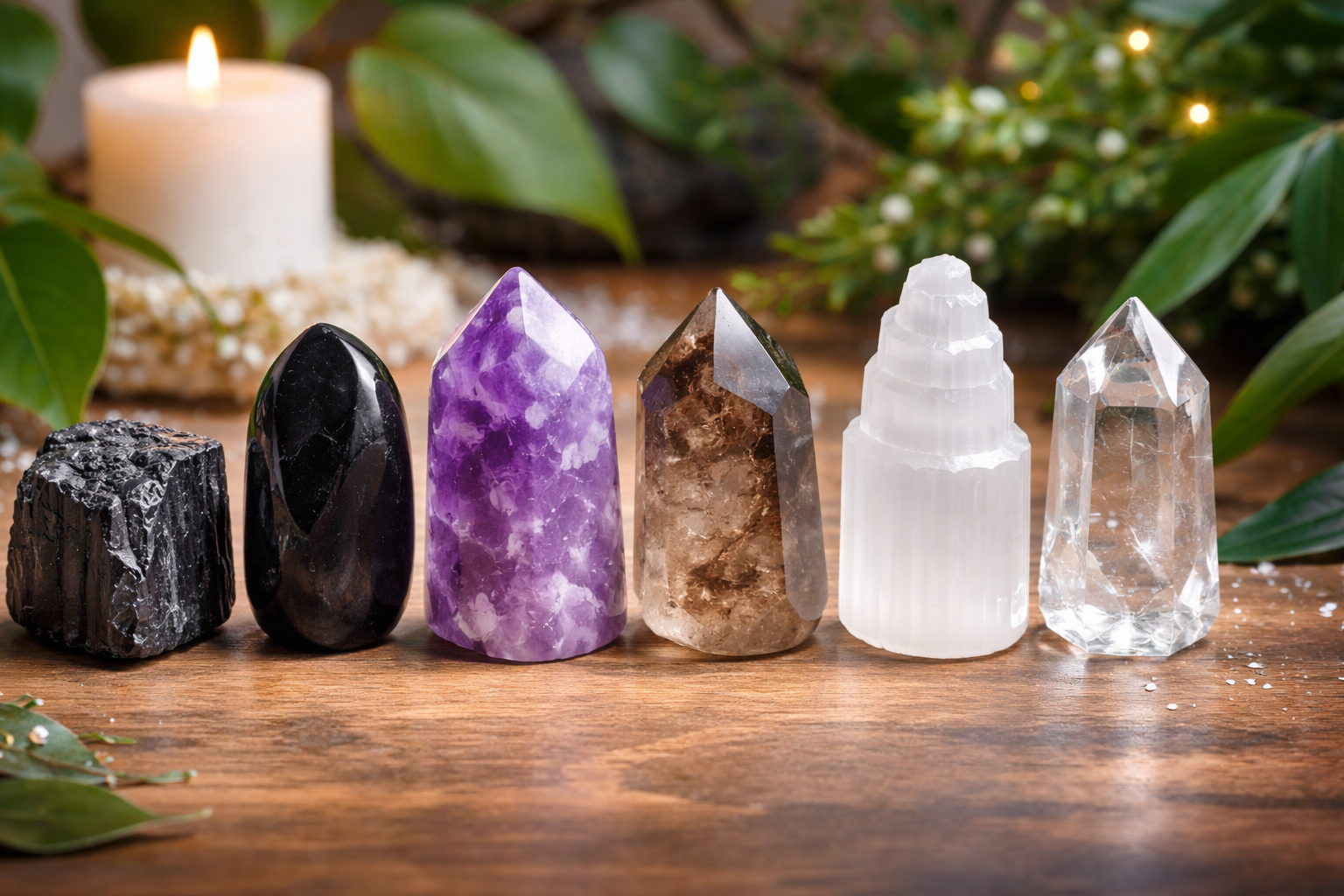
If you want the short answer, these are the crystals for protection that cover most real-life situations without making the choice harder than it needs to be.
Black tourmaline: best overall for heavy rooms, weak boundaries, draining people, and general home protection.
Obsidian: best when you want deeper clearing and a more intense, cut-through-the-noise feel.
Amethyst: best for emotional residue, bedtime tension, racing thoughts, and softer spiritual protection.
Smoky quartz: best for grounding when black tourmaline feels too severe or blunt.
Selenite: best as a cleansing support stone for shelves, altars, and calm spaces, not as your one rugged do-everything pick.
Clear quartz: best as an amplifier or sidekick when you already know the main job and want a flexible extra.
Hematite or black onyx: useful backups for grounding and daily wear, though they are not my first picks for a one-stone start.
Quick pick: If you only want one stone, buy black tourmaline. If black tourmaline feels too stern, go smoky quartz. If the problem lives more in your head than in the room, go amethyst.
The trap here is “most powerful.” That sounds useful, but it pushes people toward drama instead of fit. The better question is, “What am I actually trying to clear?”
Match the Crystal to the Kind of Negative Energy You Want to Clear
“Negative energy” gets used like one giant bucket. In practice, people usually mean one of five things: a room feels stale after conflict, another person’s mood clings to them, crowds leave them jangly, bedtime feels mentally loud, or they want a simple boundary ritual that doesn’t take over their life.
For a heavy room after conflict: pick black tourmaline. It has the best everyday “hold the line” feel for shared spaces, front doors, and desks. A raw piece or stable tower works better here than jewelry because the job belongs to the room, not your wrist.
For draining people or crowded spaces: pick black tourmaline or smoky quartz. Black tourmaline feels firmer. Smoky quartz feels softer and more wearable if you don’t want a stone that reads like emotional body armor.
For racing thoughts, emotional spillover, or a bedroom that feels a bit charged: pick amethyst. This is where a lot of people get more relief from a calming stone than a hard protective one. The bedroom often needs quiet more than barricades.
For deeper clearing or post-conflict self-checking: pick obsidian. I reach for obsidian in short, intentional sessions rather than all-day carry. It has a sharper tone, and some people love that. Others feel flattened by it.
For broad home cleansing support: pair black tourmaline with selenite. Black tourmaline does the boundary work. Selenite keeps the whole setup from feeling muddy or heavy.
Think of it like shoes. Hiking boots, slippers, and trainers all go on your feet, but you’d be miserable if you used them for the same terrain. Crystals are similar. A stone for “toxic people” is not always the right crystal for home protection or sleep.
If you’d like a tighter breakdown by setting rather than by stone, protective crystals for home, sleep, and boundaries maps that out cleanly.
Black Tourmaline, Obsidian, Amethyst, and Smoky Quartz Each Solve a Different Problem

These four cause the most hesitation because they all sit somewhere in the protection family, but they do not feel the same and they do not work best in the same slot.
Black tourmaline is the best default because it is grounded, practical, and low-fuss. It is the crystal I trust most by a front door, at a desk, or in a shared room where tension builds quietly. It doesn’t ask you to “work with it” much. You place it, decide the job, and get on with your day.
Obsidian feels different. The USGS describes obsidian as dense volcanic glass formed when lava cools so quickly that crystals do not have time to grow. That doesn’t prove a spiritual claim, of course, but it does help explain why obsidian feels sharper and less forgiving as a symbol and ritual object. I like it for short clearing sessions, journaling after conflict, and those periods when you want honesty more than comfort.
Amethyst is often sold as a general spiritual stone, which is true enough, but its real strength here is tone. It changes the emotional weather. If the problem is a buzzing mind, a restless night, or the sense that you’ve carried everyone’s nonsense home in your shoulders, amethyst usually makes more sense than a black stone.
Smoky quartz sits in the middle. It grounds well, but it does not have the harder edge of black tourmaline. That makes it one of the best crystals for negative people if you want protection without feeling like you’re walking around in a helmet.
| Stone | Best at | Tradeoff | Best form |
|---|---|---|---|
| Black tourmaline | Boundaries, rooms, daily protection | Can feel a bit stern | Raw chunk, tower, pocket stone |
| Obsidian | Deep clearing, truth-telling, reset work | Can feel intense | Polished palm stone |
| Amethyst | Calm, sleep, emotional residue | Less room-shielding than tourmaline | Palm stone, cluster |
| Smoky quartz | Soft grounding, crowd recovery | Less forceful for harsh spaces | Tumbled stone, bracelet |
If black stones are the category you’re stuck in, best black crystal for protection goes narrower and saves some second-guessing.
Use the Right Form and Placement So the Crystal Fits the Job
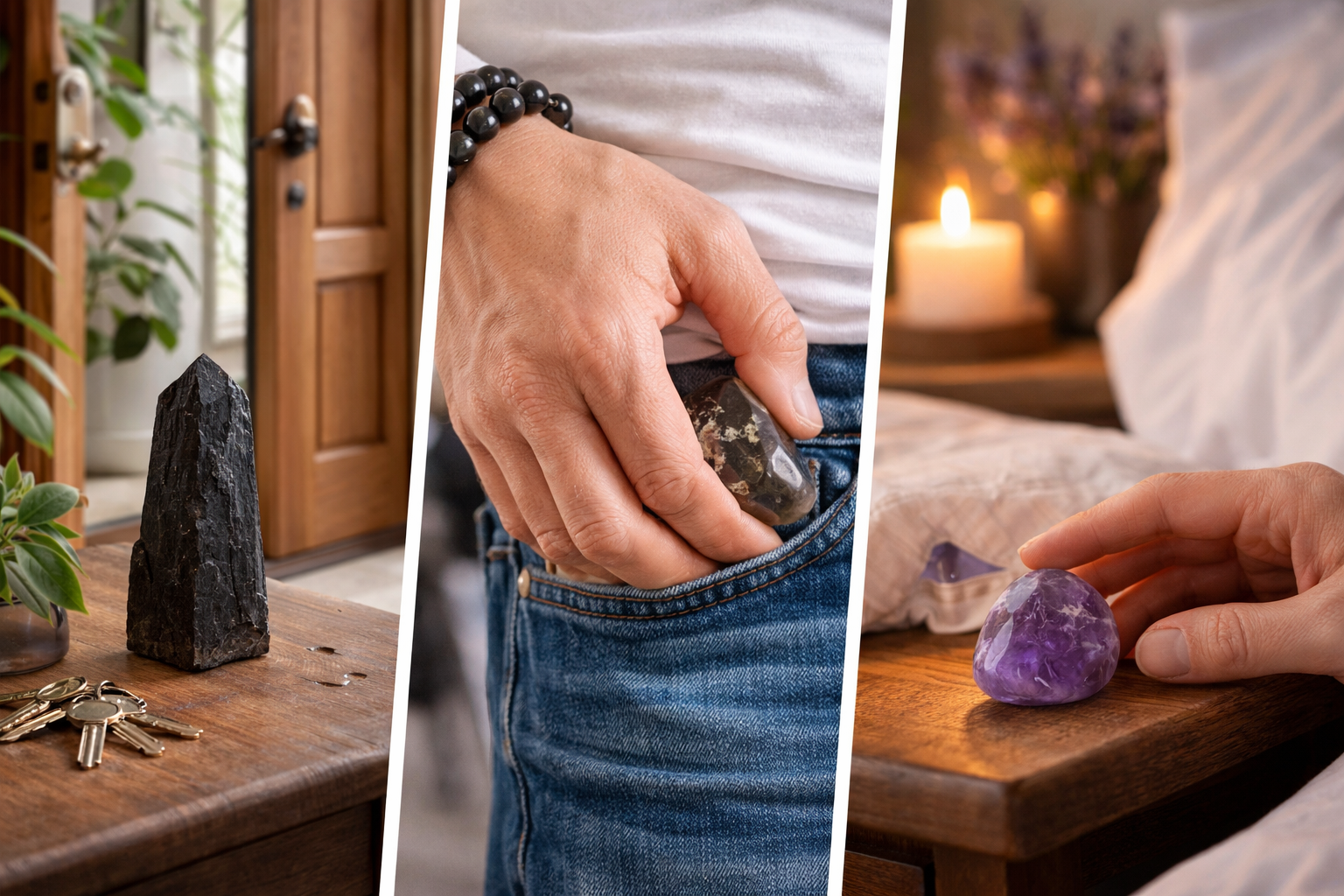
A lot of disappointment comes from using the right stone in the wrong format. You can have the perfect protection crystal and still get little out of it if the form doesn’t match the friction point.
Use a raw chunk or stable tower for room work. If the issue is a hallway, front door, office, or shared room, place the crystal where the mood enters or gathers. Entryway tables, desks, bookshelves, and the edge of a room work well because they stay visible without getting handled to death.
Use a pocket stone or bracelet for crowd work. If the problem is other people, the crystal should travel with you. Tumbled black tourmaline, smoky quartz, or hematite work better here than a fragile cluster that lives on a shelf.
Use a palm stone or small bedside piece for sleep and emotional reset. Amethyst is the easy winner here. Hold it for a minute while your mind is still noisy, then leave it on the bedside table. I would not shove a sharp point or crumbly piece under a pillow. That sounds romantic until the first jab at 2 a.m.
Use fewer placements, not more. One doorway stone, one desk stone, and one carry stone usually beats scattering little crystals across every windowsill in the house. Too many pieces turns the ritual into visual wallpaper.
Pro tip: Put the stone where the friction happens. A room problem wants a room placement. A people problem wants a carry stone. A sleep problem wants a bedside stone.
If the whole ritual side of crystal use still feels fuzzy, how to use crystals for healing lays out a beginner routine that doesn’t ask for much woo or much time.
Cleanse, Charge, and Store Protection Crystals Without Damaging Them
This is where crystal advice gets sloppy. People repeat the same charging ritual for every stone as if minerals all have the same care needs. They don’t.
Start with the low-risk stuff. Wipe the stone with a dry or slightly damp cloth if it collects dust. Reset your intention. Let it sit in a clean, quiet place for a night. That covers a lot of everyday maintenance without turning care into a ceremony every Tuesday.
Be more careful with sunlight advice. The Gemological Institute of America notes that some amethyst color can fade with prolonged exposure to intense light, and abrupt temperature changes can fracture it. So “just put it in the sun” is lazy advice, especially for purple stones you actually like looking at.
Water advice gets muddled too. Many people talk about selenite as if it were one rugged category. Mindat notes that “selenite” is mostly synonymous with gypsum and that satin spar gypsum is the fibrous variety often sold in the trade. That is why these white cleansing pieces deserve gentler handling. They are shelf stones, not bath toys.
My rule is simple. Cleanse after heavy use, after a tense event, or when the ritual feels stale. Not because the stone failed, but because repetition without attention gets flat.
Safe care shortcuts
Amethyst: keep away from harsh heat and long blasts of strong light.
Selenite or satin spar: keep dry, keep sheltered, and don’t treat it like a carry stone.
Black tourmaline: fairly easy for shelf or desk use, but rough pieces can chip if you keep knocking them about.
Obsidian: strong enough for handling, though glossy polished pieces show scratches.
There is a fuller care breakdown for fragile and moisture-sensitive stones in which crystals cannot be charged in moonlight. Handy if moon rituals are your thing but the stone itself is a bit touchy.
Avoid the Mistakes That Make Crystal Work Feel Random or Disappointing
Mistake one: choosing by hype. A stone can be famous and still be wrong for the job. Clear quartz, for example, gets used as a catch-all answer when the real task is deciding whether you need calm, boundaries, grounding, or a room reset.
Mistake two: buying too many at once. Start with one or two. That sounds almost too plain, but it works. When people buy six stones in a mixed lot, they usually stop paying attention to what each one is doing.
Mistake three: pairing opposite tones without a reason. A rev-up stone and a wind-down stone can cancel each other emotionally, even if you don’t believe in strict pairing rules. It feels like one foot on the brake and one on the gas. What crystals should not be together gets into the pairings that commonly feel muddled.
Mistake four: using a carry-stone mindset for a room problem. If your kitchen or office feels tense, a little stone in your pocket is not really addressing the space. That’s you compensating for placement.
Mistake five: waiting for fireworks. Crystal work is usually quieter than people expect. You notice that the desk feels steadier. You snap less. You sleep with less static in your head. That sort of shift is easy to miss if you’re waiting for a movie scene.
Best beginner rule: one shield and one support. Black tourmaline plus amethyst covers more ground than a random pile of trendy stones.
Buy Better Stones and Skip Dyed, Misnamed, or Overhyped Picks
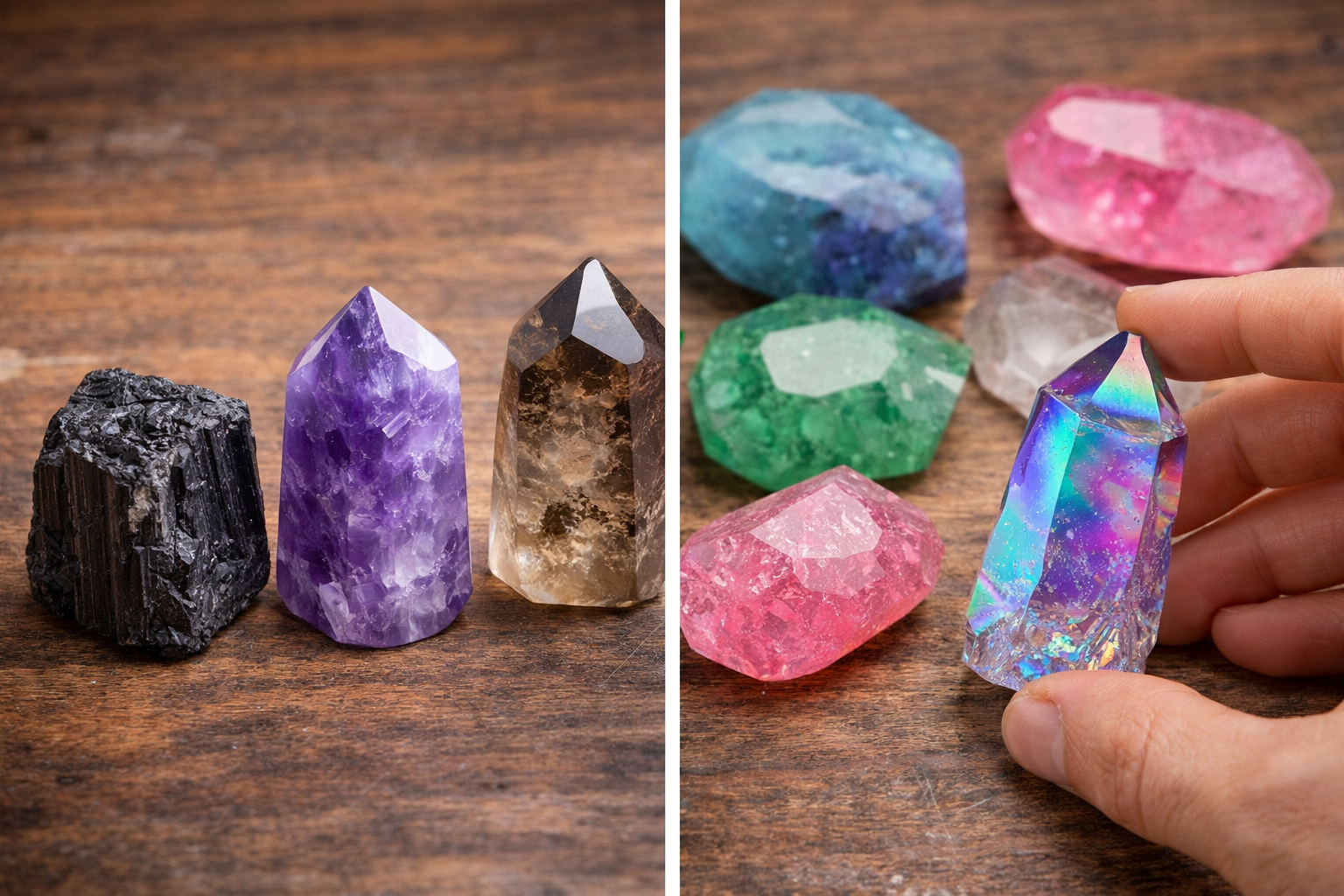
You do not need the most expensive crystal. You need one that is honestly described, fits the job, and isn’t dressed up with fantasy language so thick you can’t tell what the stone actually is.
Start with the material name. That sounds obvious, but the crystal market gets messy around trade names, coated stones, and vague phrases like “high vibration protection crystal” with no mineral listed. A listing should tell you what the stone is, what form it comes in, and whether it has been dyed, coated, or otherwise treated.
The Federal Trade Commission says sellers should tell consumers about gemstone treatments when the treatment is not permanent, when it needs special care, or when it changes value in a meaningful way. That’s jewelry guidance, yes, but the shopping logic carries over nicely to crystal buying. If a stone has been dyed or coated, that should not be hidden in the fine print.
Watch for neon colors that look sprayed on, heavy aura coatings that obscure the base material, and copy that promises health cures. Those are not little red flags. That’s the whole bunting line.
Form matters too. If you want a doorway stone, choose a stable chunk or tower. If you want daily wear, choose a tumbled or polished piece that won’t crumble in a bag. If you want a cleansing shelf stone, a satin spar wand or slab is fine, but don’t buy it thinking it will survive rough carry use.
5-point buying check
- The mineral name is stated clearly.
- The form matches the job you want it to do.
- Treatments or coatings are disclosed.
- The seller avoids cure claims.
- The photos show the actual material, not a filtered glow-fest.
When Crystals Help, and When the Better Fix Is a Boundary, a Cleanup, or Professional Support
Crystals can help as ritual tools, attention anchors, and symbols that make a boundary or reset feel more concrete. That is a real thing in lived practice. But it is not the same as medical treatment, therapy, or fixing the source of the stress.
Harvard Health explains that the placebo effect is more than positive thinking and that ritual can shape how symptoms are felt. That does not turn crystals into medicine. It does explain why a repeated act like holding a stone, naming a boundary, and changing a room setup can make you feel steadier.
So where do crystals genuinely help? When you need a cue. When you want a short ritual that tells your nervous system, “we are done with this now.” When you want a visible object that marks the doorway between public chaos and your own space.
Where are they not enough? If the room smells stale because it needs cleaning and air. If the “negative energy” is actually a relationship with bad boundaries. If your sleep is wrecked by stress, trauma, or health stuff. In those cases, a crystal can sit beside the real fix. It shouldn’t replace it.
Remember: crystals are good at marking intent. They are bad at doing the job of sleep hygiene, honest conversation, medical care, or leaving a draining situation.
A Simple Two-Stone Starter Set for Home, Carry, or Sleep
If you want to keep this simple, good. Simpler usually works better.
For home protection: start with black tourmaline and selenite. Put black tourmaline by the front door, hallway, or the room that holds the most tension. Use selenite on a shelf or table where you want the space to feel cleaner and lighter.
For daily carry: start with black tourmaline and smoky quartz. Black tourmaline handles harder edges. Smoky quartz softens the whole thing so it doesn’t feel like you’re carrying a tiny emotional bouncer.
For sleep or post-overwhelm evenings: start with amethyst and rose quartz. That is less about shielding and more about easing the tone of the room and your own body before bed.
For one stone only: black tourmaline if the problem is boundaries or heavy rooms. Amethyst if the problem is mental noise and bedtime residue.
The rule I keep coming back to is this: choose one stone that clears the lane and one that changes the tone. More than that, and beginners often end up making the choice harder than the practice itself.
FAQ
What is the single best crystal for negative energy removal?
Black tourmaline is the best first pick for most people. It suits heavy rooms, weak boundaries, draining people, and everyday home protection better than any other one-stone option.
Which crystal is better for negative energy, black tourmaline or obsidian?
Black tourmaline is better as a default daily protection stone. Obsidian is better when you want a sharper, more intense clearing feel and plan to use it more intentionally than constantly.
Is selenite the same thing as satin spar?
Not quite. In trade use, many pieces sold as “selenite” are actually satin spar gypsum, which is the fibrous variety. That is why a lot of white cleansing wands and slabs need gentler handling than people expect.