
The funny thing about amethyst is that the piece that looks the most “spiritual” often ends up doing the least for your actual practice. I’ve made that mistake myself. I once bought a dramatic, cathedral-style chunk that looked like it belonged in a temple, then left it on a shelf because it was too big to handle and too awkward to place where I actually sat to meditate.
For most people, the best amethyst crystal for spiritual growth is a small natural amethyst cluster. It is easy to place near a meditation seat, on a nightstand, or on a simple altar. If your goal is focused intention work, a tower usually fits better. If your real problem is consistency, a palm stone or bracelet tends to beat a decorative piece every time.
That is the part most pages skip. They tell you amethyst is calming, intuitive, and tied to the third eye and crown chakra. Fine. But a geode, a tower, and a bracelet are not the same decision. Choosing the right form matters more than chasing a darker purple or a loftier seller claim.
What you’ll learn here
- Which amethyst form works best for meditation, daily carry, sleep, and altar use
- How to buy a piece that looks honest instead of over-marketed
- Why “spiritual growth” usually means calm plus clarity, not drama
- When amethyst is the right first crystal and when it really isn’t
- How to cleanse, charge, and care for amethyst without slowly fading it
Fast pick
| If your goal is… | Best form | Why it tends to work |
|---|---|---|
| A calm meditation space | Small cluster | Easy to place, easy to see, no technique needed |
| Focused intention work | Tower or point | Feels more directional and ritual-friendly |
| A bedtime wind-down | Palm stone | Comfortable to hold during breathwork or journaling |
| Daily reminders | Bracelet or pocket stone | Contact beats shelf presence when habit is the weak spot |
Quick rule: buy the form that will live where your practice already happens.
The Best Amethyst Crystal for Spiritual Growth Depends on the Job
Amethyst gets grouped into one big, floaty category called “spiritual.” That is where people get lost. Spiritual growth can mean a quieter mind during meditation, cleaner reflection while journaling, better dream recall, steadier prayer, or just a gentler landing after a stressful day.
So the right pick starts with the job.
If you want one default answer, go with a small natural cluster. It has enough presence to shape a space, but it does not demand that you hold it, wear it, or arrange it just so. It simply sits there and becomes a visual cue. That sounds small, but cue-based practice is half the battle. A stone that you see every day often does more for your routine than a rarer piece tucked in a drawer.
If your practice is more deliberate, a tower makes sense. Towers feel directional. People use them for intention-setting, prayer corners, focused breathwork, and chakra layouts because the form itself nudges the mind toward one line of attention.
If you tend to think, “I’ll meditate later” and then never do, a palm stone or bracelet is the smarter buy. The best crystal for growth is not the one with the grandest aura story. It is the one that gets touched, seen, and used.
Fast pick: Choose a cluster for shared space, a tower for focused sits, and a palm stone or bracelet if consistency is the snag.
Choose the Right Amethyst Form for the Way You Practice
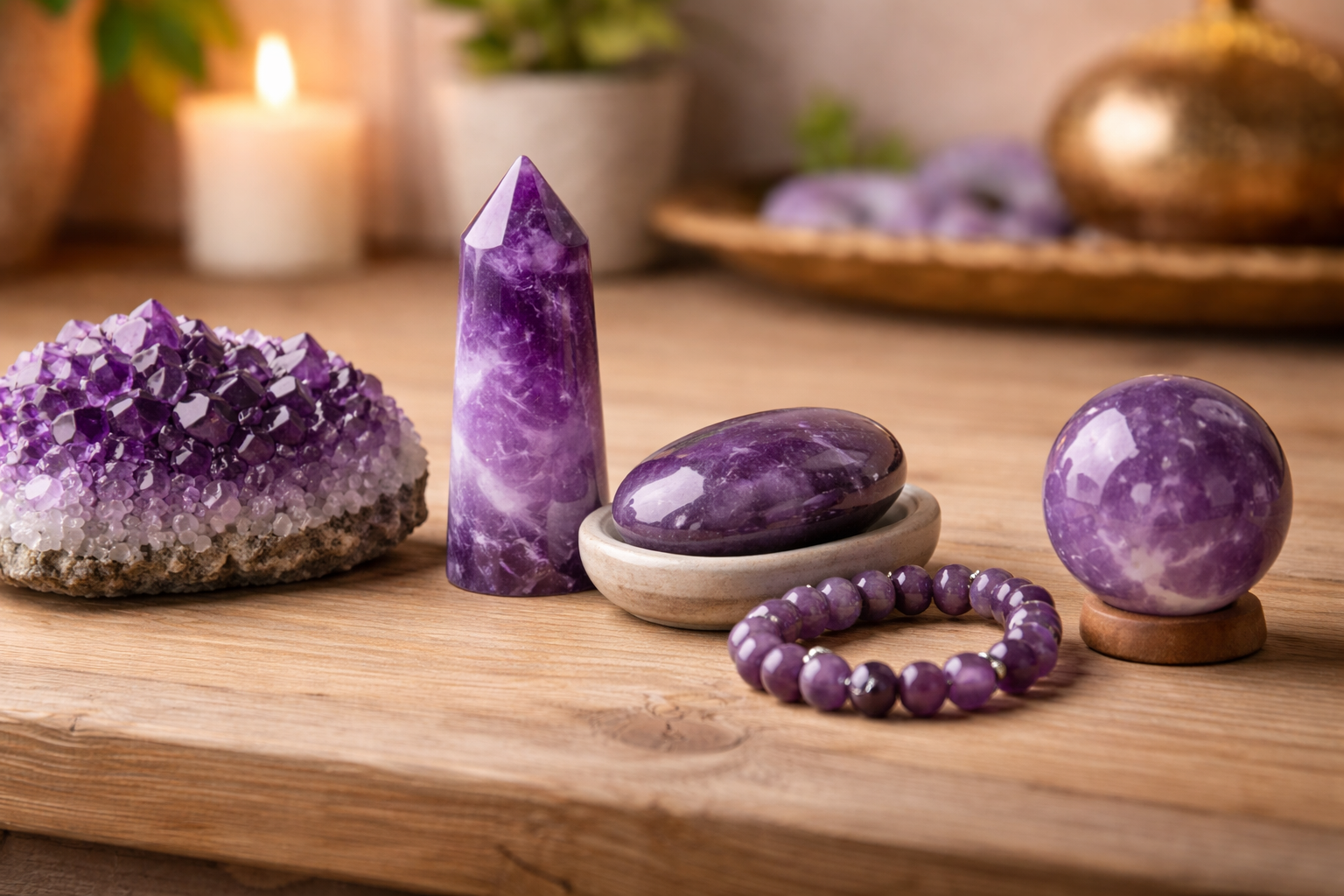
Think of amethyst forms like different shoes. A hiking boot and a house slipper can both be “good footwear,” but they solve different problems. Same stone, different job.
| Form | Best for | Tradeoff | First use to try |
|---|---|---|---|
| Cluster | Meditation corners, altars, bedrooms | Not portable | Place it where you sit for 7 days |
| Tower or point | Intention work, journaling, chakra layouts | Can feel too formal if you’re casual | Use it before one focused 10-minute sit |
| Palm stone | Breathwork, winding down, bedtime reflection | Easy to misplace | Hold it during slow breathing |
| Bracelet or mala | Habit-building, daily reminders | Less room presence | Use it as a pause cue during the day |
| Sphere | Soft ambient focus, display, calm desk energy | Least practical for direct handling | Place it where you tend to overthink |
Clusters and geodes are the easiest first choice. They bring a room-level presence and they look natural in a meditation corner. A small cluster on a shelf near eye level often works better than a big geode on the floor. That sounds obvious, but people skip it. If you cannot see the stone during the moment you want to reset, it stops doing much.
Towers and points are better when you want the practice to feel focused. They suit intention-setting and third eye or crown chakra work because the shape feels precise. That can be helpful. It can also be a bit much if your style is low-key and practical.
Palm stones are underrated. For anxious minds and busy nights, they are often the most usable form in the whole category. You can hold one during slow breaths, prayer, or quiet journaling without having to “do crystal work” in any formal sense.
Raw vs polished is not a purity contest. Raw pieces tend to feel wilder and better for display. Polished pieces are easier to handle, easier to slip in a pocket, and easier to live with day to day. If a polished palm stone gets used five times a week and a raw point gets admired once a month, the polished one wins. Pretty simple, really.
Check Amethyst Quality Before You Buy So the Stone Matches the Promise
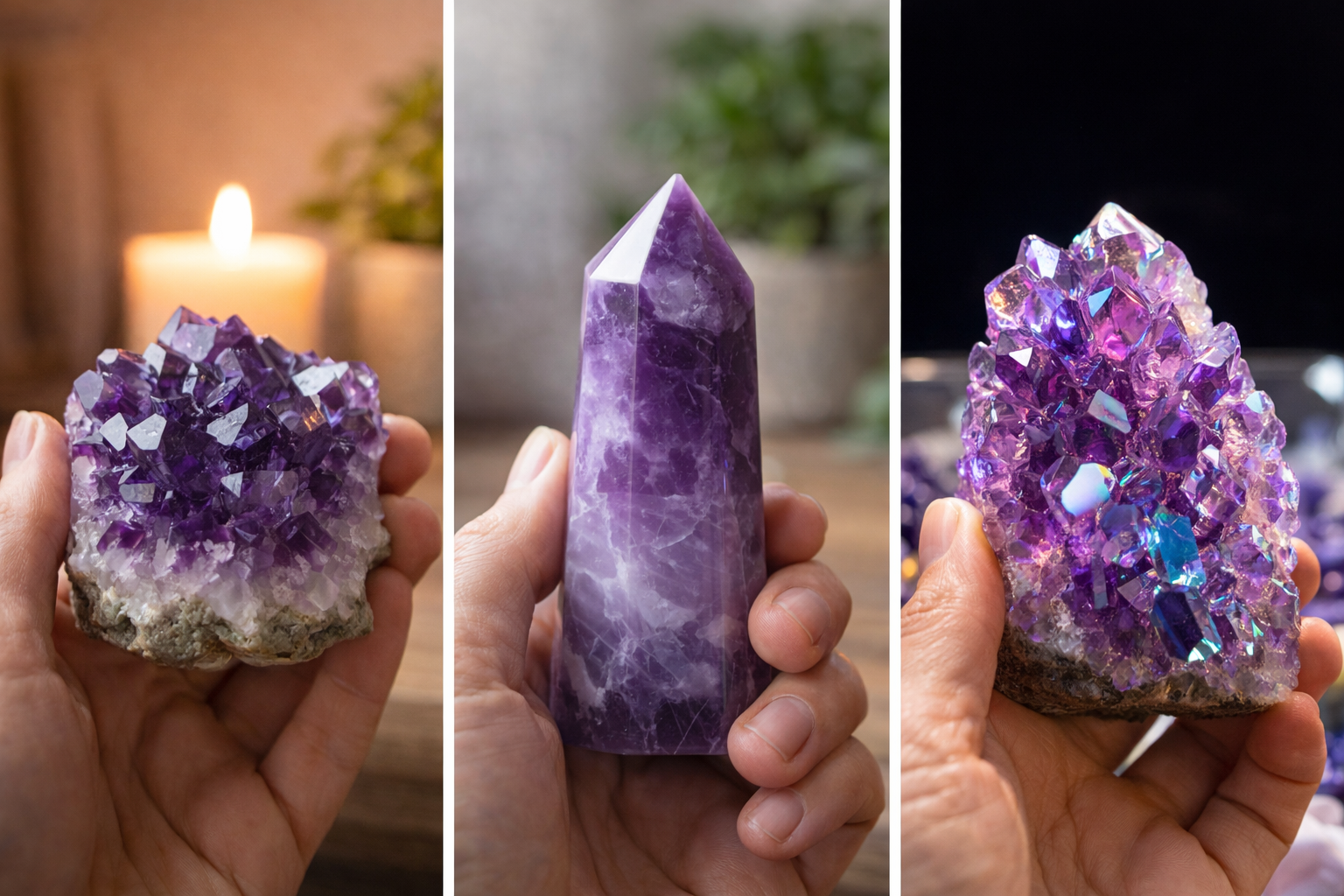
Here’s where people get sold a mood instead of a crystal. Sellers love dramatic grades like “AAA” and “AAAAA.” The problem is that those grades are not a shared industry language. GIA’s amethyst buying guidance notes that there is no standard AAA grading scale for amethyst, so treat those labels as store shorthand, not fact.
What should you look for instead?
Start with color. You want a stone that still looks purple in normal room light. If it gets so dark that it reads nearly black unless you hold it under a lamp, it can lose the softness that draws many people to amethyst in the first place. A medium-to-rich purple is usually the sweet spot.
Then check honesty signals. Natural-looking color zoning is fine. Tiny internal marks are fine. A photo set that only shows one glam angle is less fine. If a piece looks neon, oddly glassy, or sprayed with a color that seems too loud for quartz, step back. The same goes for listings that talk more about “rare vibration” than about size, shape, and condition.
Comfort matters too. A tower needs a stable base. A palm stone should fit your hand without awkward edges. A bracelet should feel like something you’ll actually wear, not a costume prop for one moon ritual and then never again.
Use this 4-point buying filter
- Color: purple in room light, not murky
- Comfort: stable, holdable, wearable, or easy to place
- Condition: no mystery coating, no hidden chips in load-bearing edges
- Credibility: clear photos, clear dimensions, plain-language description
The best amethyst crystal for spiritual growth is not the darkest one or the one with the fanciest label. It is the one that looks honest and fits your actual use.
Use a Simple Spiritual-Growth Filter Instead of Chasing Vague “High Vibration” Claims
A lot of crystal writing makes spiritual growth sound like a fog machine. More mystical language. More “frequency.” More blur. That is usually backwards.
Amethyst tends to work for spiritual practice through two plain functions: calm and clarity. Calm lowers the static. Clarity makes reflection easier. That is why people reach for it during meditation, prayer, dream work, and journaling.
Materially, the U.S. Geological Survey describes amethyst as the purple variety of quartz. Spiritually, it is often linked with the third eye and crown chakra. If that language helps you frame your practice, great. If not, think of it this way: amethyst is usually better at quieting mental chatter than at firing you up.
There is also a trust issue here. Cleveland Clinic points out that chakras are not recognized by Western science. That does not make the chakra framework useless. It just means you should treat it as a symbolic or reflective map, not a medical claim. That is a healthier way to use crystal language anyway.
If you want a cleaner filter, ask yourself three questions:
- What is getting in the way? Noise, fear, overthinking, emotional static, or lack of routine?
- What kind of support feels right? Softness, clarity, grounding, protection, or momentum?
- Where will the crystal live? In your hand, on your body, beside your bed, or in your meditation space?
If your answer sounds like “I need the noise to drop so I can hear myself think,” amethyst is a strong fit. If it sounds more like “I know what to do and I just won’t do it,” then you may need a different stone entirely. That is where what different crystals mean in practice becomes a better guide than one-size-fits-all crystal lore. The same goes for third eye and crown chakra work if that is the language you already use.
Build a Daily Amethyst Practice That You Will Actually Repeat

The stone is not the practice. It is the cue.
That distinction matters because many people buy amethyst, set it on a shelf, and then wait for it to do all the heavy lifting. A better move is to pair the stone with one short action that can survive a tired Tuesday.
My favorite beginner routine is almost boring, which is why it works. Sit down. Place the cluster or tower where you can see it, or hold a palm stone. Take five slow breaths. Name one intention in plain language. Then write one sentence in a journal or sit quietly for five to ten minutes.
If formal meditation is not your thing, don’t force it. Use amethyst during prayer, a bedtime reset, or a morning cup-of-tea pause. Habit sticks when the crystal joins something you already do.
Try the 7-day test: one stone, one location, one short ritual. Do not keep moving the stone around the house and then wonder why the practice feels fuzzy.
There is also a very grounded reason this setup can help. The National Center for Complementary and Integrative Health says mindfulness meditation may help with insomnia and may improve sleep quality and stress management for some people. That does not prove a crystal changes your nervous system on its own. It does show that a repeatable reflective practice can shift how you feel. Sometimes the crystal becomes the thing that makes the practice easy to begin.
Three simple paths work well:
Meditation-space path: place a cluster or tower near the spot where you sit. Keep it visible. Use it before one short sit a day.
Carry path: keep a palm stone in a pocket or wear a bracelet. Touch it during moments when your mind starts sprinting ahead of you.
Bedside path: place a small piece near the bed if evening reflection or dream journaling is your aim. If it feels too buzzy, move it a little farther away. Not everyone likes crystal energy right under the pillow.
If a more structured routine sounds useful, how to use crystals for healing in a simple beginner-friendly way is a good next step.
Compare Amethyst With Clear Quartz, Selenite, Fluorite, and Grounding Stones Before You Commit

Amethyst is great. It is not magic at every job.
Amethyst vs clear quartz: clear quartz is the broader all-rounder. Amethyst is narrower and moodier in a good way. If you want one stone that can flex across many uses, quartz makes sense. If you specifically want calm, reflection, and spiritual focus, amethyst usually feels more on target.
Amethyst vs selenite: selenite is lighter, cleaner, almost airy. It suits altar spaces and energetic clearing. Amethyst feels more introspective. If you want to sit, soften, and listen inward, amethyst wins. If you want a room to feel brighter and simpler, selenite can be the better tool.
Amethyst vs fluorite: fluorite often suits mental sorting. Study desks. Decision fatigue. Scattered thinking. Amethyst leans more reflective and less analytical. If your problem is brain clutter during work, fluorite may be the sharper pick.
Amethyst vs black tourmaline or smoky quartz: this is the comparison too many crystal pages skip. If meditation leaves you feeling a bit floaty, porous, or weirdly unanchored, amethyst may not be the best first move. A grounding stone can help you settle before you reach upward. That is why grounding stones for calm, protection, and focus often make more sense for overstimulated people than another upper-chakra piece.
Use this quick comparison
- Need calm plus reflection? Pick amethyst.
- Need a general all-rounder? Pick clear quartz.
- Need cleansing or lightness in a space? Pick selenite.
- Need focus for study or planning? Pick fluorite.
- Need to come back down to earth? Pick smoky quartz or black tourmaline.
This is one of those quiet but useful truths: sometimes the most spiritual choice is the stone that helps you feel steadier, not loftier.
Avoid the Mistakes That Make Amethyst Feel Flat, Overhyped, or Too Much
The first mistake is buying a showpiece when you needed a tool. A huge geode can be gorgeous. It can also be totally wrong for a person who really needs something to hold during a rough evening or wear during the workday.
The second mistake is using amethyst for a problem it does not fit. If your nervous system already feels revved up and ungrounded, another “spiritual” stone may leave you feeling even more airy. That is not failure. It is a mismatch.
The third mistake is making the ritual vague. “I’ll keep it somewhere near me” usually turns into “I forgot where I put it.” Pick one place. Pick one use. Run that setup for a week before changing anything.
Then there is the sleep question. Many people love amethyst near the bed because it feels calming and reflective. Some people find it too mentally active at close range. If your sleep gets weird, move the crystal to a shelf across the room or use it before bed instead of during sleep.
Another mistake is expecting symbolism to replace care. Crystals can support reflection, ritual, and emotional pacing. They do not replace treatment for anxiety, insomnia, or anything else that needs medical attention. Keep that line clear and the practice stays healthier.
Watch for this pattern: when a crystal feels “flat,” the problem is often not the stone. It is too much switching, too little structure, or the wrong job.
Cleanse, Charge, and Care for Amethyst Without Damaging It
There are really two different tasks here. One is physical care. The other is ritual cleansing. People mix them together and then things get murky fast.
For physical care, keep it simple. GIA says warm soapy water is safe for amethyst, while steam cleaning is not recommended, abrupt temperature changes can cause fractures, and prolonged intense light can fade some stones. So yes, that sunny windowsill may look lovely for a week. Long term, not my favorite idea.
For ritual cleansing, go low-drama. Moonlight, sound, breath, or resting the stone near selenite all work as symbolic resets if they help you reconnect with the piece. You do not need a complicated ceremony every time your week feels messy.
If the stone is natural and untreated, routine care is pretty easy. Still, gentle habits win. Dry it well. Store it where it will not get knocked around. And do not treat every crystal like it should live in direct sun just because sunlight photographs well.
If moon work is part of your practice, moonlight charging safety for different crystals is worth a look. Amethyst is not the fragile outlier in that group, which is nice news.
Easy care rule
Clean with warm soapy water when it needs actual cleaning. Use moonlight or sound when you want a ritual reset. Keep it out of harsh light if you care about color.
Know When Amethyst Is Not the Best First Pick
Sometimes the answer is not amethyst. Saying that makes the recommendation better, not weaker.
If you feel scrambled, porous, or oddly disconnected after spiritual work, start with a grounding stone. If your mind is not too noisy but your body is unsettled, amethyst can be a touch too heady. Smoky quartz and black tourmaline usually make more sense first.
If your real work is emotional tenderness, grief, or self-compassion, rose quartz may fit better. If the issue is stalled action, not insight, look at stones that nudge movement rather than reflection. That is where clarity before action in manifestation work becomes a useful frame. Sometimes you do not need more awareness. You need traction.
If you want one adaptable default crystal and do not want to think too hard about form, placement, or symbolism, clear quartz is the easier generalist.
Here is the rule I come back to: when the next step is buried under noise, pick amethyst. When the next step is obvious and you still are not moving, pick something else.
FAQ
Is raw amethyst better than polished amethyst for spiritual growth?
Not by default. Raw amethyst often works better for altars and room placement because it has more visual presence. Polished amethyst usually works better for daily use because it is easier to hold, carry, or wear. Pick the form you will actually use.
Does darker purple mean stronger spiritual energy?
No. Darker color can look rich, but a very dark piece may lose the softness people like in amethyst and can read nearly black in ordinary light. A medium-to-rich purple that still looks alive in your room is usually a better buy.
Can I sleep with amethyst near my bed every night?
Usually, yes. Many people like it near the bed for a calmer wind-down. If sleep feels too active or you wake up feeling a bit wired, move it to a shelf across the room or use it before bed instead of right beside your pillow.