
Most people do not have a crystal problem. They have a sorting problem.
If you want one crystal for psychic protection, start with black tourmaline. It is the safest first pick for most people because it suits the use cases that send people searching in the first place: crowded spaces, draining people, a desk that feels tense, or a room that just feels a bit off. But that stock answer gets thin fast. A stone that helps with weak boundaries is not always the right stone for sleep, intuitive work, or a heavy-feeling home.
I have seen this go sideways the same way again and again. Someone buys amethyst because it is beautiful, obsidian because it sounds strong, and black tourmaline because every list says to. Then all three end up on a shelf because no one explained which one should live in a pocket, which one belongs by the bed, and which one can feel like a lot on a first try.
So let’s make this easy.
At a glance: pick the stone by the job
| Situation | Best first pick | Why it fits |
|---|---|---|
| Crowded places, draining people, weak boundaries | Black tourmaline | Grounded, firm, easy to wear or place near a doorway or desk |
| Bedtime, spiritual calm, dream-heavy nights | Amethyst | Gentler feel, calmer tone, fits bedrooms better than harsher stones |
| Everyday grounding without a stern feel | Smoky quartz | Steadying, softer than black tourmaline, easy daily carry |
| Deeper clearing, shadowy or intense work | Obsidian | Sharper feel, often better once you know you like stronger stones |
| Intuitive work with cleaner boundaries | Labradorite | Popular with readers who want intuition and protection together |
- Pick one stone first
- Match the form to the problem: wear it, carry it, or place it
- Keep the ritual simple enough that you will actually do it
- Use crystals as a spiritual tool, not as a stand-in for medical or mental health care
Crystal for Psychic Protection: The Short Answer
If you want the clean answer, black tourmaline is still the best first pick. It works because it is practical. You can wear it, keep it in a pocket, place it by the front door, or leave it beside a laptop at work and the use case still makes sense. It is also the stone that shows up most often when practitioners talk about energetic boundaries.
There is a bit of solid mineral context here too. According to Britannica’s entry on tourmaline, the black variety is iron tourmaline, also called schorl. That does not prove metaphysical effects, of course. But it does help explain why black tourmaline feels like a stable default in crystal practice: it is not a vague trade name. It is a specific, well-known mineral variety.
If black tourmaline sounds too stern, go one notch softer. Amethyst is the better pick for sleep, spiritual calm, or a protection practice that needs to feel lighter. Smoky quartz is the middle road when you want grounding without that hard-edged “keep out” mood. Obsidian can work well for intense clearing, but I would not hand it to every beginner as the only answer. Labradorite makes the most sense when you want psychic protection and intuitive sensitivity to sit in the same routine.
Quick rule: If the problem feels like outside pressure, start with black tourmaline. If it feels like internal overstimulation, start with amethyst or smoky quartz.
Match the Stone to the Kind of Psychic Protection You Actually Need
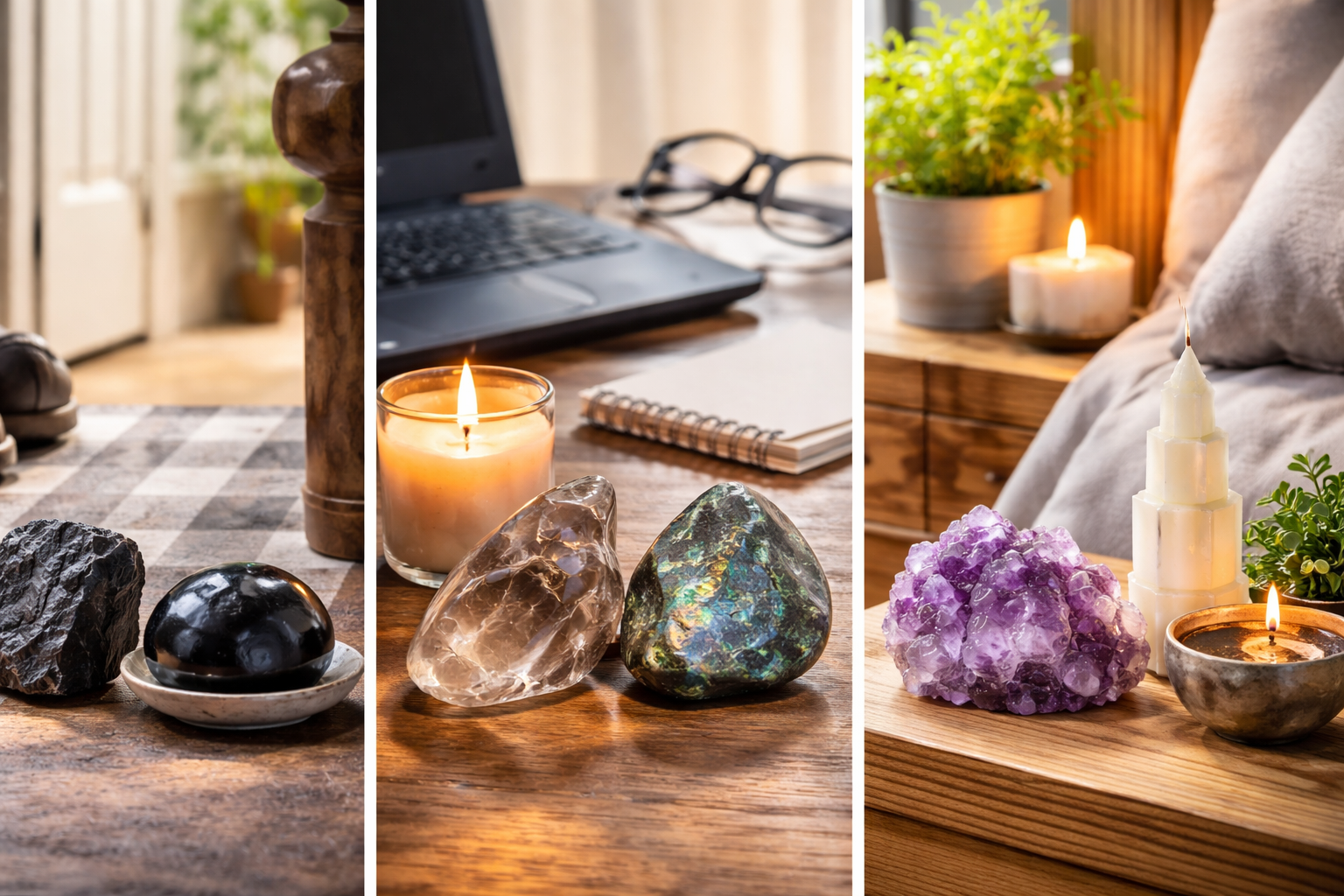
“Psychic protection” sounds like one job, but it usually hides three different ones.
First, you might need boundaries. That is the crowded-train, emotionally clingy coworker, family-group-chat, after-the-party kind of issue. Second, you might need grounding. That is the buzzy, scattered, floaty feeling where everything gets under your skin. Third, you might need clearing. That is the stale room, tense corner, or weirdly heavy bedroom that never quite settles.
When people skip that sorting step, they buy by vibe and then wonder why the stone never clicked. It is like buying winter boots because they look tough, then wearing them to a beach town. Wrong terrain.
Use this three-question filter:
- Is the problem happening around people or in a place? If it travels with you, wear or carry the stone. If it sits in one room, place the stone there.
- Do you need shielding, grounding, or clearing? Shielding suits weak boundaries. Grounding suits overstimulation. Clearing suits stale-feeling spaces.
- Do you want the energy to feel firm or gentle? Firm points you toward black tourmaline or obsidian. Gentle points you toward amethyst or smoky quartz.
Here is how that plays out in actual life:
- Draining people, social overwhelm, empath-style overload: black tourmaline.
- Heavy workday, too much screen time, scattered focus: smoky quartz or one of these grounding crystals for calm, protection, and focus.
- Nightmares, restless spiritual practice, bedroom that feels “on” all the time: amethyst.
- Tarot, meditation, intuitive work where you still want boundaries: labradorite, sometimes paired with black tourmaline.
- One stale corner of the home, doorway, altar, or room reset: selenite near the space, often with a firmer protection stone nearby.
If this, then that
If you keep saying “I feel everyone’s mood,” pick black tourmaline.
If you keep saying “I can’t settle down at night,” pick amethyst.
If you keep saying “I feel too wired and too open,” pick smoky quartz.
If you keep saying “I want intuition without feeling porous,” pick labradorite.
Black Tourmaline vs Amethyst vs Obsidian vs Smoky Quartz vs Labradorite
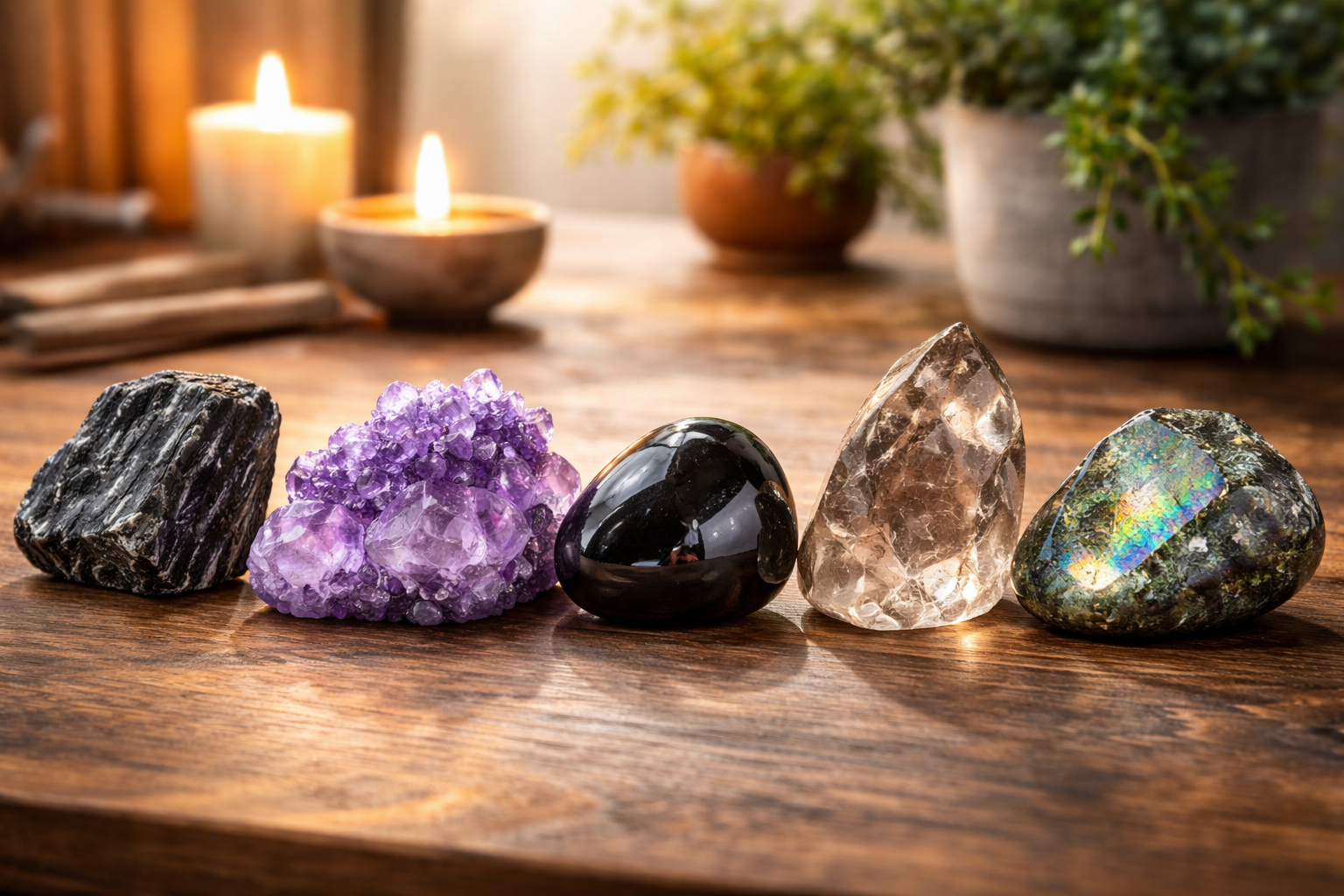
This is the section most roundup posts blur together. The stones are not interchangeable. They overlap, yes, but they do not feel the same in use.
| Stone | Best for | Feels like | Skip it if |
|---|---|---|---|
| Black tourmaline | Boundaries, daily shielding, public spaces | Firm, grounded, no-nonsense | You want bedtime softness |
| Amethyst | Sleep, calm, spiritual protection | Gentle, clear, quieter | You need firmer daytime boundaries |
| Obsidian | Deep clearing, heavy work, stronger feel | Sharp, dense, intense | You are brand new and want something easy |
| Smoky quartz | Grounding, steady daily support | Soft but anchored | You want a harder protective edge |
| Labradorite | Intuition with cleaner boundaries | Shimmery, alert, more inward | You need plain, everyday shielding |
Black tourmaline is the practical one. It is what I would hand to someone starting a commute-heavy job, sharing space with a difficult person, or feeling too porous around other people’s moods. It is stable and boring in the best way. That is praise.
Amethyst sits in a different lane. Britannica describes amethyst as a violet variety of quartz, and that fits the way the stone is used in crystal practice too: calmer, clearer, more bedroom-and-meditation than doorway-and-office. If the protection you want is “help me settle” rather than “help me block,” amethyst often lands better.
Obsidian gets talked about like the heavyweight champion. That is not wrong, exactly, but it can be sloppy advice. Britannica notes that obsidian is natural volcanic glass, not technically a crystal, which is a neat reminder that crystal culture and geology are not always using the same categories. In practice, obsidian is often used for strong clearing and shadow work. I like it more as a second-step stone than a first one.
Smoky quartz is what I reach for when black tourmaline feels a touch too stern. It still grounds. It still steadies. But it does not feel like a bouncer at the door. If black tourmaline is boots, smoky quartz is a solid pair of everyday trainers.
Labradorite makes the most sense when the routine includes divination, dream work, or intuition practice. Britannica describes labradorite as a feldspar prized for its iridescence, and that shimmering quality lines up with how many people experience it symbolically too: not heavier, just more liminal. I would not swap it in for black tourmaline at a chaotic office. I would add it when the goal is “stay open, but not too open.”
Good beginner call: black tourmaline for day, amethyst for night. Questionable beginner call: jumping straight to obsidian because it sounds stronger.
Raw Stone, Tumbled Stone, Bracelet, or Pendant? Choose the Form You Will Actually Use

Form matters more than most crystal guides admit. A perfect stone in the wrong format turns into decor.
Raw chunks are best for placement. Front door, shelf, desk, meditation corner, nightstand. They have presence, and they are hard to ignore. If the problem belongs to a place, use a place-based stone.
Tumbled stones or palm stones are best for touch. Pocket carry works when the ritual is tied to contact: a hand in the pocket before a stressful meeting, a thumb rub during a train ride, a few breaths before walking through the door.
Bracelets work for people who lose loose stones. That sounds obvious, but it matters. The best spiritual tool is often the one you stop forgetting.
Pendants make sense for all-day wear in public spaces, especially if your issue is other people rather than a specific room. If the protection practice is meant to travel with you, jewelry solves the friction better than a stone left at home.
Here is the simple placement rule:
- Wear it if the problem moves with you.
- Carry it if the ritual depends on touch or habit.
- Place it if the problem belongs to a room, doorway, desk, or bedside.
That is why protective crystals for home, sleep, and boundaries often work best when the guidance gets specific about location. A doorway stone and a bedside stone are not doing the same job, even if the word “protection” sits on both.
One small caution
Putting any stone under a pillow sounds romantic, but many stones are simply too bulky or distracting there. A nightstand is often the smarter call.
How to Use a Protection Crystal Without Turning It Into Homework
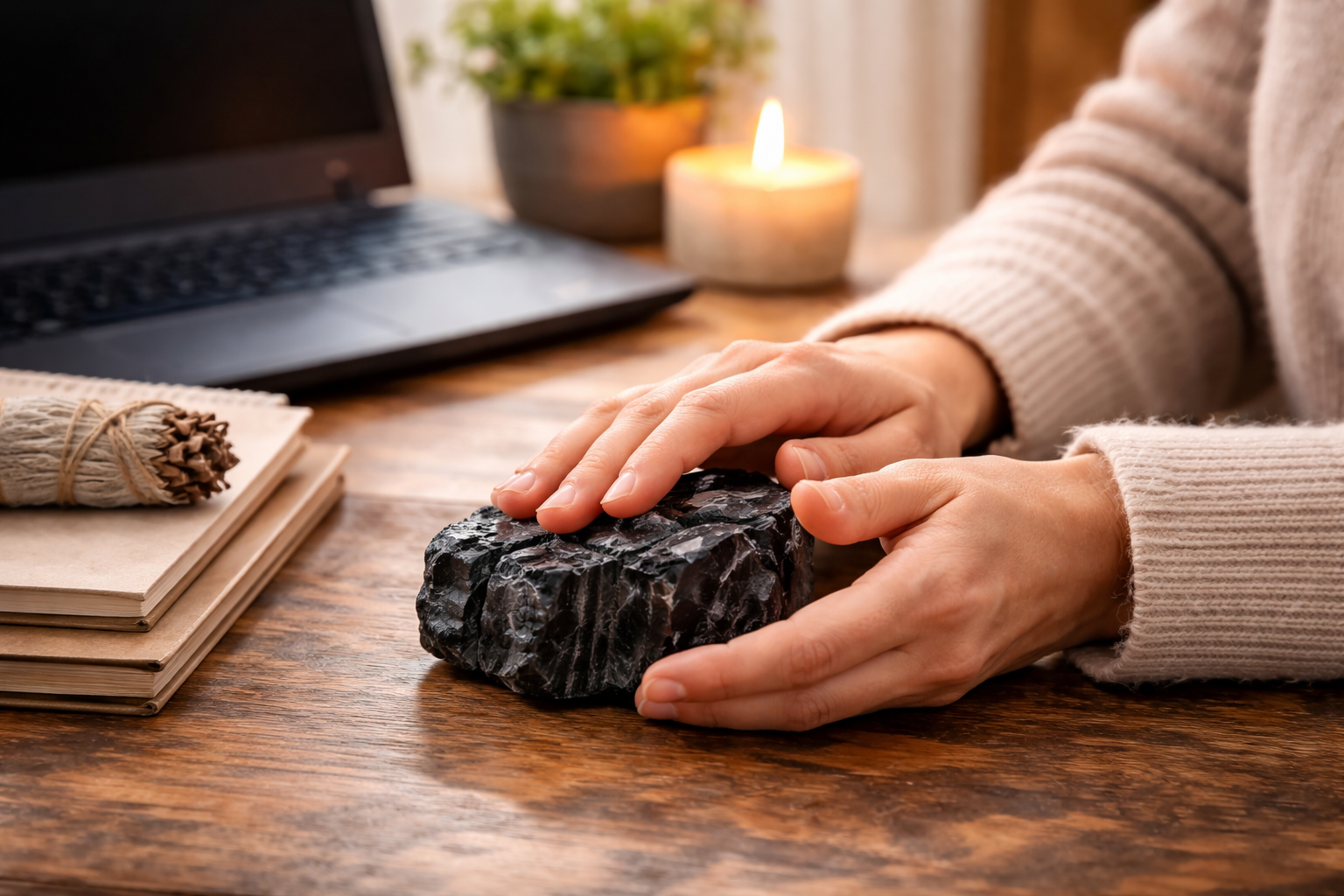
This part gets overcomplicated fast. You do not need a moon phase spreadsheet and six cleansing tools to begin.
Use a three-step routine:
Step 1. Name one job.
Not “protect me from everything.” Try “help me hold my boundary at work” or “help this room feel less heavy at night.” Vague intention gives vague use.
Step 2. Put the stone where the friction happens.
That might mean a pendant for crowded spaces, a black tourmaline piece near the laptop, or amethyst on the nightstand. When the stone lives where the problem happens, you stop relying on memory alone.
Step 3. Repeat the same small ritual until it sticks.
A hand on the stone before you leave home. A breath and a short phrase before sleep. A quick reset at the desk after lunch. Boring is fine here. Boring is what becomes a practice.
Cleansing matters mostly because it refreshes attention. Some people like moonlight. Some prefer smoke, sound, or placing the stone near selenite. Pick one method that feels easy enough to repeat. If the ritual starts taking more energy than the problem itself, trim it down.
I have a soft spot for “one stone, one phrase, one place.” That structure stops the whole thing from sprawling. It also makes it much easier to notice whether the routine is helping you feel steadier, calmer, or more contained.
When One Stone Is Enough, and When a Pair Makes More Sense
One stone is enough for most beginners. Really. A lot of crystal confusion comes from stacking five intentions on top of one another and then calling the blur “energy.”
Start with one main stone when the job is singular. Black tourmaline for daily boundaries. Amethyst for sleep. Smoky quartz for grounding. Keep that clean for a week or two and see whether the routine feels natural.
Add a second stone only when the job is clearly two-part.
- Black tourmaline + selenite works when you want one stone for firm boundaries and one for a cleaner-feeling room.
- Amethyst + smoky quartz works when you want calm but still need to stay in your body, not float off into candle-shop bliss.
- Labradorite + black tourmaline works when intuitive practice opens you up and you still want firmer edges.
Notice what those pairings have in common. Each one has a lead stone and a support stone. None of them is a pile.
Simple cap for beginners: start with one stone. If the job stays split after a fair try, add one support stone and stop there.
The Mistakes That Make Psychic Protection Feel Vague or Overwhelming
Picking the strongest-sounding stone.
This is why beginners rush to obsidian. Stronger is not always better. A stone that feels too dense or dramatic for your actual routine gets abandoned.
Using a sleep stone for a boundary problem.
Amethyst can be lovely, but if the issue is emotional spillover from other people all day long, black tourmaline or smoky quartz is usually the sharper match.
Using a room stone for a people problem.
If your stress shows up on trains, in meetings, or after social contact, the stone needs to travel with you. A crystal beside the bed cannot do all the heavy lifting for a commute.
Making the ritual too fussy.
If you need a cloth pouch, a full moon, three affirmations, and a separate charging slab every time you touch the stone, the practice will probably die on a Wednesday. Keep it simple enough that tired-you can still do it.
Buying a whole cast before learning your own pattern.
This one is sneaky. Collecting can feel like progress. Often it is just delay. One well-matched stone used in a clear way beats five “powerful” ones rolling around in a drawer.
There is also a subtler mistake that does not get said enough: some people do not need more shielding. They need more grounding. If psychic protection content keeps feeling abstract, annoying, or weirdly unhelpful, the better question might be “Do I need less input and more steadiness?” not “Which darker stone am I missing?”
What Crystals Can Help With, and What They Should Never Replace
Crystal practice can be meaningful. That part is real in the lived sense. A stone can become a cue for breath, a boundary ritual, a way to mark intention, or a tactile anchor when your nervous system feels too open. I have seen that click for people, and honestly, sometimes the value is in the click itself.
But the evidence line should stay honest. A 2025 randomized study indexed by PubMed found that healing crystals did not show anxiolytic effects beyond placebo, and the changes that did show up were tied to expectancy and conditioning. That does not make the practice pointless. It does mean you should treat crystals as a spiritual, reflective, or self-soothing tool rather than a medical treatment.
So yes, a protection crystal can support a routine. It can help you pause, name the problem, and act with more care. It can make a room feel more intentional. It can become part of a bedtime or boundary ritual that actually sticks. But if you are dealing with severe anxiety, trauma symptoms, paranoia, persistent nightmares, or mental health issues that are cutting into daily life, a stone should sit beside proper care, not instead of it.
That is one reason broader beginner guides like healing crystals for stress, sleep, love, and protection can be useful after you have already chosen your main protection stone. They help widen the toolkit without pretending every need belongs to the same crystal.
FAQ
Can black tourmaline be too heavy for sleep?
Yes. Plenty of people like black tourmaline by the front door or at a desk but find it a bit too stern for bedtime. If the bedroom goal is calm, amethyst is usually the better first try. Smoky quartz can work too if you want grounding without a sharper edge.
How do you know a protection crystal is the wrong fit?
Usually the mismatch shows up as friction, not drama. You keep forgetting the stone, the ritual feels annoying, or the effect you wanted never lines up with the setting where the problem happens. That often means the issue is fit, not “power.” Switch the stone, the form, or the placement before you buy more.
Is labradorite or black tourmaline better for empaths?
Black tourmaline is the safer first pick when empath language really means weak boundaries or absorbing other people’s moods. Labradorite makes more sense when the practice already leans intuitive and you want cleaner edges without losing that open, perceptive feel.