You can spot the moment this search starts to wobble. One tab says Rose Quartz. Another says Moonstone. A third throws in Garnet, Emerald, Pink Opal, Clear Quartz, and about six more stones for good measure. Twenty minutes later, you’re not closer to love. You’re just comparing pink rocks like they’re paint swatches.
If you’re wondering what crystals attract love, start with Rose Quartz. It is the safest first pick for most people because it covers the reason many searches begin in the first place: softness, self-love, emotional warmth, and a gentler way of opening up to romance. But that stock answer gets thin fast. A crystal for self-love is not always the right crystal for heartbreak, honest communication, or bringing warmth back into a relationship that feels a bit flat.
That is where most articles go mushy. They hand you a list when what you need is a filter.
So this guide keeps it simple. You’ll see which stone fits each love goal, how to choose between the ones that sound almost identical, how to use them without turning the whole thing into candle-lit theatre, and where crystal advice goes off the rails.
- Which crystal is the smartest first pick
- Which stone fits self-love, new romance, heartbreak, passion, or commitment
- How Rose Quartz compares with Rhodonite, Moonstone, and Garnet
- How to use love crystals in a way that changes behavior, not just mood
- How to avoid the usual mistakes and care for stones you wear daily
At a Glance: pick the crystal by the job, not by the color
| Love goal | Best starting crystal | Why it fits |
|---|---|---|
| Self-love and emotional softness | Rose Quartz | Gentle, heart-led, easy to live with daily |
| Breakup recovery and forgiveness | Rhodonite | Better for old hurt, resentment, and repair work |
| New romance and emotional openness | Moonstone | Often linked with receptivity, intuition, and new phases |
| Warmth, chemistry, and rekindling | Garnet | More spark and momentum than the softer heart stones |
| Fresh starts and steadier growth | Green Aventurine | A lighter, forward-looking pick when passion feels too heavy |
Rule of thumb: start with one main stone. Add one companion stone only if the second job is clear.
What crystals attract love? Start with Rose Quartz, then match the stone to the job
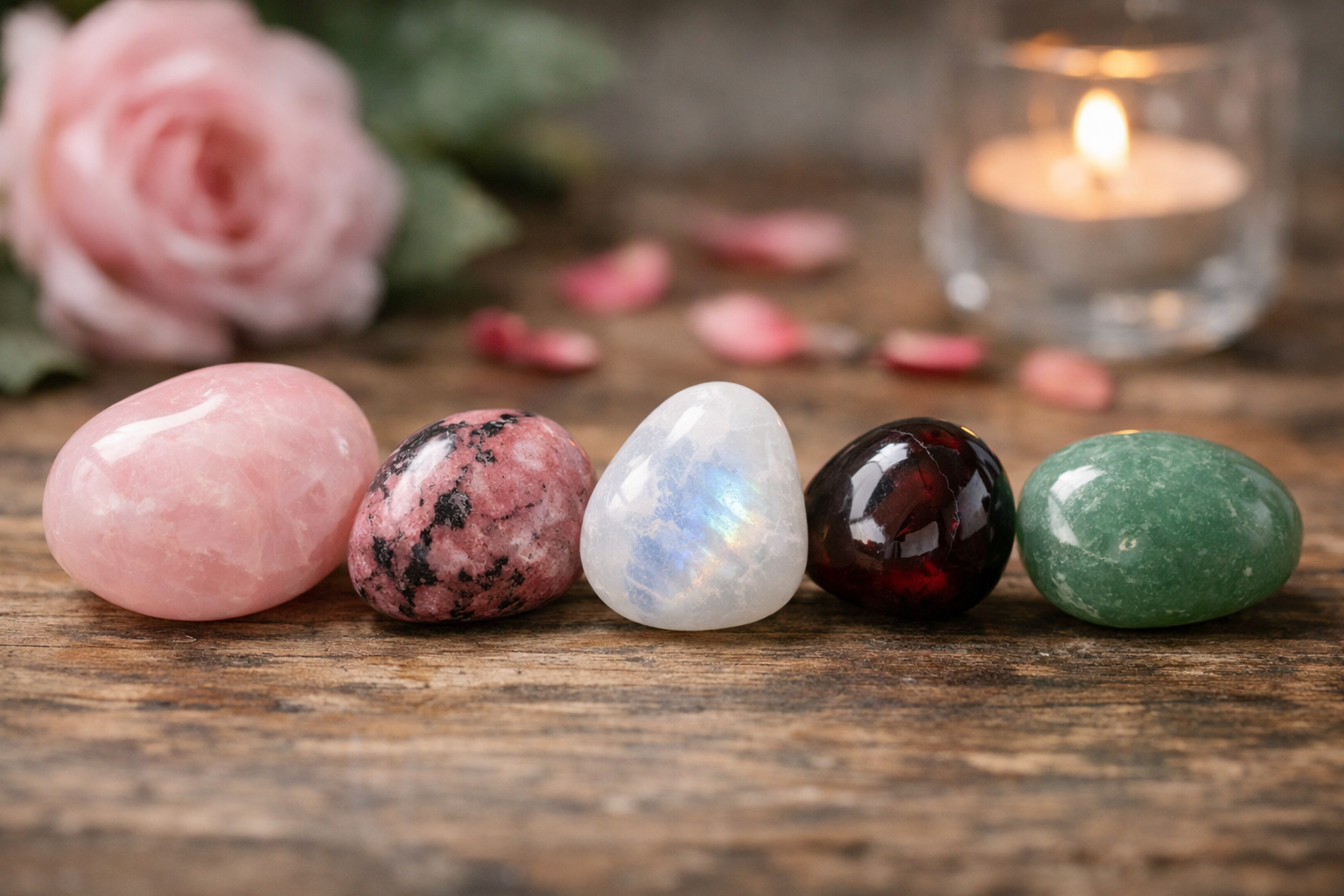
Rose Quartz is still the best short answer. Not because it is the most magical-looking stone in the bowl, but because it matches the broadest version of the question. Most people are not actually asking for a crystal that beams a soulmate through the letterbox. They are asking for help with softness, hope, openness, and that slightly bruised feeling that can make love seem farther away than it is.
That is also why Rose Quartz shows up in so many heart-centered practices. If the broader question is what different crystals mean, Rose Quartz usually lands in the lane of tenderness, affection, and emotional ease. And if the angle is more chakra-based, it often appears in guides to heart chakra crystals because that is the symbolism people are usually trying to tap into.
Still, Rose Quartz is not the whole answer.
If your real issue is grief after a breakup, start with Rhodonite. If the problem is feeling shut down or wary about dating again, Moonstone often makes more sense. If the relationship is loving but flat, Garnet is usually the cleaner move. And if the mood is “I want something fresh and hopeful without all the heat,” Green Aventurine earns its place.
Note: Crystal meanings live in tradition, symbolism, and personal ritual. They are not hard scientific facts. That does not make the practice pointless. A well-known review of placebo research describes placebo effects as genuine psychobiological phenomena shaped by context and ritual, which is a useful reality check here: the stone is not a lab-proven love magnet, but the way you use it can still shape attention, mood, and behavior.
So the clean answer is this: start with Rose Quartz if you want the broadest crystal for love. Switch the stone when the job gets specific.
The best crystals for self-love, new romance, heartbreak, and deeper commitment
The easiest way to choose is to stop asking “Which crystal attracts love?” and start asking “What kind of love issue am I trying to work on?” That question cuts through a lot of fluff.
For self-love and emotional rawness, choose Rose Quartz. This is the stone I keep coming back to when someone has been hard on themselves for a while. Rose Quartz is less about fireworks and more about emotional temperature. A 2022 scoping review on self-compassion and close relationships found links between self-compassion and a wide range of factors tied to relationship health and functioning. That does not prove a crystal causes those changes, of course. It does make the “self-love first” angle feel less like fluffy shop copy and more like a decent starting principle.
For heartbreak, resentment, or the heavy-heart phase after a split, choose Rhodonite. Rose Quartz is tender. Rhodonite feels more like triage. When the hurt is fresh or tangled, I would rather reach for a stone associated with repair than one associated with pure romance. If the pain is more grief than dating disappointment, crystals for grieving can be a better lens than generic love lists.
For new romance, emotional openness, or dating again after a closed-off season, choose Moonstone. Moonstone often shows up when people want intuition, receptivity, and softer transitions. It suits that strange stage where nothing is technically wrong, but you can tell your guard is still half-up.
For chemistry, warmth, and rekindling, choose Garnet. Some relationships do not need more softness. They need more heat, movement, and initiative. Garnet tends to fit there better than Rose Quartz does. Rose Quartz is the blanket. Garnet is the match.
For steadier commitment or a fresh start that feels hopeful rather than intense, choose Green Aventurine or Emerald. Green Aventurine is often the friendlier pick because it feels lighter and less loaded. Emerald carries a long history of association with love and loyalty, but for most beginners it is more of a symbolic reference point than the first stone to buy.
A simple if/then filter
If you feel emotionally scraped raw, pick Rose Quartz.
If you feel wounded or bitter after a breakup, pick Rhodonite.
If you want to open up to something new, pick Moonstone.
If the relationship feels low-voltage, pick Garnet.
If you want growth and a cleaner fresh start, pick Green Aventurine.
That is the real sorting hat here. Not “love crystals” as one giant category, but the emotional task sitting underneath it.
Rose Quartz vs Rhodonite vs Moonstone vs Garnet: how to choose when the lists blur together
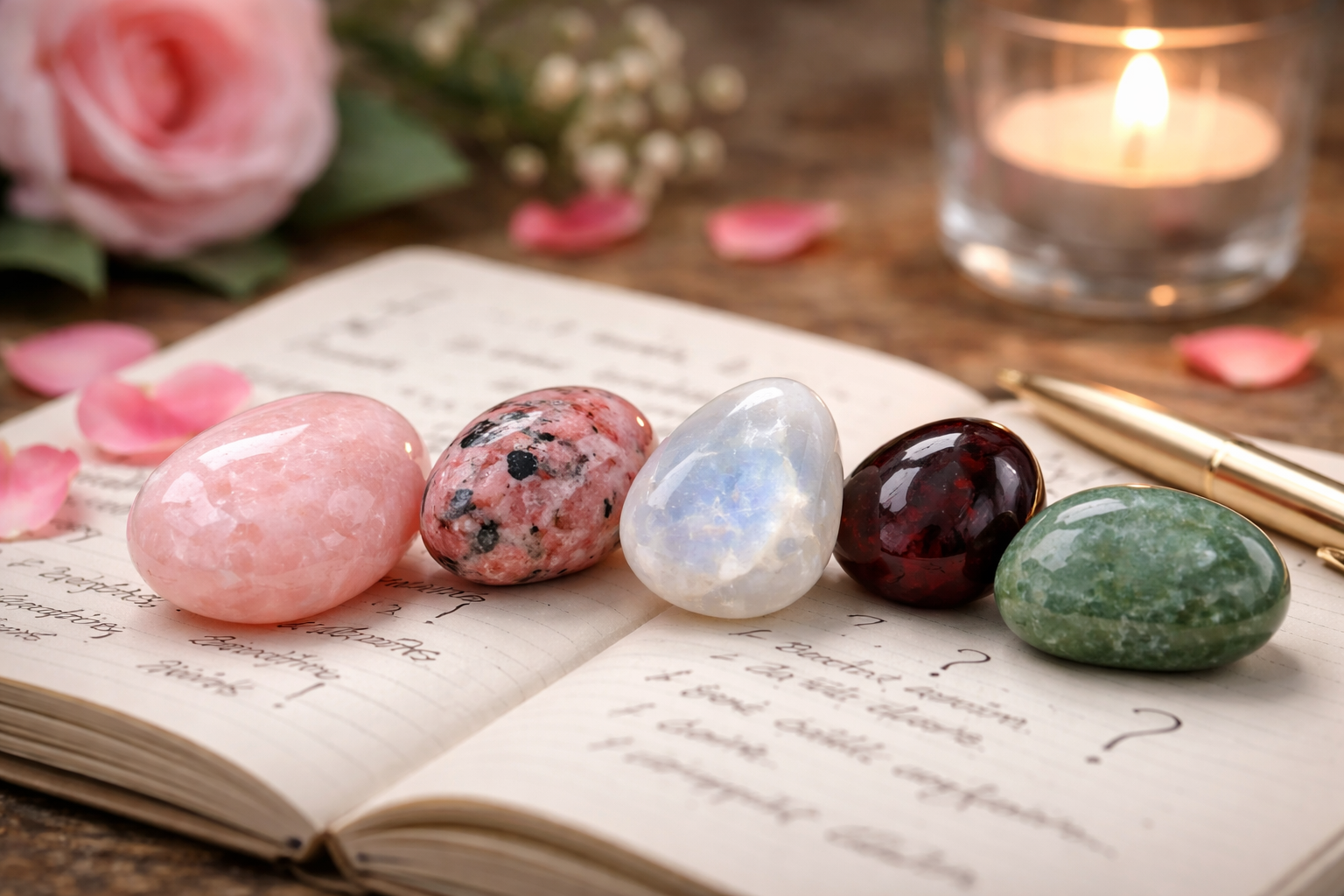
This is where people get stuck, and fair enough. Most listicles describe these stones with the same soft words until they all start sounding like cousins in matching knitwear.
| Stone | Best for | Emotional tone | Skip it first if… |
|---|---|---|---|
| Rose Quartz | Self-love, softness, general love work | Warm, gentle, reassuring | The real issue is anger, heartbreak, or flat chemistry |
| Rhodonite | Repair, forgiveness, post-breakup work | Grounded, steady, mending | You want fresh romance more than healing |
| Moonstone | Openness, intuition, new phases | Reflective, fluid, receptive | You need more warmth or more repair |
| Garnet | Passion, initiative, rekindling | Bold, energising, alive | You feel emotionally fragile and need gentleness first |
Here is the plain-English version.
Rose Quartz vs Rhodonite: Rose Quartz comforts. Rhodonite helps you work the knot out. If Rose Quartz is the blanket, Rhodonite is the bandage.
Rose Quartz vs Moonstone: Rose Quartz is better when you need kindness. Moonstone is better when you need to trust the next chapter and soften your grip a bit.
Moonstone vs Garnet: Moonstone opens. Garnet ignites. One suits a careful re-entry into love. The other suits warmth, courage, and actual movement.
Rhodonite vs Garnet: Rhodonite is for the wound. Garnet is for the spark. Mixing those jobs up is one of the easiest ways to buy the wrong stone.
When I test choices like this in practice, the question that helps most is not “Which stone is strongest?” It is “What feeling do I need more of this month?” Softer. Braver. Less bitter. More open. That question usually points to the right crystal faster than any mystical paragraph does.
How to use love crystals so they support action, not fantasy

A crystal works best when it is tied to a habit. Otherwise it turns into shelf decor with excellent branding.
Pick one stone and give it one job. If you carry Rose Quartz for self-love, let that be the whole brief. Do not also load it up with attraction, commitment, jealousy repair, sexual magnetism, and “manifesting my person by Friday.” That is too much static.
Wear it where the reminder will actually hit. A pendant or bracelet keeps the stone in your line of sight. A pocket stone works if you already touch your keys or phone when stressed. A bedside stone suits reflection and quiet check-ins. The placement matters less than the repeat contact.
Attach it to one visible behaviour. This is the bit people skip. If Rose Quartz is for self-love, pair it with kinder self-talk before dates. If Rhodonite is for heartbreak, pair it with ten minutes of honest journaling instead of doom-scrolling an old chat thread. If Moonstone is for new romance, pair it with saying yes to one low-pressure social plan instead of endlessly “waiting for the right moment.” If Garnet is for rekindling, pair it with initiating affection or a proper conversation at home.
Keep the ritual short. Five minutes is plenty. Hold the stone, say the intention out loud, then do the thing that lines up with it. That last part matters more than the candle.
Pro tip: The phrase that tends to work best is not lofty. It is specific. “I want softer energy” is vague. “I want to speak more kindly to myself this week” is a usable instruction. For a fuller beginner routine, how to use crystals for healing gives the broader method without making it feel like homework.
That is also why I do not love overlong affirmation lists here. One crystal. One sentence. One real-world action. Clean beats ceremonial every time.
Love crystal combinations that actually make sense
You can combine love crystals, but most people do better with two than with five. Once the bowl starts looking like a small museum display, the intention usually gets muddy.
Rose Quartz + Rhodonite works when you want tenderness and repair at the same time. This is the pairing I like for the “I want to heal but I am still a bit spiky about it” phase.
Rose Quartz + Moonstone fits softness plus openness. Good for dating again after a long dry spell, or for easing the nervous edge around vulnerability.
Rose Quartz + Garnet makes sense when a relationship is caring but sleepy. Rose Quartz keeps it warm. Garnet stops it from going limp.
Clear Quartz + one targeted love stone is the only amplifier pairing I think stays tidy for beginners. Clear Quartz is not a substitute for choosing well, but it can be a flexible companion when the main stone already makes sense.
A clean pairing rule
Use 2 stones when the jobs are distinct and compatible. Cap it at 3 only if the third stone is clearly supportive. More than that and the whole thing starts to feel like wish-list soup.
If you are tempted to build a bigger set, pause and ask whether the extra stones are helping the message or just making it look more impressive. Usually it is the second one.
Where love crystal advice goes wrong
Most bad advice in this space comes from one of two mistakes. It either promises too much or it stays so vague that it cannot help anyone do anything.
Mistake one: buying for aesthetics alone. A pretty pink stone is not automatically the right stone. I have seen people pick Moonstone when what they really needed was heartbreak support, and pick Garnet when what they really needed was self-worth after a bruising relationship. Colour can start the conversation. It should not finish it.
Mistake two: treating “love” like one task. Self-love, reconciliation, dating confidence, honesty, trust, and passion are not the same job. When articles blur them together, the advice gets watery.
Mistake three: expecting the crystal to do the relationship work. The American Psychological Association’s guidance on healthy relationships puts communication right near the centre. That is a useful line in the sand. A crystal can support calm, reflection, courage, or intention. It cannot replace a hard conversation, rebuild trust on its own, or make someone else behave well.
Mistake four: using the same care method for every stone. Moon-bath everything, smoke-clean everything, water-clean everything. That lazy “one method fits all” habit causes more confusion than people realise.
Mistake five: calling symbolic practice scientific proof. If a stone helps you feel more grounded, hopeful, or emotionally steady, great. That is a meaningful experience. It is still better to describe it honestly than to dress it up as verified cause and effect.
Remember: a crystal can support a mood and a habit. It cannot do boundaries for you. It cannot choose better partners for you. It cannot talk honestly on your behalf. Slightly annoying answer, maybe, but a useful one.
How to tell whether your crystal practice is actually helping your love life
This question is worth asking because “Is it working?” can turn weirdly cinematic in crystal spaces. People start looking for signs, numbers, coincidences, or sudden declarations of love from the universe. I think the better check is quieter.
Look for changes in behaviour first.
Are you speaking to yourself with less contempt? Are you showing up to dates a bit less armoured? Are you less likely to re-open an old wound just because the silence feels uncomfortable? Are you communicating more directly at home? Those shifts count.
A simple test window is two to four weeks. That is long enough to notice whether the stone is helping you repeat a better pattern. Keep it basic and track five things: self-talk, openness, boundaries, honesty, and follow-through. If none of those move at all, the crystal may be the wrong fit, the ritual may be too vague, or the real issue may sit somewhere else entirely.
There is also a good kind of “not working.” Sometimes a stone reveals that the original goal was off. You thought you wanted attraction. What you actually needed was healing. You thought you wanted passion. What you actually needed was a conversation about resentment. That is not failure. That is the practice getting more honest.
2 to 4 week check-in
- Am I calmer or kinder with myself?
- Am I acting more in line with the intention?
- Am I dodging fewer conversations?
- Am I choosing people or patterns more carefully?
- Does this stone still match the real job?
The best sign is rarely mystical fireworks. It is usually steadier behaviour. Less drama. Cleaner choices. More truth. Quiet stuff, but it counts.
How to buy and care for love crystals if you wear them daily
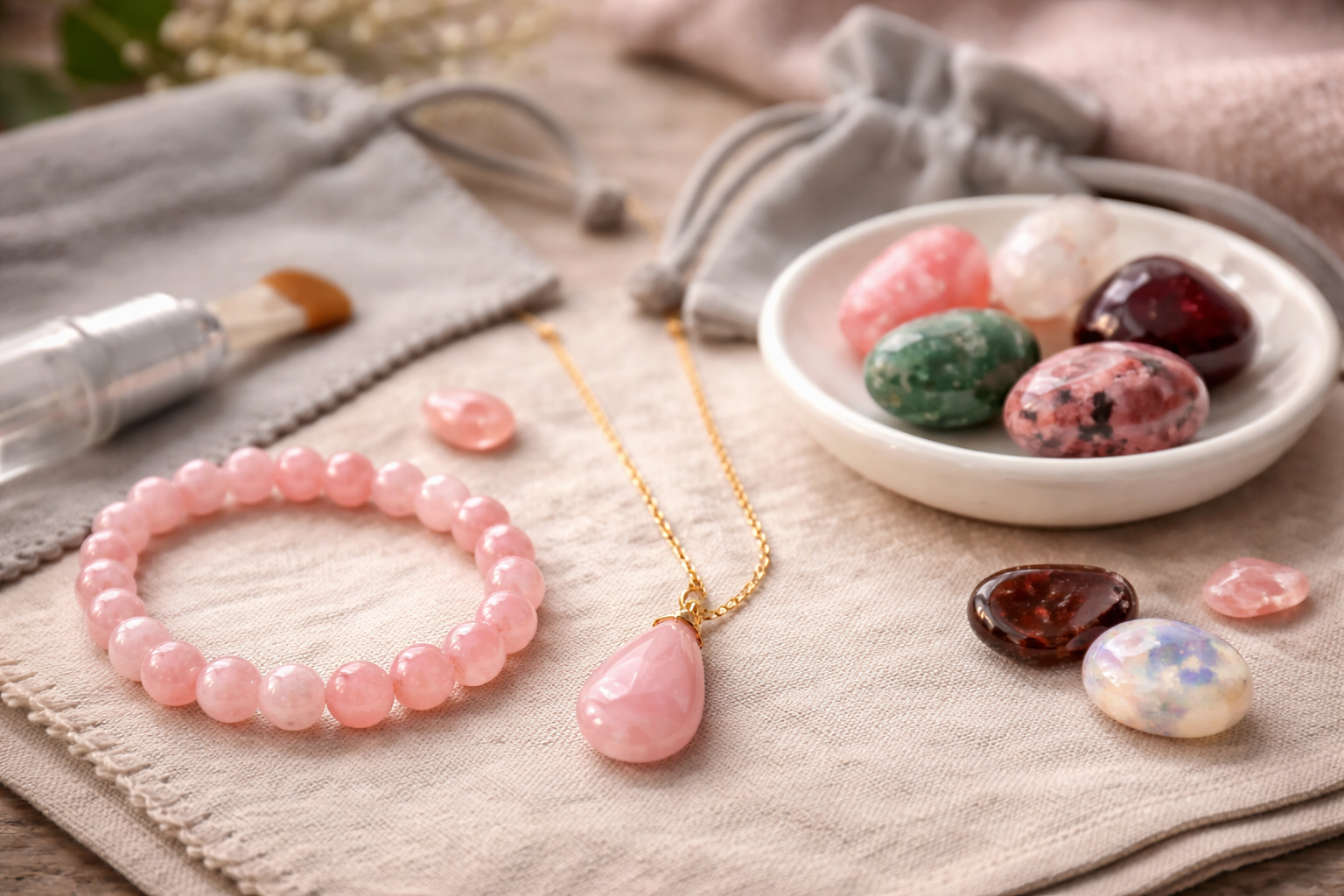
If a crystal is going to live in a pocket, on a chain, or on a bedside table for months, shape and durability matter more than people think.
Buy a form you will actually use. A small tumbled stone is the easiest beginner pick. A simple pendant works well if visual reminders help. Bracelets are fine too, though they take more knocks than people expect. Giant statement pieces look dramatic and then spend most of their life in a drawer.
Check that the stone is clearly identified. The listing should tell you what the material is and show the actual colour and variation. This matters a bit more with stones that get confused in the market, especially anything sold under dreamy names that drift away from mineral identity.
Know the wear tradeoff. Rose Quartz is quite friendly for daily use. The Gemological Institute of America notes that it ranks 7 on the Mohs hardness scale and that warm, soapy water is a safe cleaning method for rose quartz, while steam and ultrasonic cleaners are best skipped. That is pleasantly low-drama.
Moonstone is a little fussier. The Gemological Institute of America notes that moonstone is less durable than gems like sapphire, diamond, or amethyst and is vulnerable to scratching, chipping, or cleaving if knocked against a hard surface. That does not mean “never wear it.” It means a Moonstone pendant or earrings are often an easier long-term bet than a ring you wear during gym sessions, cleaning, and all the rest of normal life.
Do not overbuy. One or two well-chosen stones beat a giant “love kit” every time. Bigger collections feel exciting for about a week and then you are back to not knowing which one does what.
Be sensible about cleansing. If moonlight charging is part of the routine, not every stone belongs outside in every condition. Which crystals cannot be charged in moonlight is worth a quick look before assuming that “natural” means indestructible.
A buying rule I actually trust: pick the stone that fits the job, then choose the form that fits the habit. That order saves money and a fair bit of nonsense.
FAQ
Can Rose Quartz help an existing relationship, or is it only for new love?
Rose Quartz can help an existing relationship if the missing ingredient is softness, warmth, or emotional reassurance. It is less useful as the first pick when the real issue is resentment, poor communication, or a dead spark. In those cases Rhodonite or Garnet often fits better.
Can I sleep with a love crystal under my pillow?
Yes, many people do. Rose Quartz is usually the easiest starting stone for bedside use because it is gentle and physically easy to keep nearby. Moonstone can work too. Just keep the setup simple and avoid turning bedtime into a full ritual production.
How do I know when to switch from one love crystal to another?
Switch when the job changes. If the first phase was heartbreak and the next phase is dating again, moving from Rhodonite to Moonstone makes more sense than clinging to the old brief. A two to four week check-in is usually enough to spot that shift.