You usually find out how unhelpful crystal roundups are when you actually need one. You are tired, your chest feels scraped raw, sleep is odd, and every list says some version of “rose quartz for love, amethyst for calm” like that settles anything.
If you want the short answer, the best crystals for grieving are rose quartz for tenderness, smoky quartz for grounding, amethyst or lepidolite for quiet, rhodonite for the heavy-heart days, black onyx for boundaries, moonstone for change, and Apache tears for fresh, tear-heavy sorrow. The catch is that grief is not one feeling. A stone that helps on a sleepless night is often the wrong pick for a funeral, a breakup, or that numb, floaty afternoon when you just need to stay in your body.
I learned that the hard way after a loss a few years back. The first stone I reached for looked “right” on paper and felt completely wrong in my hand. Too bright. Too cheerful. What actually helped was a darker, steadier stone that gave me something to hold while the day kept moving.
What you’ll get from this guide
- Which grief crystals fit tenderness, grounding, sleep, or emotional containment
- How to choose one stone without buying a whole sadness starter kit
- What to use for raw loss, trigger days, pet loss, or breakup grief
- A simple ritual that does not turn comfort into homework
- Where crystal support stops and extra help should start
At a glance: pick by what hurts most right now
| If this is the feeling | Start here | Why it fits |
|---|---|---|
| Tender, shattered, self-blaming | Rose quartz | Softens the edge and feels kind, not stern |
| Scattered, ungrounded, too “up in the air” | Smoky quartz | Grounds without feeling heavy-handed |
| Racing thoughts and restless nights | Amethyst | Best when the mind will not stop circling |
| Frayed nerves and emotional overload | Lepidolite | A gentler “calm down” stone for transitions |
| Raw tears and fresh loss | Apache tears | Often chosen when grief is still very close to the surface |
| Public-facing days and stronger boundaries | Black onyx | Containment beats softness on certain days |
Fast rule: one soft stone plus one grounding stone covers most grief routines better than a big mixed set.
Best crystals for grieving: the short list and fast chooser
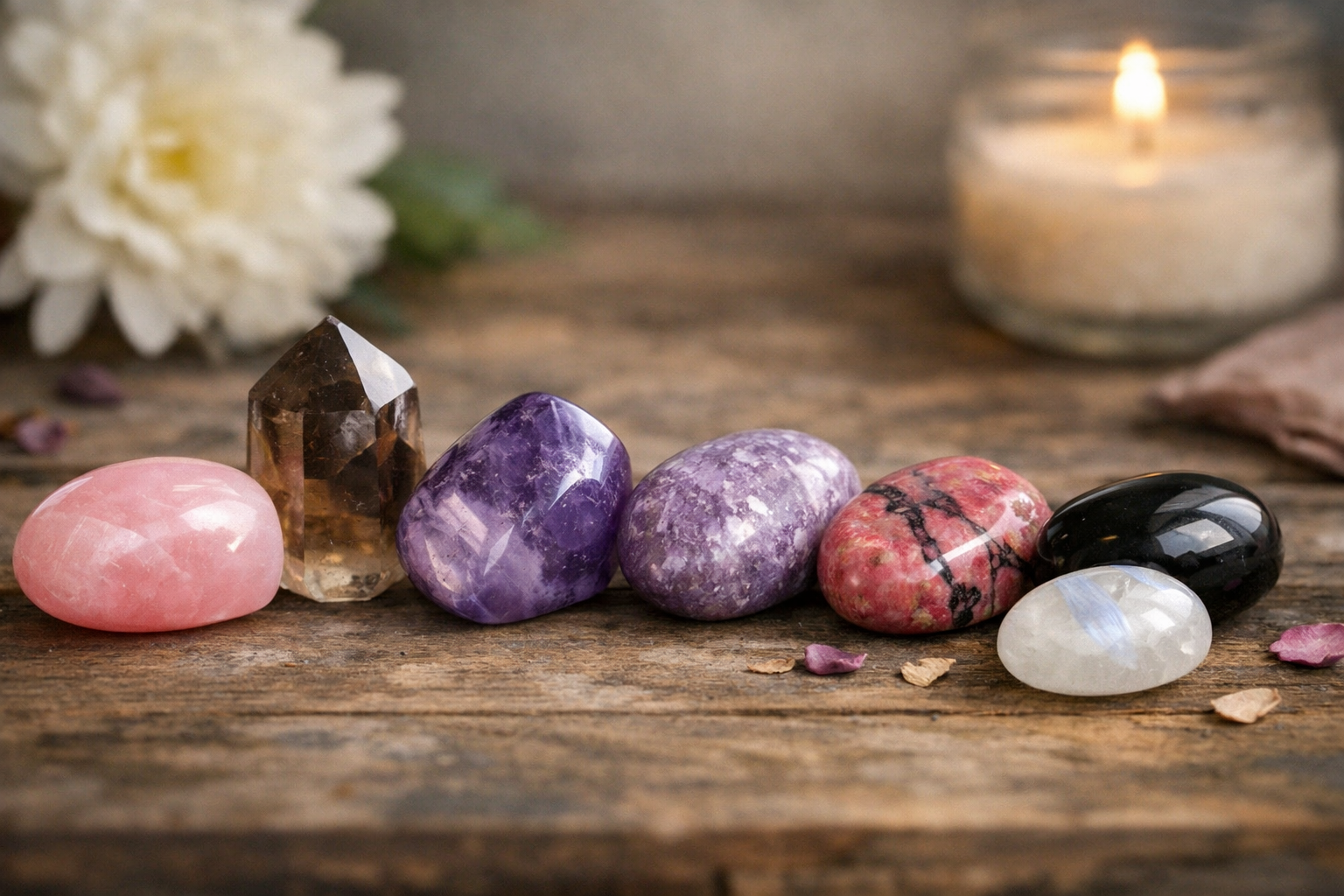
If you only want the shortlist, here it is.
- Rose quartz for tenderness, self-compassion, and that cracked-open feeling.
- Smoky quartz for grounding when your mind feels floaty or your body feels buzzy.
- Amethyst for mental quiet, especially at night.
- Lepidolite for frayed nerves and emotional overstimulation.
- Rhodonite for grief mixed with guilt, resentment, or old hurt.
- Black onyx for emotional containment and steadier boundaries.
- Moonstone for transitions, anniversaries, and the strange after-part when life has changed shape.
If you want just one, pick the stone that matches the job. Rose quartz is the best first crystal when grief feels tender and personal. Smoky quartz is the better first crystal when you need to stay upright, go to work, answer messages, and not drift off the edge of your own day. Amethyst is the smartest pick when the hardest part happens after dark.
That is why generic lists feel thin. “Best” sounds like one answer. Grief is usually three or four jobs stacked on top of each other: comfort, grounding, quiet, and sometimes protection from everybody else’s noise.
Simple rule: Start with one stone for seven days. If you still feel a clear gap, add a second stone that does a different job. Do not start with five.
Match the crystal to the feeling, not the label
Most people do not need a “grief crystal.” They need a crystal for the flavor of grief they are dealing with today.
The NHS notes that grief can happen after losing someone or something important, and that matters here. Bereavement, pet loss, a breakup, a miscarriage, losing your health, losing the version of the future you expected, all of that can hit with different emotional textures. The stone should match the texture, not the label.
| What grief feels like | Better pick | Why |
|---|---|---|
| Soft, exposed, lonely | Rose quartz | Feels warmer and kinder than darker stones |
| Scattered, foggy, disconnected from your body | Smoky quartz | Good for grounding without making the mood feel harsher |
| Mind racing, sleep broken, thoughts looping | Amethyst | A classic calm stone when the noise is mostly mental |
| Nervous system feels rubbed raw | Lepidolite | Useful when calm needs to feel soft, not sleepy |
| Heartache mixed with guilt or old wounds | Rhodonite | Often feels more “repairing” than rose quartz |
| Hard day ahead, too many people, no spare softness | Black onyx | Contains and steadies when you need your edges back |
A few quick comparisons help.
Rose quartz vs rhodonite: rose quartz is the gentler arm-around-the-shoulder stone. Rhodonite has more backbone. If grief is tangled up with regret, conflict, or self-blame, rhodonite often makes more sense.
Smoky quartz vs black onyx: both are grounding. Smoky quartz feels more breathable. Black onyx feels firmer, better for days when you need a clean emotional perimeter.
Amethyst vs lepidolite: amethyst suits mental circling and evening rituals. Lepidolite fits the jangly, rubbed-too-thin kind of overwhelm. One quiets the head. The other helps when the whole system feels fried.
Worth remembering: grief can look like tears, anger, numbness, busyness, bad sleep, or a weird flatness that does not even feel like grief at first. Choose for the symptom you can actually name.
Rose quartz, smoky quartz, amethyst, and lepidolite are the smartest first four
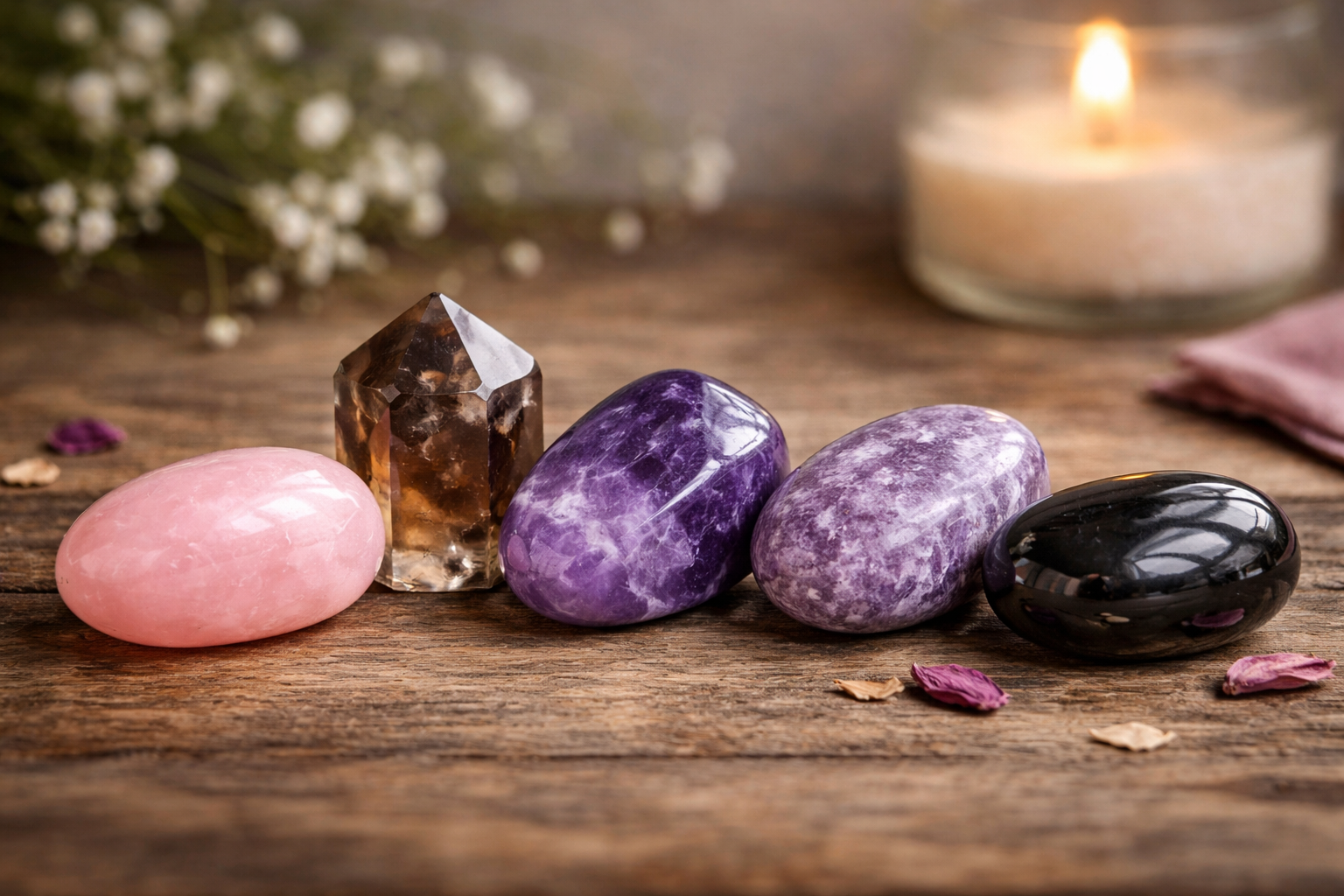
If you are new to healing crystals for grief, these four cover the most ground with the least confusion.
Rose quartz is still the safest first pick for a lot of people because grief often strips the skin off your emotional world. Rose quartz does not push. It does not feel grand or ceremonial. A polished palm stone can be enough. I like it for mornings, hard conversations, and those moments when you are trying not to get mean with yourself on top of everything else.
Skip it if what you need is more spine than softness. On days when you have to travel, sort paperwork, sit in a waiting room, or hold yourself together around other people, rose quartz can feel a little too soft-focus.
Smoky quartz is the better beginner stone than many lists give it credit for. It grounds without turning gloomy. If black tourmaline is the heavy boot, smoky quartz is the worn-in trainer. You still feel steadier, but the whole thing is easier to live with. For grief and anxiety, it is often a better daytime carry than a heart-centered stone.
Skip it if what you want is explicit comfort. Smoky quartz supports, but it does not cuddle.
Amethyst earns its spot because grief loves the night shift. When the daytime noise finally goes quiet, the mind can start replaying. Amethyst is the one I reach for when thoughts get sticky and the room feels too loud even when it is silent. A small bedside piece or palm stone is enough. Bigger is not better here.
Skip it if the problem is not mental noise but emotional buzz in the body. In that case, lepidolite or smoky quartz often lands better.
Lepidolite is the quiet fixer in this group. It is not as famous. It should be. When your nerves feel frayed and your patience is gone and every tiny task feels like it has sand in it, lepidolite has a softer, more exhale-like quality than amethyst. It is good for transitions too, which is why it shows up so often in grief and loss routines.
Skip it if you want a crystal with very clear, distinct symbolism. Lepidolite works best as a “this helps me settle” stone, not a big personality stone.
| Crystal | Best for | Best first form | Skip it if |
|---|---|---|---|
| Rose quartz | Comfort, self-kindness, heartbreak | Palm stone or jewelry | You need stronger containment |
| Smoky quartz | Grounding, functional support, steadiness | Pocket stone | You want obvious emotional softness |
| Amethyst | Restless thoughts, bedtime ritual | Bedside piece or palm stone | You need a daytime grounding stone |
| Lepidolite | Frayed nerves, transitions, emotional overload | Polished palm stone | You want a very firm boundary stone |
Little practical thing: if you forget loose stones, jewelry beats intention. A bracelet or pendant you already enjoy wearing has a much better shot at becoming part of your day.
Use different stones for raw grief, restless nights, and trigger days
This is where most grief crystal guides stop being useful. They hand you one list for every moment of loss. Real life is messier than that.
For raw, fresh grief: Apache tears and smoky quartz are strong picks. Apache tears are often chosen when sorrow sits very near the surface and crying comes fast. Smoky quartz is better when grief is fresh but life still expects you to function. If I had to build the simplest raw-grief pairing, it would be rose quartz plus smoky quartz. One softens. One steadies.
For restless nights: amethyst still leads, but lepidolite and howlite deserve a mention. Use amethyst if thoughts are looping. Use lepidolite if your whole system feels overcooked. Use howlite if the mental tone is more tense than sad. If sleep has become part of the problem, a broader piece on healing crystals for stress, sleep, love, and protection can help you sort bedtime stones with a little more precision.
For trigger days, anniversaries, birthdays, and firsts: moonstone is a smart choice. It is not the most dramatic crystal on the table, and that is part of why it works. Grief anniversaries are often less about collapse and more about living through a changed version of time. Moonstone suits that in-between feeling.
For the heavy-heart days: rhodonite is the one I would choose when grief is not only sad but complicated. Old conflicts. Words unsaid. Relief mixed with shame. The sort of grief that does not sit down in a neat chair and wait its turn. Rhodonite feels more like repair work than comfort work.
For public-facing days: black onyx or smoky quartz. When you have a meeting, a family gathering, a train journey, or any situation where you cannot dissolve on cue, boundary stones help more than comfort stones. This is where grounding crystals often become more useful than heart chakra crystals.
For breakup grief or pet loss: start with rose quartz and add one grounding stone. Breakup grief often needs self-compassion more than ritual symbolism. Pet loss can feel so physically tender that a soft, tactile stone makes a lot of sense. In both cases, one comfort stone plus one steadying stone usually covers more than a themed bundle.
Two-stone formulas that actually make sense
- Fresh loss: rose quartz + smoky quartz
- Bad nights: amethyst + lepidolite
- Trigger days: moonstone + smoky quartz
- Complicated grief: rhodonite + black onyx
Build a grief ritual that is small enough to keep
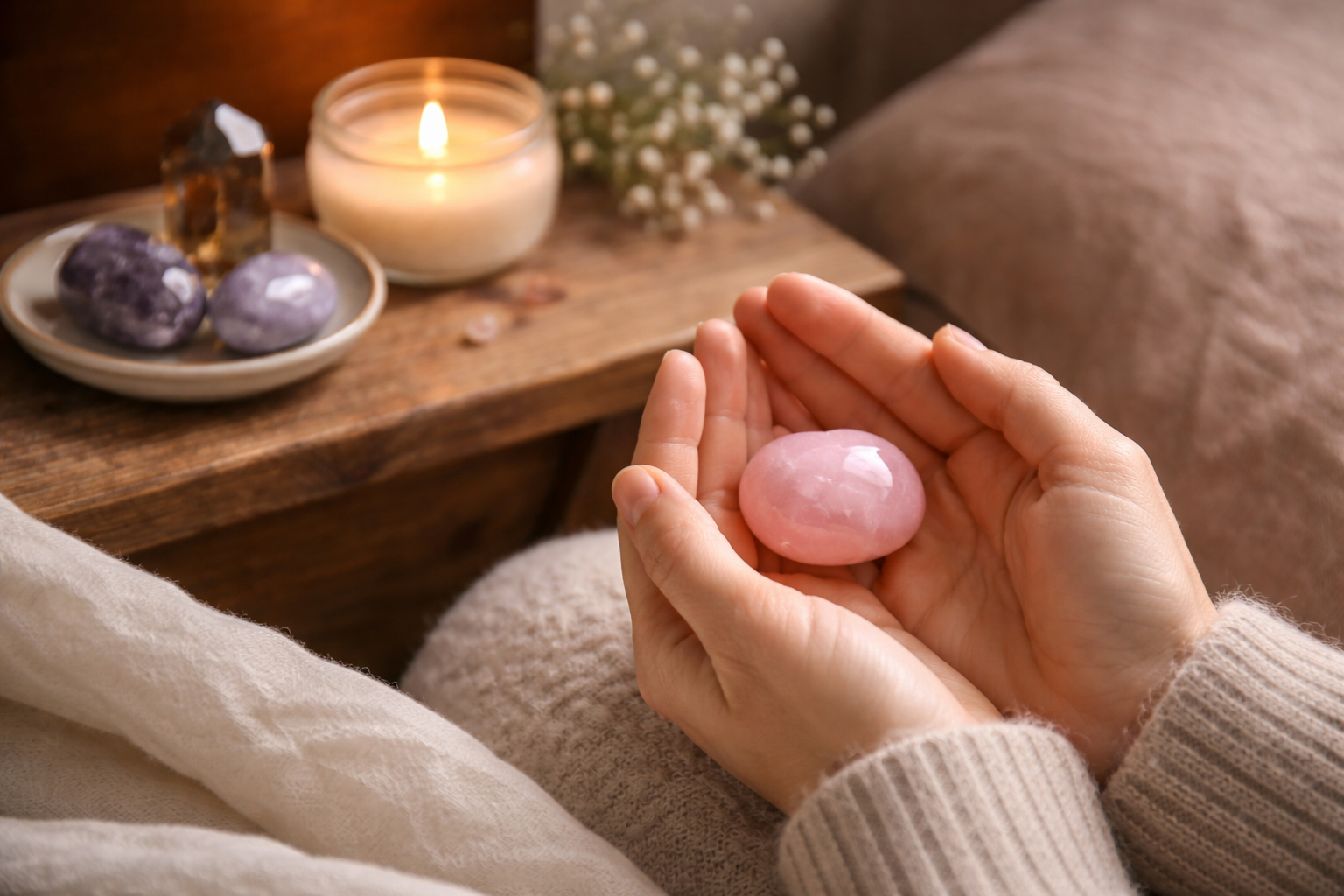
A grief ritual should help, not loom over you like another thing you failed to do.
The American Psychological Association says many people recover through time, social support, and healthy habits. That is the right frame for crystals too. They work best as anchors inside ordinary care, not as substitutes for it.
Here is a simple routine that I think works because it is almost too small to resist.
Step 1. Hold one stone and name one job.
Pick one crystal and say what it is there to do. “Help me stay grounded.” “Help me be gentle with myself.” “Help me get through tonight without spiraling.” That one line matters. A vague ritual slips away fast.
Step 2. Put it where the friction happens.
If mornings are rough, keep the stone by the kettle or toothbrush. If evenings are worse, put it on the bedside table. If work is the hard part, carry it in a pocket. People often overthink the method and ignore placement. Placement is half the ritual.
Step 3. Pair it with five slow breaths.
You do not need a long meditation. Just breathe in, feel the stone, breathe out. Five rounds is enough to make the moment different from the rest of your day.
Step 4. Repeat the same tiny pattern for a week.
Do not invent a new ritual every night. Repetition builds the meaning. Meaning is what turns a stone from decor into support.
One-minute ritual: hold the stone, place your feet on the floor, inhale for four, exhale for six, repeat five times, then say one plain sentence such as “I do not need to fix this tonight.”
That is enough. Truly.
If you want a little more structure, you can wear a bracelet on hard days, hold a palm stone during a memory ritual, or keep one stone on a memorial shelf. But the best grief ritual is the one you will still do on an ordinary Tuesday when you are tired and a bit over it.
Know what crystals can help with, and what they cannot do
There is a clean way to talk about this without stripping the meaning out of crystal practice.
A 2025 paper indexed on PubMed found that healing crystals did not show effects beyond placebo for anxiety in that randomized study. That does not make your ritual fake or silly. It does mean a grief crystal should be framed as a symbolic, tactile, calming support, not as a medically proven treatment for grief.
That distinction matters. A stone can still help because it slows you down, gives your hands something to do, marks a moment of care, and makes a feeling easier to name. Humans use objects this way all the time. Wedding rings, memorial candles, prayer beads, old photos, a shirt that still smells faintly familiar. Not everything meaningful needs a lab coat, but medical claims do.
Grief also has a wider range than people like to admit. The NHS says there is no right or wrong way to feel after a bereavement or loss, and that is worth keeping close. If a crystal helps you cry, sleep, steady yourself, or remember someone with a little less panic in your chest, that is useful. If it starts feeling like pressure, performance, or magical thinking you do not even believe in, step back.
There is another line worth drawing. The National Institute of Mental Health advises seeking professional help when severe or distressing symptoms last two weeks or more, especially if sleep, concentration, appetite, mood, or ordinary tasks are getting badly knocked around. Crystals can sit alongside support. They should not stand in for it.
A good expectation
Use crystals for ritual, grounding, comfort, and meaning. Do not use them as proof that you should be coping better than you are.
Avoid the grief-crystal mistakes that make the whole thing feel hollow
The biggest mistake is not choosing the “wrong” stone. It is asking the stone to do a job that belongs to fit, routine, or support.
Mistake one: buying by popularity.
The internet loves a familiar list. That does not mean the list fits your day. If you need grounding, a famous heart stone can feel almost useless.
Mistake two: buying too many at once.
A ten-stone set looks caring. In practice, it often becomes emotional clutter. Start with one. Add a second only if it does a clearly different job.
Mistake three: forcing an upbeat stone.
When grief is heavy, a bright “joy” crystal can feel like being handed party music at the dentist. Sometimes what helps is not uplift. It is containment, quiet, or softness.
Mistake four: choosing the wrong form.
A beautiful tower is nice on a shelf. It is not helpful in a waiting room or on a walk. For grief support crystals, palm stones, pocket stones, and simple jewelry beat altar pieces most days.
Mistake five: turning care into chores.
If your ritual has seven steps, three cleansing methods, and a moon phase tracker, you have probably built yourself a hobby, not support. Keep it plain.
Mistake six: using a stone to dodge what you know is going on.
If the real problem is panic, insomnia, isolation, or depression, name that. A crystal can still be part of the picture, and a piece on crystals for anxiety and depression can help separate those moods from grief. But the point is honesty, not spiritual wallpaper.
Best buying filter: if the seller cannot clearly tell you what the stone is, what form it comes in, and why that form helps, keep scrolling.
A thoughtful crystal gift for someone grieving should feel simple, not symbolic overload
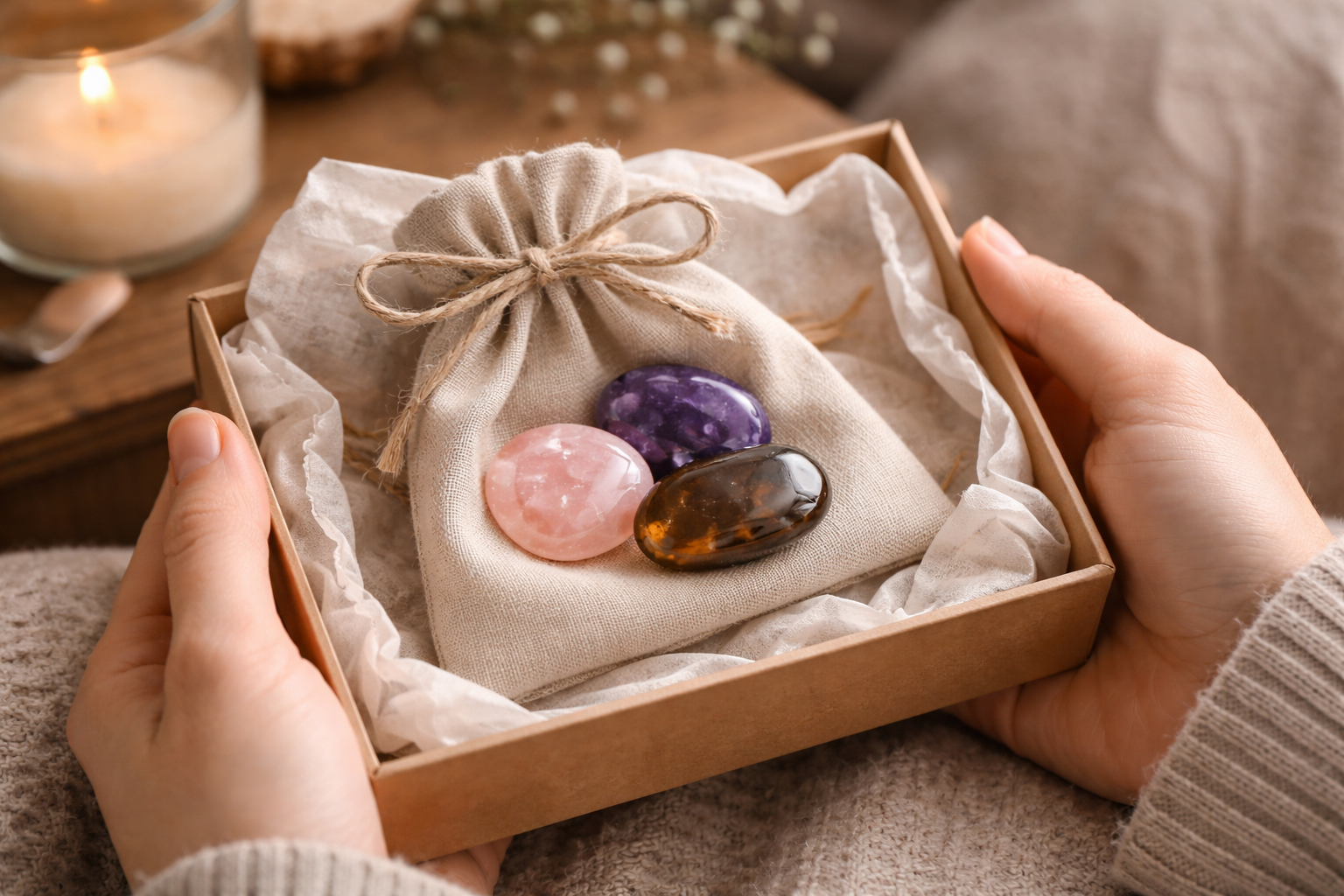
A crystal can be a lovely grief gift. It can also be oddly awkward if it comes wrapped in too much meaning, too many promises, or too much stuff.
The safest gifts are rose quartz, smoky quartz, and amethyst. Rose quartz is gentle and widely readable. Smoky quartz is good when you want the gift to say “steady” rather than “please cry.” Amethyst works well when sleep, calm, or bedtime ritual are part of the struggle.
The best forms are simple too. A palm stone. A small tumbled stone in a pouch. A bracelet only if the person already wears bracelets. I would skip elaborate carved shapes, giant hearts, and heavily worded gift sets unless you know the person’s style well.
The note matters more than the symbolism. Keep it plain. “No need to use this in any special way. I just wanted to send you something small to hold onto.” That lands better than a paragraph about chakras and cosmic healing. Soft, not salesy. Human, not mystical theatre.
If you do buy a crystal, keep one eye on sourcing. National Geographic reported in 2024 that crystal mining can fuel worker exploitation and environmental harm. You are not going to solve the whole supply chain from one checkout page, but you can still lean toward sellers who say something concrete about where their stones come from and how they buy them.
A good grief gift checklist
- One crystal, not a bundle
- Palm stone or tumbled stone first
- Short note, no spiritual lecture
- Seller gives at least some sourcing detail
FAQ
Can you use more than one crystal for grief at the same time?
Yes, but keep the jobs different. One soft stone plus one grounding stone works well. Rose quartz and smoky quartz is a solid pair. More than two or three usually adds clutter, not comfort.
Which crystal is best for pet loss?
Rose quartz is often the best first pick for pet loss because that kind of grief can feel especially tender and bodily. Add smoky quartz if daily life feels wobbly or ungrounded.
Is a bracelet better than a loose stone?
A bracelet is better if you already wear jewelry and tend to forget pocket stones. A loose palm stone is better if you want something to hold during a quiet moment. The better form is the one you will actually use without thinking too hard about it.