
You can usually spot the moment someone has read too many crystal roundups. They end up with amethyst, selenite, rose quartz, black tourmaline, maybe moonstone too, and they’re still staring at the ceiling at 1:17 a.m. The stones are not always the problem. The bigger issue is that “best crystals for sleep” only becomes a useful question once you pin down why you’re awake.
If you want the short answer, start with amethyst. It is the safest all-round pick for most people. But that stock answer gets thin fast. If your mind is looping, lepidolite or howlite usually fit better. If the night feels emotionally heavy, rose quartz makes more sense. If your room feels buzzy or you wake from bad dreams, black tourmaline or smoky quartz are stronger bets.
One clean reality check helps here. A crystal can support a bedtime ritual. It is not a treatment for insomnia. That sounds less magical, sure, but it is actually more helpful. You do not need a dramatic altar or a dozen stones on the mattress. You need one good match, the right placement, and a routine you can still do when you’re tired and grumpy.
In this guide you’ll get:
- a fast way to match a crystal to the reason sleep keeps slipping away
- the tradeoffs between amethyst, lepidolite, rose quartz, black tourmaline, moonstone, and selenite
- where to put sleep crystals so they help instead of annoy you
- a 5-minute bedtime ritual that feels doable, not ceremonial
- the mistakes that make a sleep crystal setup feel weirdly useless
Fast Match: pick the stone by the problem, not by popularity
| If this is the real issue | Start here | Best placement |
|---|---|---|
| General restlessness, light bedtime stress | Amethyst | Nightstand or under pillow |
| Racing thoughts and mental chatter | Lepidolite or howlite | Pillowcase or in hand before bed |
| Emotional heaviness, heartbreak, over-feeling | Rose quartz | Nightstand |
| Nightmares, feeling unsafe, odd room energy | Black tourmaline or smoky quartz | By the bed or under the bed |
| Dreamwork, softer nighttime mood | Moonstone | Nightstand |
| Bedroom atmosphere and calm room feel | Selenite | Nightstand or dresser |
Quick rule: one stone, one job. Start there.
Best Crystals for Sleep at a Glance
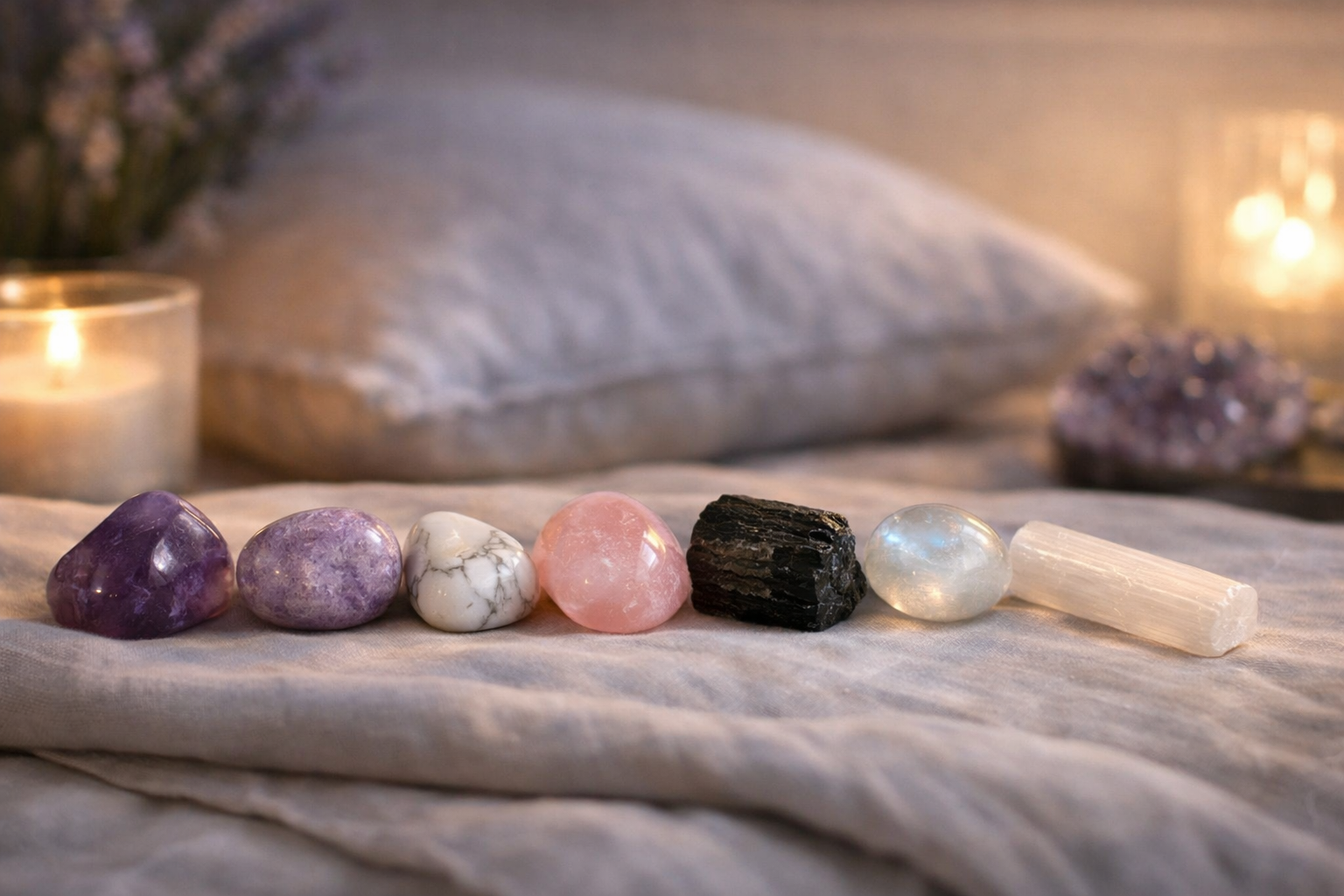
If you only want the shortlist, here it is: amethyst, lepidolite, howlite, rose quartz, black tourmaline, moonstone, and selenite. That group covers most real sleep-related reasons people reach for crystals in the first place: calming mental noise, feeling emotionally held, grounding the room, softening dream-heavy nights, and making the bedroom feel quieter.
If I were helping a friend pick just one stone tonight, I would not hand them a random “sleep crystal set.” I would start with amethyst if their issue is broad and fuzzy, or lepidolite if they are saying, “My body is tired but my brain will not shut up.” That tiny bit of sorting makes the whole thing more useful.
Note: The most famous sleep crystal is not always the best sleep crystal. Amethyst is the safest starter. It is not the sharpest fit for every kind of bad night.
One subtle point gets missed a lot. Some stones are calming. Some are grounding. Some feel more like emotional comfort. Some lean into dreams. If you mix those categories without thinking, the setup can feel muddy. You might not feel “more spiritual.” You might just feel distracted.
Choose by What Is Actually Keeping You Awake
Sleep trouble has a sneaky habit of wearing one label when it is really something else. A lot of people say “I need a crystal for insomnia” when what they mean is one of four things: my thoughts are racing, my chest feels heavy, my room feels off, or I keep waking from vivid dreams.
That is where the matching gets easier.
- If your mind is noisy: go with lepidolite or howlite. These are the better picks for overthinking, replaying conversations, doomscroll residue, and that weird 2 a.m. urge to solve your whole life.
- If the night feels emotional: choose rose quartz. This is the stone I like for heartbreak, family stress, or the kind of tiredness that feels more like sadness than stimulation. There is a close overlap here with the emotional patterns covered in best crystals for anxiety and depression.
- If you feel ungrounded or unsafe: pick black tourmaline or smoky quartz. These are better when the room feels jangly, when nightmares keep showing up, or when your nervous system feels like it never fully clocks out.
- If you want a softer all-rounder: start with amethyst. It is the easiest broad-use stone in this whole category.
- If dreams are part of why you are here: try moonstone. It is lovely for dreamwork and nighttime intuition, but it is not my first pick for someone who just wants to fall asleep fast.
I have had nights when an under-pillow amethyst felt great, and others when it felt like one more thing in the bed I wanted to chuck across the room. On those nights, moving the stone to the nightstand worked better. That sounds small. It is not small. The way a crystal shows up in your space matters almost as much as the stone itself.
The Best Crystals for Sleep, Sorted by Need
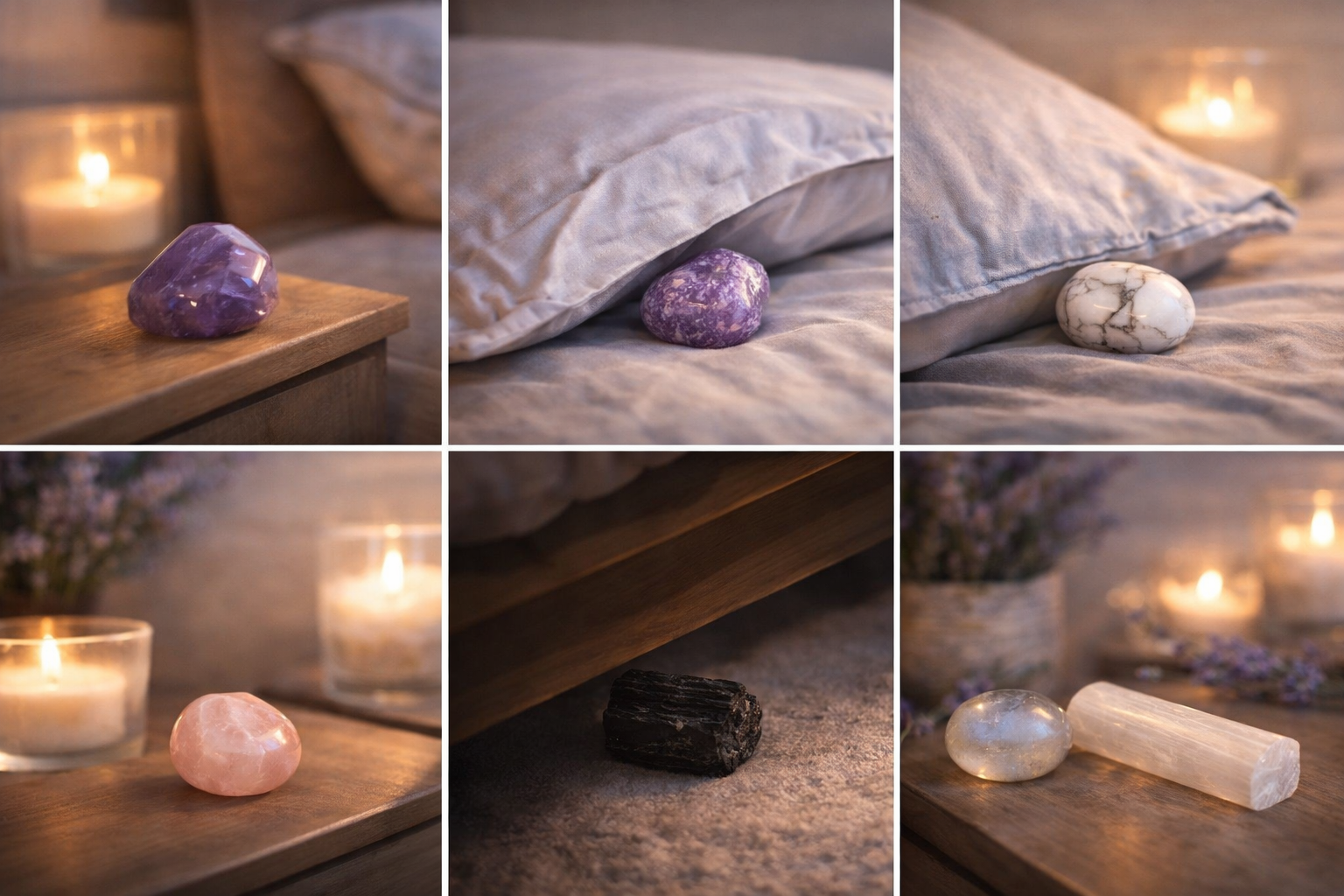
| Crystal | Best for | Where to place it | Skip it if |
|---|---|---|---|
| Amethyst | General calm and a softer bedtime mood | Nightstand or under pillow | You need strong grounding more than gentle calm |
| Lepidolite | Racing thoughts and bedtime spirals | Pillowcase or hand-held before sleep | You are choosing it only because people mention lithium |
| Howlite | Mental chatter with a clean, simple feel | Under pillow or on nightstand | You want emotional warmth rather than quiet |
| Rose quartz | Emotional restlessness and heartbreak nights | Nightstand | Your main issue is nightmares or feeling ungrounded |
| Black tourmaline | Grounding, protection, bad dreams | By the bed or under the bed | You want a soft, heart-centered feel |
| Moonstone | Dreamwork and a softer nighttime tone | Nightstand | You want the most direct route to simple calm |
| Selenite | A quieter bedroom atmosphere | Nightstand or dresser | You want something to sleep directly on |
Amethyst: This is still the best first pick for most people because it covers the broad middle ground. It feels calming without being flat. It works for people who are a bit stressed, a bit activated, and not fully sure what the deeper issue is. If your nights are all over the place, amethyst is the easiest stone to live with.
Lepidolite: Lepidolite shines when your brain feels like a browser with 27 tabs open. A lot of crystal content leans hard on the fact that lepidolite contains lithium. I would not use that as the reason to choose it. You are not absorbing medicine from a stone under a pillow. What matters here is the way many people experience lepidolite in practice: as a mental downshift stone, especially for thought loops and bedtime over-analysis.
Howlite: Howlite is the cleaner, plainer cousin in this category. Less emotional softness. More “please let the noise in my head shut up for five minutes.” If rose quartz feels too gentle and black tourmaline feels too stern, howlite often lands in a sweet spot.
Rose quartz: This is not just a love stone. It is one of the better crystals for sleep when the real problem is emotional agitation. Grief, heartbreak, family tension, that tender bruised feeling after a hard conversation, rose quartz is good there. If that is the thread you are pulling, best crystals for love is a useful companion read because the emotional logic overlaps more than people think.
Black tourmaline: When someone says their bedroom feels “off,” this is where I start. It is not romantic. It is not floaty. It is solid. If you want the direct version of grounding and protection in the sleep space, protective crystals for home, sleep, and boundaries digs into that lane more deeply. For people who find black tourmaline a bit heavy, smoky quartz is a softer cousin and a strong option from the group covered in grounding crystals for calm, protection, and focus.
Moonstone: Moonstone is lovely. It also gets oversold as a universal sleep crystal. I like it best for readers who care about dream recall, moon rituals, or a softer mystical feel at the bedside. If your main goal is to stop the 1 a.m. brain sprint, I would not make moonstone your first buy.
Selenite: I think of selenite as a room stone more than a bed stone. It can help the bedroom feel cleaner and quieter in an energetic sense, but many pieces are long, brittle, or just awkward for direct under-pillow use. Put it on the nightstand, dresser, or windowsill. Let it shape the space, not your neck.
Pro tip: If you are torn between two stones, choose the one that solves the sharper problem. “General calm” sounds nice, but “I wake from bad dreams” is the kind of clue that should steer the pick.
Where to Put Sleep Crystals So They Help Instead of Distract
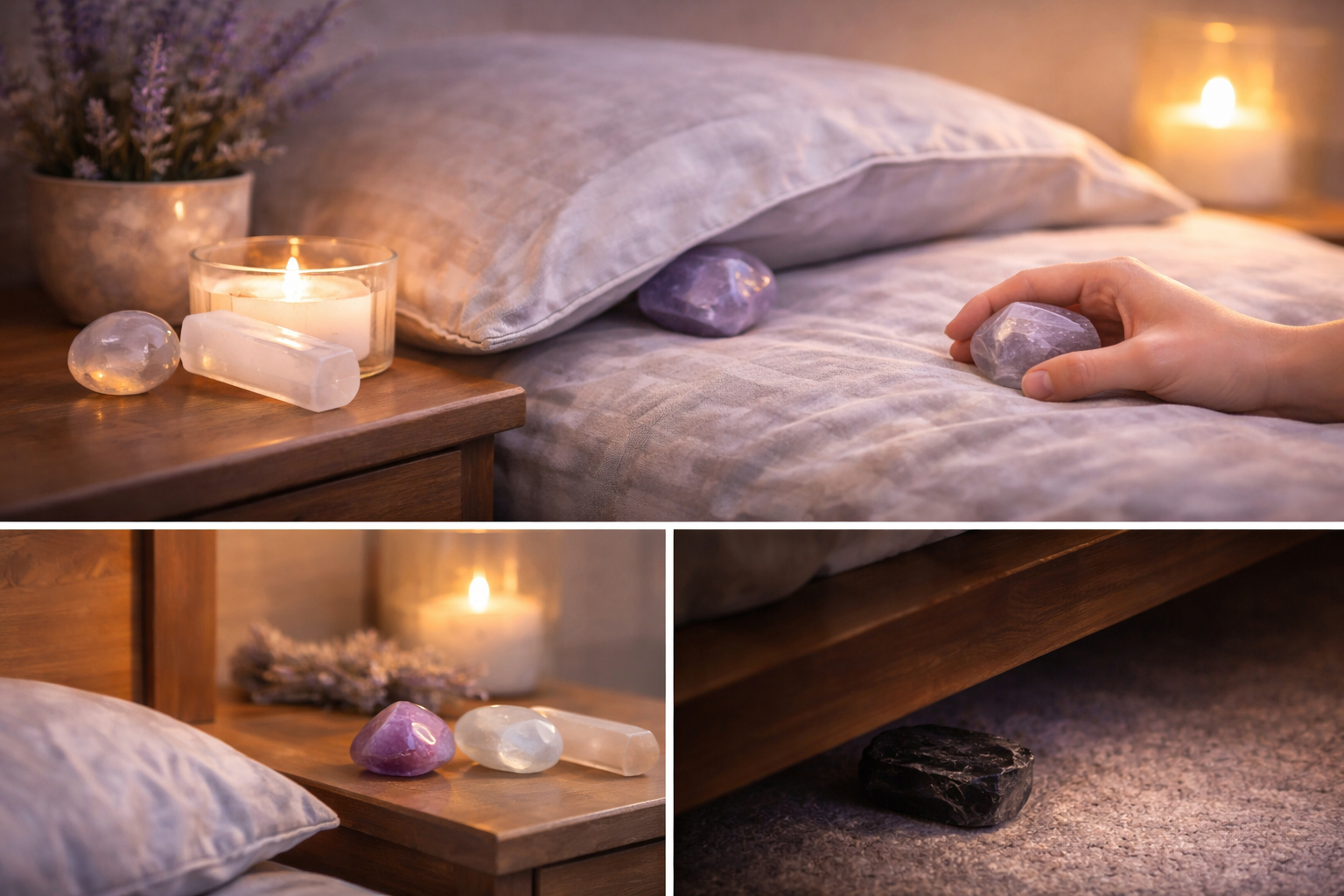
Placement is where a lot of otherwise good crystal advice falls apart. People hear “sleep with it under your pillow” and treat that like a rule. It is not a rule. It is one option.
Under the pillow or inside the pillowcase works best for small, smooth tumbled stones. Think amethyst, howlite, or lepidolite. Nothing jagged. Nothing heavy. If you are a light sleeper, even a good stone can become an annoying lump by 3 a.m.
On the nightstand is better for plenty of people, me included on fussy nights. This is the safest placement for rose quartz, moonstone, and selenite. It keeps the stone close without adding one more physical thing to deal with in bed.
By the bed frame or under the bed is the sweet spot for black tourmaline and smoky quartz. These are the stones I like a little farther from the body and more connected to the room itself.
In your hand for two minutes before lights out is underrated. If you hate objects in the bed, hold the stone while breathing slowly, then place it on the nightstand. Same ritual cue. Less fuss.
Remember
Closer is not always better. A crystal that feels calming on the nightstand can feel distracting under your cheekbone. Move the stone before you give up on the stone.
Build a 5-Minute Bedtime Crystal Ritual That Supports Sleep
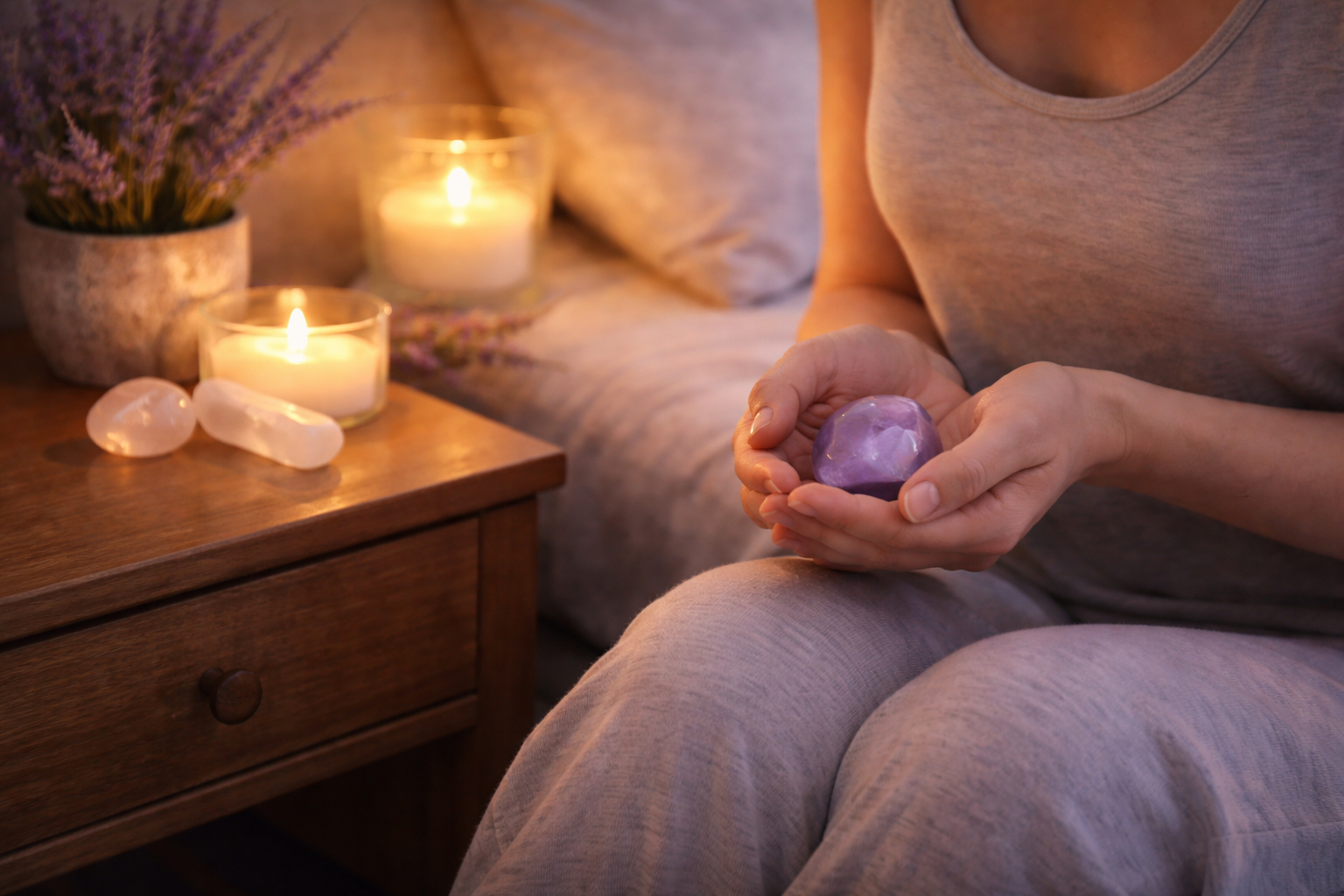
A crystal works better as a cue than as a miracle. That is why a tiny routine matters. According to the Sleep Foundation’s guide to bedtime routines, a nightly wind-down is a set of activities done in the same order in the 30 to 60 minutes before bed. That is the lane where crystals fit best.
- Pick one stone and one job. Do not start with a handful. Choose one crystal and give it a simple purpose: quiet my thoughts, soften my mood, ground the room, or calm bad-dream energy.
- Dim the noise. Put the phone down, lower the light, and let the room signal that the day is over. If the room stays loud and bright, the crystal has to fight upstream.
- Take six slow breaths while holding the stone. Count a longer exhale than inhale if that feels good. Nothing fancy here.
- Say one plain sentence. Something like “Quiet mind, soft body” or “Let this room feel calm tonight.” Short is better. You are cueing the nervous system, not writing poetry.
- Place the stone and leave it alone. Under the pillow, on the nightstand, or near the bed frame. Then stop fiddling with it.
- Track it for seven nights. Write one line in a note app or journal: what stone, where it sat, how the night felt. That helps you spot whether the crystal, the placement, or the routine changed something.
The National Center for Complementary and Integrative Health says that relaxation techniques are sometimes included in cognitive behavioral therapy for insomnia, but on their own they have only a small amount of low-quality evidence for helping insomnia. That is a useful frame. The routine can still help. It just helps most as part of a larger wind-down habit, not as a stand-alone cure.
That seven-night test is worth more than it sounds. A lot of people change the stone, the placement, the incense, the pillow spray, the bedtime tea, and the playlist all at once. Then they have no clue what actually helped. A little patience saves a lot of woo-woo confusion.
Which Crystals Can Feel Too Stimulating in the Bedroom
Not every beautiful crystal belongs near the bed. Some stones just lean more morning than midnight.
Citrine, carnelian, and tiger’s eye are the usual suspects. People love them for confidence, motivation, warmth, and daytime lift. Great stones. Just not my first picks for a sleep space.
Clear quartz is trickier. It is not “bad” for the bedroom, but it can feel amplifying. If you already have a noisy mind, that extra sense of charge is not always what you want at bedtime. Some people do fine with it. Some do not. That is why I would test clear quartz on the dresser before I ever stick it under a pillow.
If a crystal feels too stimulating, do not banish it like it offended the moon. Move it. Put it on a desk, vanity, or entry table for two or three nights and see if the room feels better. Small changes beat dramatic rules here.
Quick filter: If a stone makes you think “focus, confidence, energy, drive,” it probably belongs farther from the bed.
What Sleep Crystals Can Help With, and What They Cannot Do
Here is the honest version. A crystal can help mark the shift from day to night. It can make a routine feel grounded and repeatable. It can give your hands and your attention something simple to settle into. What it cannot do is step in as a proven medical treatment for insomnia.
A 2025 randomized controlled trial indexed on PubMed followed 138 adults who used either rose quartz or a visually matched placebo over 14 days. Anxiety improved only among believers, and it improved regardless of whether they had the real crystal or the placebo. That is a pretty clean reminder that expectation and ritual can matter a lot, but the study did not find crystal-specific effects beyond placebo.
That does not make your bedtime ritual pointless. It just tells you what bucket to place it in. Think of crystals as ritual supports, not sleep medicine.
When sleep trouble starts stretching out, the frame needs to change. The American Academy of Sleep Medicine says cognitive behavioral therapy for insomnia is first-line treatment for chronic insomnia in adults. And the NHS notes that insomnia lasting 3 months or longer counts as long-term insomnia. The same NHS advice says to speak with a GP if sleep trouble has gone on for months or is affecting daily life.
So where do crystals fit? Right beside better sleep habits. If your room is too hot, your phone is still bright at midnight, your pillow is awful, or you are running on caffeine and stress, a crystal will not bulldoze over that. It can still be part of the picture. Just not the whole picture.
Common Mistakes That Make Sleep Crystal Setups Less Helpful
Buying five stones before testing one. This is the biggest one. You end up with a jumble of energy language and no idea which stone is doing what. Start with one.
Choosing by vibe instead of by problem. A gorgeous moonstone tower is not the right answer just because it looks dreamy on the bedside table. If your issue is nightmares or feeling ungrounded, black tourmaline or smoky quartz is the cleaner call.
Using the wrong placement. Plenty of “this crystal did nothing” stories are really “this crystal did not belong under my pillow.” Move it to the nightstand before you write it off.
Picking a stone that is physically annoying. Sharp edges, heavy palm stones, brittle pieces, long satin spar sticks, no thanks. Sleep crystals should not feel like hidden Lego.
Ignoring ordinary sleep habits. The same NHS insomnia advice that points people toward medical help also covers plain old basics like relaxing at least an hour before bed and keeping the bedroom dark and quiet. Sleep hygiene is not glamorous. It matters anyway.
A simple rule that actually works
One stone, one job, one week. That is enough to tell whether a crystal belongs in the bedtime routine or back in the bowl.
FAQ
Can you use more than one sleep crystal at once?
Yes, but it is smarter to start with one. Once you know how amethyst, lepidolite, or black tourmaline feels on its own, then you can pair two stones without turning the setup into guesswork.
Do sleep crystals need cleansing or charging?
If cleansing is part of the practice, keep it simple. A quick intention reset, moonlight, or a place away from clutter is enough for most people. Do not turn maintenance into another bedtime chore.
What if a crystal makes sleep feel worse?
Change the placement first. Move it from under the pillow to the nightstand, or out of the bedroom for two nights. If the room feels better, the issue was probably fit or placement, not that the crystal was “bad.”