
I’ve done the lazy windowsill thing myself: set a favorite stone out on a full-moon night, gone to bed feeling rather pleased, then remembered at breakfast that “overnight” also includes dew, cold glass, and the first slice of morning sun.
So, which crystals cannot be charged in moonlight? The short answer is this: skip open-air moon charging for stones that dislike water, humidity, bright light, or rough handling. That puts selenite and other gypsum forms, halite, chalcanthite, many opals, turquoise, and other porous or fragile stones in the high-risk pile. A few internet-list regulars like amethyst and rose quartz need a calmer answer. They are not in the same danger bracket as stones that are soluble, moisture-sensitive, or easy to mark.
That split matters. Moonlight is reflected sunlight, and a peer-reviewed lighting review notes that moonlight sits around 0.2 lux while sunlight can hit 100,000 lux. In plain English, moonlight itself is gentle. The real trouble is usually the setup around it: damp air, a forgotten dawn, heat swings, or a stone that was delicate from the start.
- Which stones are the clearest “no” for outdoor overnight charging
- Why blacklists get muddled and why some are shakier than they look
- A quick four-part screen for stones you cannot identify with confidence
- Better charging options for porous, treated, or light-sensitive crystals
- What to do if a crystal already sat out too long
At a glance
| Risk level | Common examples | What to do instead |
|---|---|---|
| High-risk | Selenite, gypsum, halite, chalcanthite, many opals | Use a dry indoor method such as sound, smoke, or intention work |
| Caution | Turquoise, malachite, fluorite, treated stones, jewelry with glue or plating | Prefer a windowsill or skip exposure and go dry |
| Lower-risk | Clear quartz, moonstone, labradorite | Short indoor moonlight session, then remove before sunrise |
Quick rule: If the stone hates water, hates bright light, or chips easily, don’t give it the open sky.
Which Crystals Cannot Be Charged in Moonlight? The Fast Answer
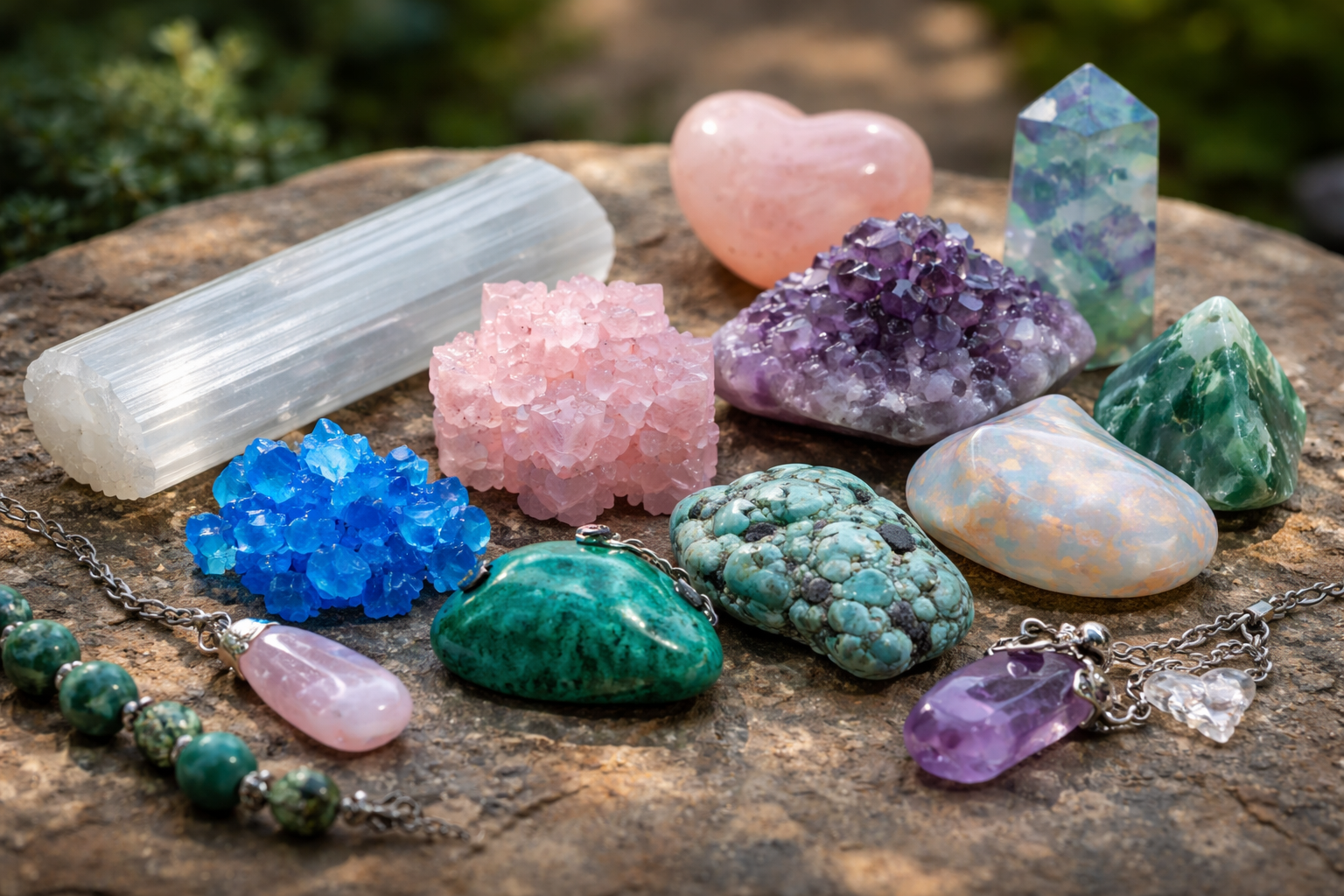
If what you want is the no-nonsense list, here it is.
High-confidence skips for open-air moon charging: selenite and other gypsum forms, halite, chalcanthite, many opals, and stones that are notably porous or easy to stain such as turquoise. These are the pieces I would not leave outside overnight. Not for a full moon. Not for a “just once” ritual. Not for a pretty photo on the patio.
Case-by-case caution: malachite, fluorite, amethyst, rose quartz, and any treated, dyed, glued, or plated crystal jewelry. Those do not all fail for the same reason. Some dislike moisture. Some can fade under prolonged natural light. Some are fine in a dry windowsill setup but poor candidates for a damp garden wall at 2 a.m.
Use this split, not a flat blacklist: high-risk stones should skip outdoor moon charging. caution stones can need a gentler setup or a different method. That is a much better guide than “never moon-charge these seven crystals.”
The other thing worth saying out loud: a crystal does not need moonlight to be spiritually useful. People often lump “cleanse” and “charge” together as if they are one fixed ritual. They aren’t. If a stone is delicate, the smart move is to keep the ritual and swap the exposure.
Moonlight Is Not the Whole Story
A lot of confusion starts with one sloppy shortcut. People say “moonlight can damage crystals” when what they often mean is “leaving crystals outside overnight can cause problems.”
Those are not the same sentence.
NASA’s moon page explains that moonlight is reflected sunlight. A lighting review in Philosophical Transactions of the Royal Society B puts moonlight at about 0.2 lux, compared with sunlight that may reach 100,000 lux. So on a plain material-care level, moonlight is nothing like direct afternoon sun. It is more nightlight than blowtorch.
What actually causes trouble?
- Dew and humidity. Soft or porous stones can take on moisture or react badly to damp air.
- Morning sun. The moon is not the only light in the story. Dawn is where plenty of avoidable damage starts.
- Temperature swings. Outdoors means the stone is not sitting in one stable little pocket of air.
- Exposure creep. A “few peaceful hours” turns into eight or nine when you forget the crystal is still out there.
This is also where spiritual language and mineral care part company a bit. You can believe a stone is not the best energetic match for lunar work and still admit that moonlight itself is physically gentle. Those are two different questions. Most pages blur them, and that is why their lists wobble.
Small but useful distinction: an indoor windowsill setup is usually a care question. “Is this crystal aligned with moon energy?” is a ritual question. Don’t force one answer to do both jobs.
Use This Four-Part Check Before Any Crystal Sees the Windowsill
When you cannot tell whether a stone belongs on a moonlight-safe list, this quick screen is a lifesaver. I use some version of it whenever I see a crystal at a market with a handwritten label and a very confident seller.
Step 1. Check for moisture risk and avoid the obvious trap
Ask whether the stone hates water, humidity, or low-level damp. If the answer is yes, skip outdoor overnight exposure. That covers selenite, gypsum, halite, chalcanthite, and several softer or porous stones.
Step 2. Check for porosity and reduce staining risk
Porous stones can absorb oils, moisture, and residue. That makes them fussy around dew, skin oils, perfume, and even the surface you leave them on. Turquoise is a classic example. A stone can look sturdy and still be absorbent.
Step 3. Check for light sensitivity and keep colour from drifting
If a crystal is known to fade in natural light, treat outdoor exposure with more care. That does not mean a faint moonbeam will erase it overnight. It means the safe habit is to avoid any setup that could bleed into direct sun.
Step 4. Check for softness, brittleness, or mixed materials and prevent hidden damage
Hardness helps, but it is not the whole story. Softness, brittleness, coatings, glue, plating, and metal settings all change the risk. A tumbled stone and a delicate pendant do not live by the same rules. Jewelry is its own category and it usually deserves more caution.
If any answer comes back “yes,” switch to a dry method or keep the ritual strictly indoors and short. That one little if/then rule saves a lot of guesswork.
The four-part screen in one line
Moisture-sensitive? Porous? Light-sensitive? Brittle or treated? If you tick one box, don’t leave it out in the open overnight.
Stones That Are Higher Risk Outdoors Overnight
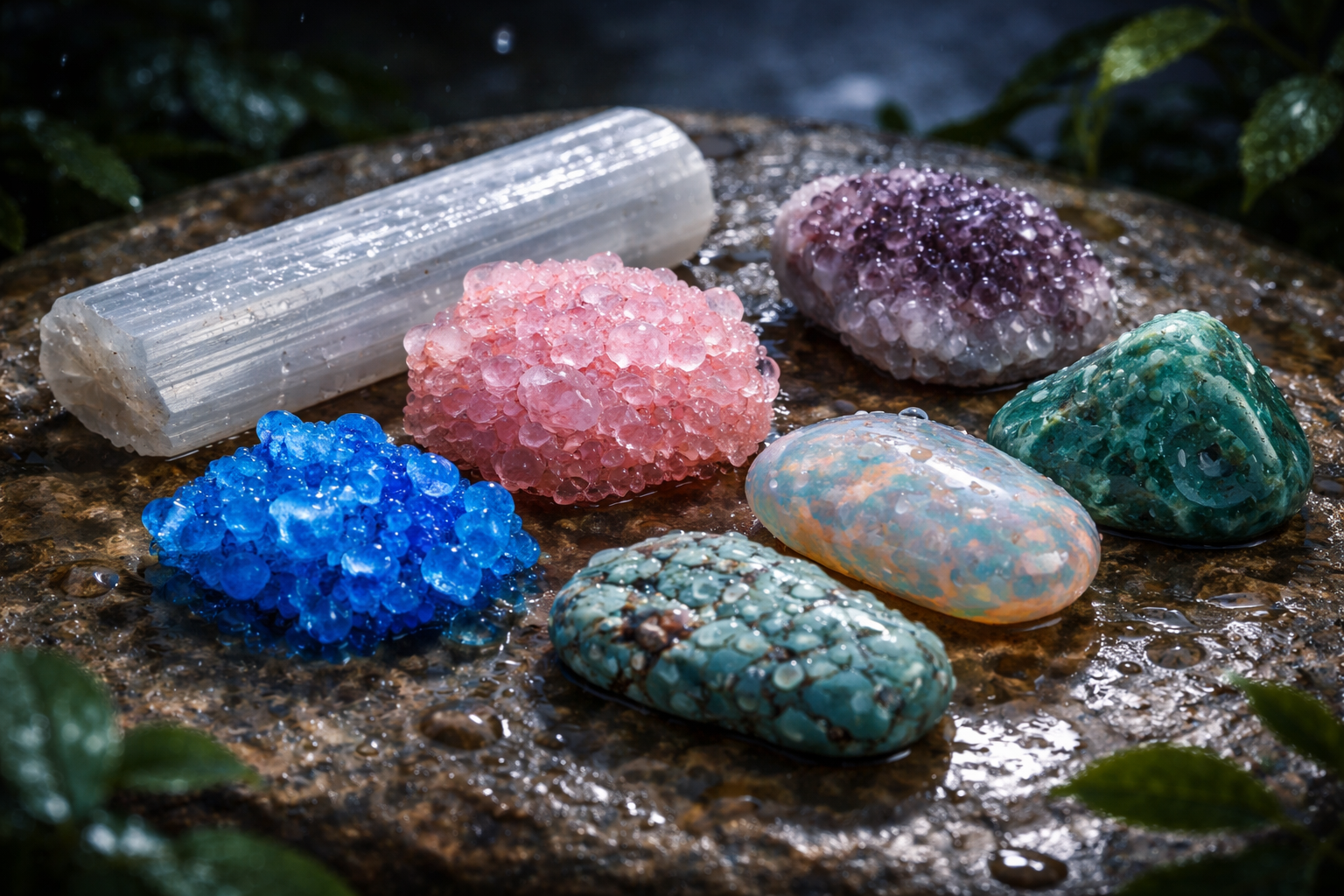
Grouping stones by why they are risky is far more useful than memorising a random list.
Moisture-sensitive or soluble stones
The U.S. Geological Survey describes gypsum as a highly soluble rock, which is the cleanest material-care reason to keep selenite and other gypsum forms away from damp overnight setups. Halite is another obvious skip. Chalcanthite is also no fit for this kind of ritual. These are not “maybe” stones. They are the crystal equivalent of suede shoes in a rainstorm.
Porous or easy-to-mark stones
GIA’s durability guide notes that opals can lose moisture and crack or craze, while porous gems such as turquoise can discolor or degrade. The same guide also notes that long exposure to water can damage some gems such as malachite. That does not turn every moon ritual into a disaster. It does mean outdoor exposure is a poor trade for these stones. You are taking on risk for very little upside.
Light-sensitive stones
Amethyst lands on many “do not charge” lists for one fair reason and one lazy reason. The fair reason is that GIA notes prolonged exposure to heat and light can fade amethyst. The lazy reason is pretending moonlight behaves like full sun. It doesn’t. So the practical verdict is this: amethyst is not a great stone to forget outside till mid-morning, but it is not in the same class as gypsum or halite.
Rose quartz needs the same kind of nuance. GIA notes that some pink quartz material fades in natural light. That does not mean every chunky rose quartz heart on a bedroom sill is doomed. It means outdoor exposure plus strong daylight is not worth the gamble, especially if you do not know exactly what kind of material you have.
Treated stones and fragile crystal jewelry
This group gets ignored a lot and it shouldn’t. Dyed, coated, stabilised, glued, or plated pieces are trickier than raw or plain tumbled stones. So is jewelry. I’ve seen people treat a pendant like a tumble and then wonder why the setting loosened or the finish looked odd. The crystal might have been fine. The rest of the piece was the weak link.
Where the lists go wrong: the strongest “don’t leave it out” cases are water-sensitive, porous, soluble, or fragile stones. Light-sensitive quartz types sit in a different, milder caution bucket.
Safer Ways to Charge Delicate or Moisture-Sensitive Crystals
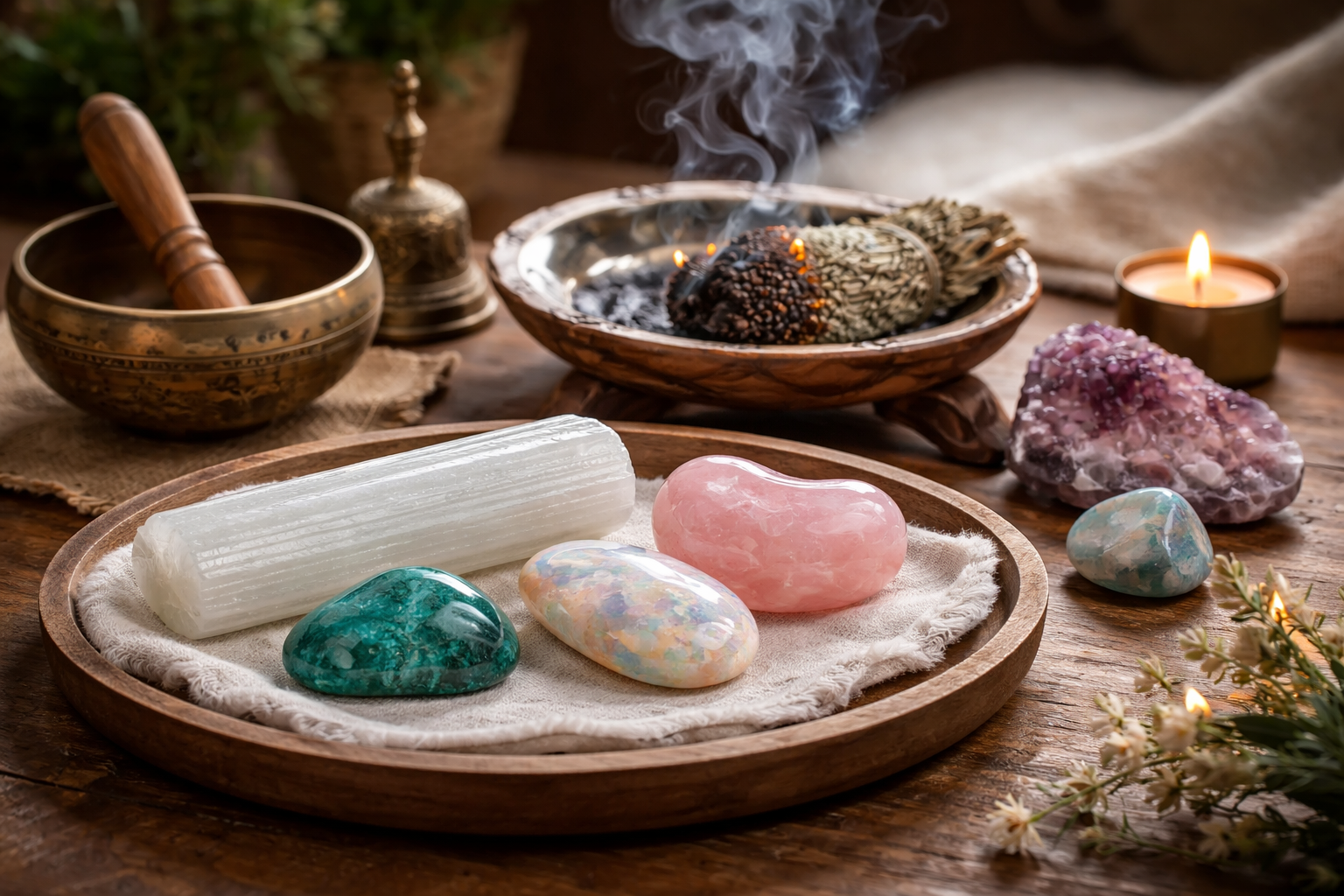
If a stone is not a good candidate for moonlight charging, don’t force it. Swap the method and keep the ritual.
Use smoke when you want a familiar ritual feel
Smoke works well when the goal is a reset rather than outdoor exposure. For a gentle version, smoke cleansing alternatives like frankincense or sandalwood make the room feel clear without dragging a delicate stone into damp night air. If a deeper, more traditional reset is the mood, a sage cleansing alternative can fit better than the windowsill does.
Use sound when the stone itself needs no physical exposure
For soft, porous, or unknown pieces, I like sound because it asks almost nothing from the crystal. A short pass with a bell or sound cleansing with a singing bowl keeps the practice dry, tidy, and low-fuss.
Use intention when you want the least fussy option
Quiet intention-setting gets mocked more than it should. If your stone is delicate, a clean cloth, a steady breath, and a short spoken intention can be the best call. No one hands out medals for the most dramatic charging setup.
Use a dry indoor rest when the crystal is already touchy
Some stones do better when you simply let them sit somewhere calm and clean. A shelf, altar, wooden tray, or covered bowl can be enough. For people who are still building a practice, how to use crystals for healing matters a lot more than whether the crystal spent six hours under a particular moon phase.
Match the method to the risk
- Water-sensitive stone: choose sound, smoke, or intention
- Porous stone: keep it dry and off oily hands or scented surfaces
- Light-sensitive stone: avoid any setup that could roll into sunrise
- Unknown stone: go with the gentlest dry method and call it a win
How to Use Moonlight Without Accidentally Damaging the Stone
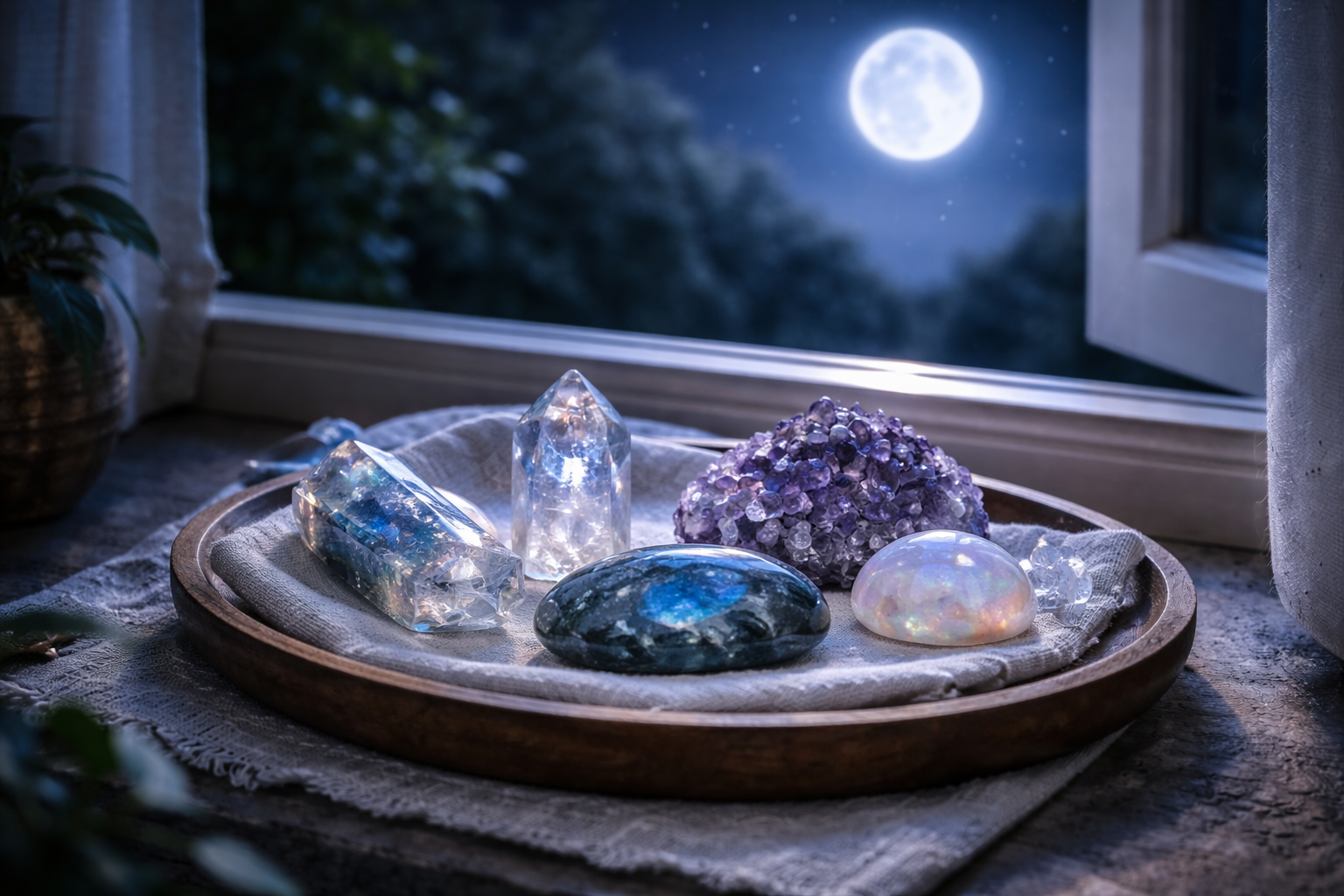
If you want the ritual and your crystal is a lower-risk type, the setup is simple. The trick is not to get cute with it.
Step 1. Choose the stone and cut out the guesswork
Use moonlight for crystals you know well and that are not soft, porous, soluble, or treated. Clear quartz, moonstone, and labradorite are much calmer bets than opal or selenite.
Step 2. Choose the spot and lower the weather risk
An indoor windowsill is usually safer than bare outdoor exposure. Yes, some people prefer direct moonlight with no glass between the stone and the sky. Fine. From a care point of view, glass is often the smarter trade.
Step 3. Set the timing and beat the sunrise
There is no lab-backed magic number for “proper” moon charging time. You will see anything from a few hours to all night. A sensible rule is easier to remember: put it out after dark and remove it before direct morning sun. That is the bit that changes the outcome.
Step 4. Keep the ritual clean and stop at enough
Use a dry dish, cloth, or tray. Skip wet grass, damp stone ledges, and places where the crystal can roll, fall, or collect grime. A simple setup done on purpose beats an elaborate one done sloppily. Every time.
And no, it does not need to be a full moon to “count.” Full moon charging is the symbolic default because people like the drama and the clear timing. But if your practice feels better on another lunar phase, that is a ritual call, not a care problem.
Best low-drama setup: known lower-risk stone, dry indoor windowsill, after dark, then back inside before sunrise.
What to Do If You Already Left a Sensitive Crystal Out
First, don’t panic. One moonlit night does not automatically wreck a stone.
What matters is what happened around that night. Was there dew? Did the crystal sit into direct sun? Is it porous, soft, or treated? Did you leave out jewelry rather than a plain stone?
Step 1. Inspect the surface and spot real damage
Look for cracks, chalkiness, rough patches, colour drift, cloudiness, or a finish that suddenly looks tired. On jewelry, check the setting too. Sometimes the crystal is fine and the mounting is what suffered.
Step 2. Dry it gently and stop the experiment
If the piece feels damp or cool, dry it with a soft cloth and leave it somewhere stable indoors. Don’t try to “balance it out” with extra sun, water, or aggressive cleaning. That is how a small worry turns into an actual problem.
Step 3. Switch methods and keep using the crystal if it looks sound
If there is no visible damage, move on to a dry charging method next time. If there is surface change, retire that stone from outdoor rituals and keep the care gentle. Spiritually, a stone is not ruined because you used the wrong setup once. People can get oddly dramatic about that.
Aftercare checklist
- Check for cracks, chalkiness, fading, or roughness
- Dry the stone and store it indoors
- Stop using water or sun as a “fix”
- Switch to sound, smoke, or intention for the next cleanse or charge
Lower-Risk Crystals for Moonlight and the One Rule Worth Remembering
If you still want a short list of crystals that are usually better suited to moonlight, clear quartz, moonstone, and labradorite are fair starting points. They recur in crystal practice for a reason. They are familiar, not especially fussy in ordinary care, and they fit the lunar ritual vibe people are usually after.
Still, “lower-risk” is the right phrase. Not “safe in every possible setup.” A polished moonstone on a dry indoor sill is one thing. A glued pendant forgotten on a damp porch is another.
So here is the rule worth keeping: if the stone hates water, hates bright light, or chips easily, skip the open sky and charge it another way.
That rule is better than a longer blacklist because it still works when the label is wrong, the seller is vague, or the crystal is part of a piece of jewelry with more going on than the stone alone.
A Few Remaining Questions About Moonlight Charging
Can crystals charge in moonlight through a window?
Yes, many people use a windowsill for moonlight charging and it is often the safer care choice. Glass changes the ritual setup a bit, but it also cuts out dew, surprise rain, and some of the risk that comes from forgetting the crystal till morning.
Do crystals need a full moon to charge properly?
No. Full moon charging is popular because it is easy to time and it feels symbolically strong, but the care advice does not change much by phase. What matters more is the stone’s material sensitivity and whether the setup stays dry and out of direct sunrise.
Is crystal jewelry riskier than a loose stone?
Usually, yes. Jewelry can include glue, plating, soft metal, fragile prongs, porous beads, or treated stones. A plain tumbled crystal is simpler. A pendant or ring asks for more caution.