
You can spot the problem with most lists of crystals for the root chakra in about 30 seconds. They throw black tourmaline, red jasper, hematite, smoky quartz, garnet, and obsidian into one basket, give each stone a soft little paragraph, and leave you staring at six answers that sound the same.
The quick answer is simpler than that. For one safe first pick, start with black tourmaline when life feels noisy, draining, or boundary-heavy. Start with red jasper when you want steadiness, courage, and a calmer kind of strength. Most people do better with one of those two than with a random mixed set.
That stock answer still needs context. A stone for feeling scattered is not always the right stone for feeling flat, overexposed, or emotionally raw. So this guide sorts root chakra stones by job, shows you how to use them without fuss, and gives you a clean way to tell whether a stone is helping or just sitting there looking pretty.
At a Glance: pick by job, not by color alone
- The starter stone that fits crowded, draining days
- The calmer pick for steadiness and backbone
- The tradeoff between heavy grounding and softer grounding
- A simple way to test one stone without guesswork
- The care mistakes that can nick, dull, or confuse your stones
Quick pick matrix
| How it feels | Start here | Why |
|---|---|---|
| Buzzy, overexposed, crowded | Black tourmaline | Firm boundary feel |
| Wobbly, tired, needing backbone | Red jasper | Steady and supportive |
| Floaty, uncentered, hard to land | Hematite | Heavy grounding feel |
| Tense but wanting a gentler stone | Smoky quartz | Grounding without the hard edge |
| Flat, low, underfueled | Garnet | Warmth and movement |
Crystals for the Root Chakra: The Useful Answer Up Front
Britannica describes chakra as “wheel” and places the muladhara, or root chakra, at the base of the spine. Cleveland Clinic explains chakras as part of South Asian healing traditions rather than Western science. That gives you the right frame from the start: root chakra work is best treated as a spiritual or reflective practice that can help you feel steadier, not as a medical system with lab-tested anatomy.
In modern crystal practice, the root chakra is the one most people connect with safety, grounding, stability, home, money stress, weak boundaries, and that odd floaty feeling where your mind is three rooms ahead of your body. When I test beginner routines, that is the cluster I look for. Not “Do you believe enough?” More like, “What is actually off this week?”
For the cleanest first answer, these are the two starter picks I trust most:
Fast rule: pick black tourmaline when the problem feels external and pick red jasper when the problem feels internal.
Black tourmaline suits crowded places, emotional spillover, and poor boundaries. Red jasper suits shakiness, fatigue, and the need for steady courage.
For a broader chakra map before getting picky about stones, What Are the 7 Chakra Stones? A Clear Beginner’s Guide lays out the full system without the usual fog.
The generic answer is incomplete because “root chakra crystal” is not one job. A bodyguard stone is not the same as a backbone stone. A crystal that feels good on a tense commute is not always the one you want during meditation or sleep.
The 7 Root Chakra Crystals That Cover Most Real Needs
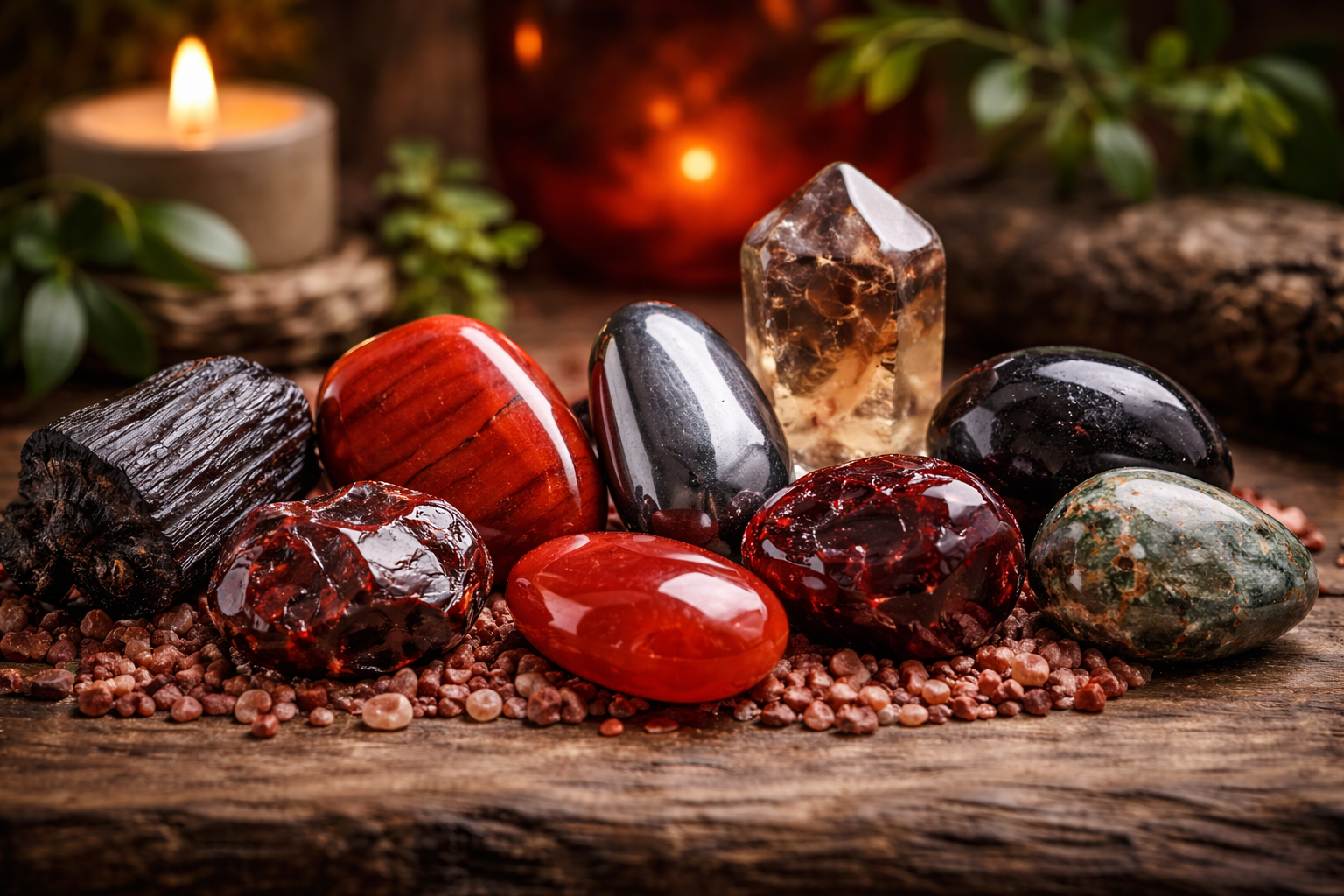
You do not need a tray full of red and black stones to cover the basics. Seven is plenty. Any more than that and beginner choice turns into shelf decor.
| Stone | Best for | Watch for |
|---|---|---|
| Black tourmaline | Boundaries, protection, heavy environments | Can feel too stern when warmth is the real need |
| Red jasper | Steady courage, calm stamina, emotional steadiness | Less “shield” energy than tourmaline |
| Hematite | Centering, heaviness, landing back in the body | Can feel a bit blunt for sensitive people |
| Smoky quartz | Gentler grounding, decompression, settling down | Not as firm for hard boundary work |
| Garnet | Warmth, momentum, low-energy periods | Can feel too lively near bedtime |
| Obsidian | Deep clearing, sharper introspection | Often too intense as a first stone |
| Bloodstone | Grounded courage, grit, getting moving again | Less common in beginner sets |
Black tourmaline is the stone I reach for when the room feels “off” or when I know the day will involve too many people. Its reputation in crystal practice is blunt on purpose. It is the nearest thing this category has to a raincoat. For a deeper look at how it differs from other dark stones, Best Black Crystal for Protection: 7 Smart Picks by Need makes the lines clearer.
Red jasper gets flattened into “grounding” in a lot of guides. That sells it short. Red jasper is better thought of as grounded stamina. It is the stone I like when someone does not need armor so much as they need to stop wobbling every time a hard week hits.
Hematite has a denser feel. When people say they want to feel back in their body, this is often the first stone I test. If black tourmaline feels like a shield, hematite feels like ankle weights. Good ankle weights, mind you.
Smoky quartz is what I suggest when tourmaline feels too severe and hematite feels too heavy. It still grounds but it does so with less bark. That matters for people who are already tense.
Garnet is useful when the root-chakra issue is not just fear or floatiness but low fuel. It brings a warmer tone than the darker stones. I would not make it the bedtime pick for a wired person though.
Obsidian can be excellent for deeper clearing and honest self-work. It can also feel like too much too soon. I rarely hand obsidian to a beginner who is already raw, over-stimulated, or going through a rough patch.
Bloodstone sits in an interesting middle ground. It has backbone, movement, and a grounded sort of courage. It is less famous in beginner roundups, which is a shame, because it often fits people who need a nudge without the harder edge of obsidian.
About color: red, black, and brown stones show up again and again in root chakra work because they match the usual symbolism of earth, safety, body, and survival. Use that as a clue, not a law. Job first. Color second.
Choose the Right Stone by What Feels Off, Not by Color Alone
This is where most people either get the article they needed or waste twenty minutes reading stone meanings that never turn into a choice.
The phrase “blocked root chakra” can be handy but it gets sloppy fast. I treat it like shorthand for a theme that feels unstable, not a diagnosis. Maybe you feel buzzy and porous after time with other people. Maybe money stress has you half in your head all day. Maybe you are not anxious exactly. You just do not feel planted.
Fast pick matrix
| If this feels like your week | Start with | Skip for now |
|---|---|---|
| Crowded, draining, too much input | Black tourmaline | Garnet |
| Wobbly, tired, needing backbone | Red jasper | Obsidian |
| Floaty, uncentered, not quite “here” | Hematite | Garnet |
| Tense and brittle but still needing grounding | Smoky quartz | Hematite |
| Flat, sluggish, underpowered | Garnet or bloodstone | Heavy double-black combos |
| Deep emotional clearing, shadow work mood | Obsidian | Random beginner bundles |
Notice what the chart is doing. It is sorting by feeling, then by job. That sounds obvious yet it is the piece most crystal roundups dodge.
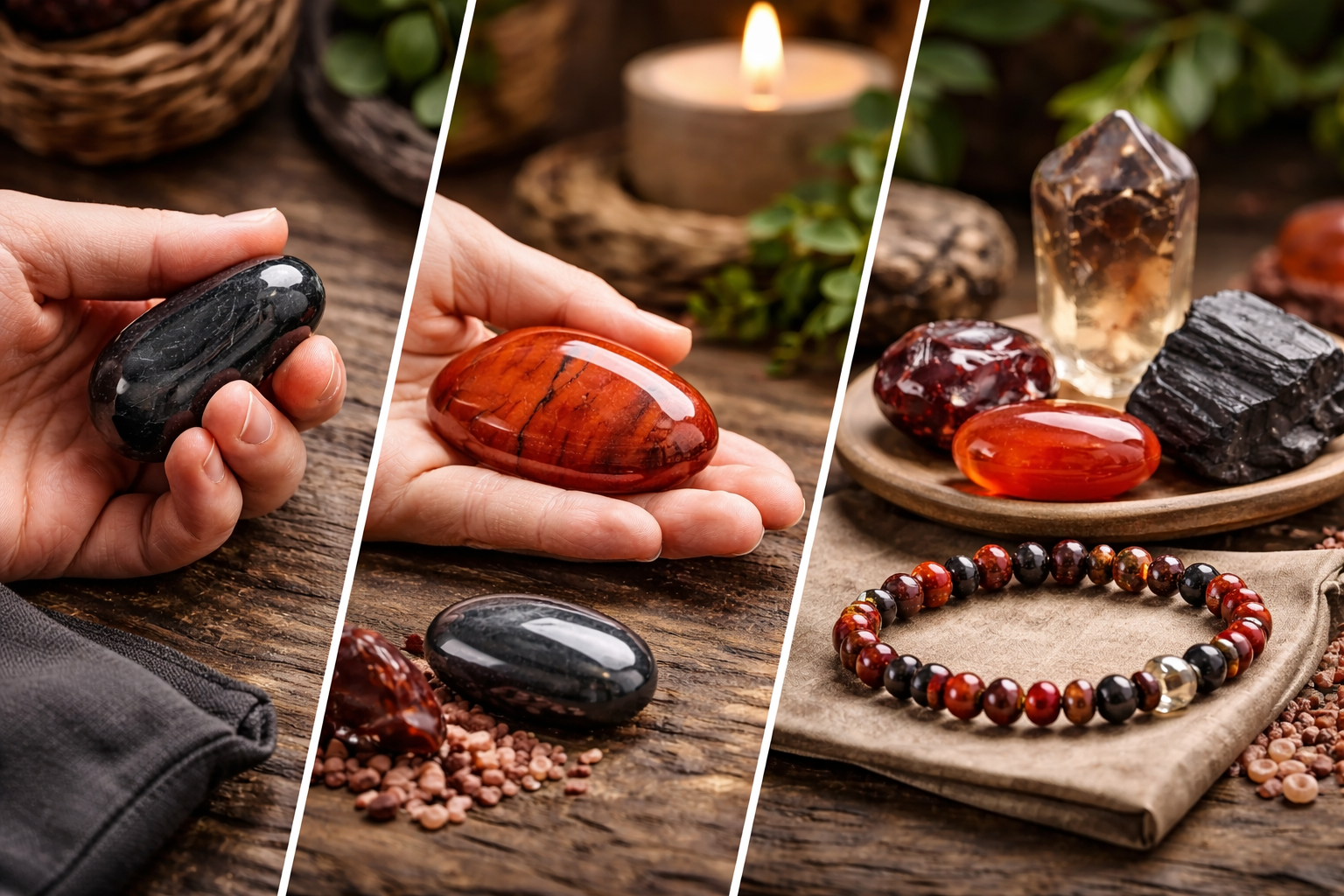
Form matters too. A pocket stone is good for commutes and busy days. A palm stone works for meditation. A bracelet is handy if you forget loose stones in every jacket you own. A large tower or chunk makes more sense at a desk or entryway than in a pocket. The best stone is often the one whose form fits your actual routine.
If the broader question is not just “which crystal?” but “how do I work with this chakra at all?” then How to Heal a Chakra: 5 Practical Steps That Actually Help picks up from exactly that point.
Use Root Chakra Crystals in a Way That Actually Fits Daily Life
NCCIH says meditation and mindfulness practices may help people manage stress and it also notes that yoga can support general wellness and anxiety symptoms. That is why I like root chakra stones best as anchors inside a small grounding habit. The crystal is the cue. The routine does the real heavy lifting.
You do not need a dramatic ritual. Four simple methods cover most cases:
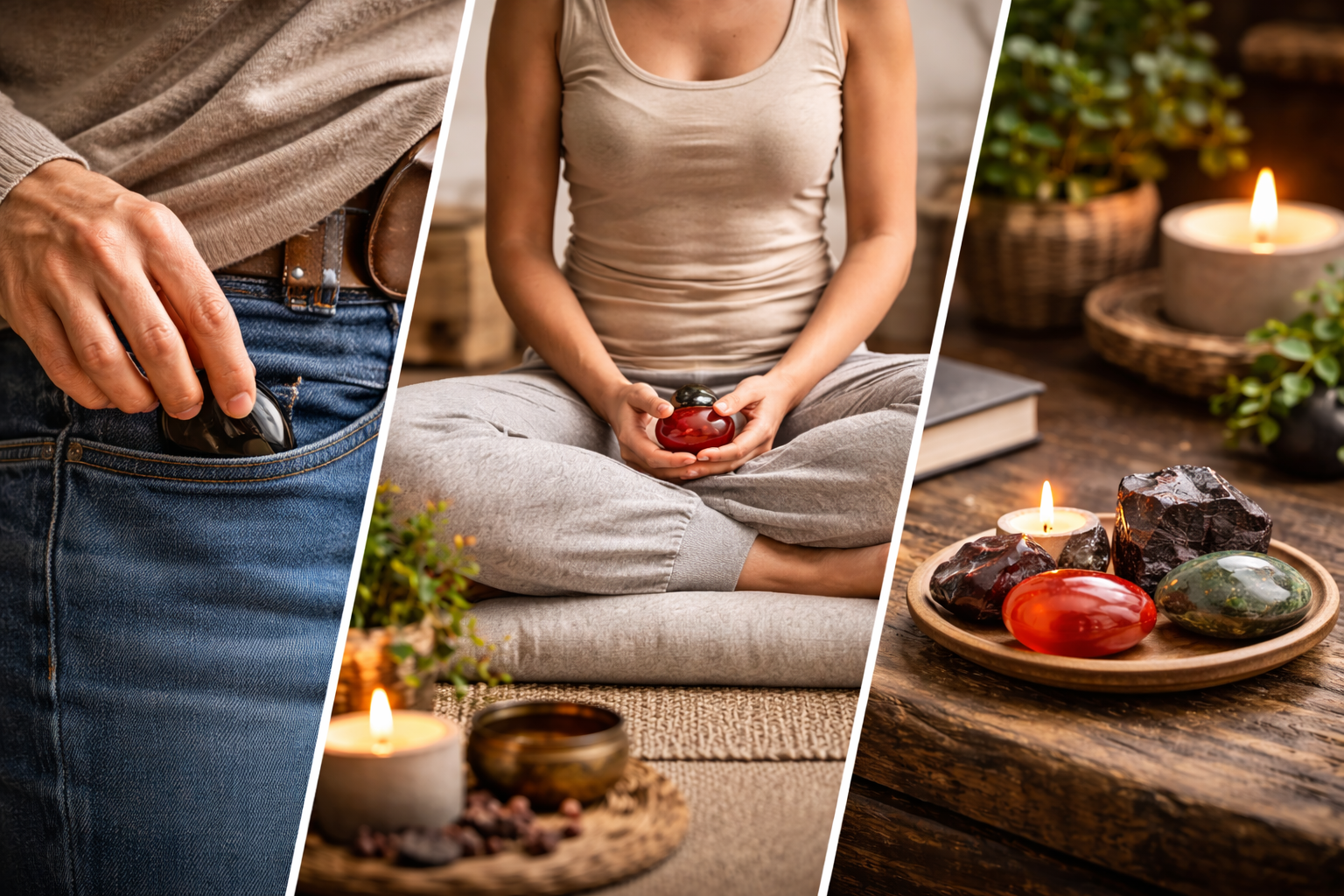
- Carry it for portable grounding. A small tumbled stone in a pocket or bag gives you something physical to reach for when your mind starts skating.
- Hold it during a short sit. Five minutes with one stone is plenty. More is fine but five is enough to build the habit.
- Place it low on the body during rest. Near the base of the spine, in the lap, or under the feet while seated all make more sense than balancing it on your forehead and hoping for poetry.
- Give it one fixed place at home. Desk, entryway, bedside table, or meditation spot. Pick one and keep it there.
A 5-minute grounding routine
1. Sit with both feet flat.
2. Hold the stone or place it in your lap.
3. Take 6 slow breaths and feel where your body meets the chair or floor.
4. Say one plain sentence: “I need steadiness today” or “I want firmer boundaries today.”
5. Stop there. Do not turn a useful habit into a ceremony you will avoid tomorrow.
Consistency beats spectacle here. I have seen more people stick with a pocket stone and a five-minute sit than with complicated layouts, candle spreads, and a dozen affirmations they never quite believe.
For a cleaner beginner routine across all crystal work, How to Use Crystals for Healing: 7 Beginner Steps That Stick is a good next stop.
What to Do If You Feel Nothing at First
This is normal. More normal than people admit, honestly.
A lot of crystal work is subtle. You are not waiting for a trumpet blast. You are watching for smaller shifts like breathing a bit lower, staying less frazzled after a meeting, or feeling less like your thoughts are running ahead of your body.
The cleanest test I know is a 7-day trial with one stone and one method. No swaps on day two. No adding a bracelet, tower, and bath soak because you got impatient.
The 7-day test
- Pick one stone.
- Pick one use method.
- Use it once a day for 7 days.
- Ask one question after each use: “Do I feel more settled, more protected, or more here?”
- Write down one line only. Keep it stupid simple.
If you feel nothing after a week, three things are common. The stone may be the wrong match. The method may not fit your day. Or your expectations were set at fireworks when the change was always going to be quieter than that.
Here is the useful switch rule. If black tourmaline feels too stern, move to smoky quartz. If red jasper feels too flat, try garnet. If obsidian leaves you feeling raw, back up to red jasper or smoky quartz. Small shifts usually beat big dramatic jumps.
When mixed pairings are muddying the waters, What Crystals Should Not Be Together? 9 Common Pairings to Avoid helps sort out whether the problem is the stone or the combo.
Cleanse, Charge, and Store Root Chakra Stones Without Damaging Them
There are really two jobs here and people blend them together all the time. Energetic cleansing is about ritual. Physical care is about not wrecking the stone.
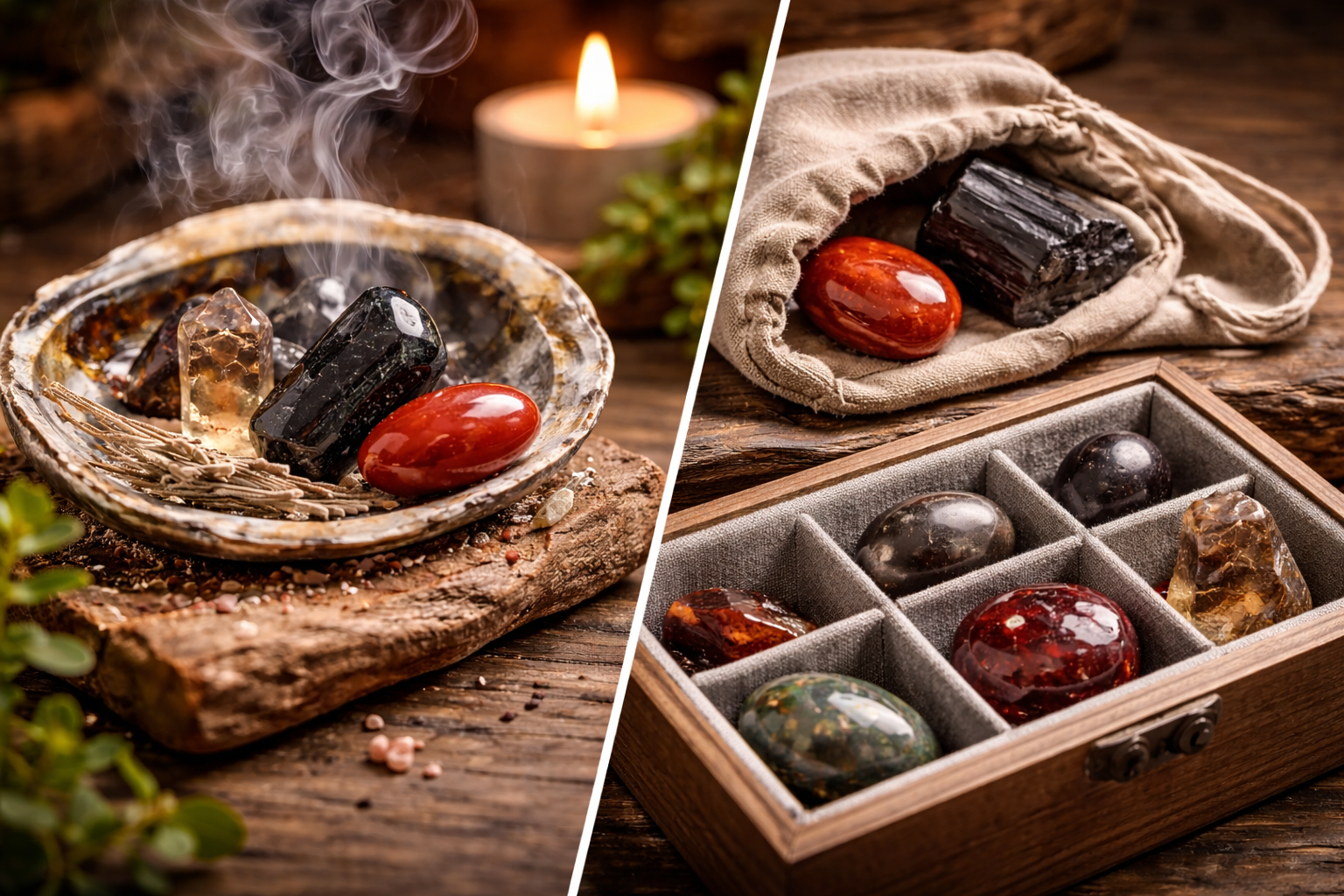
When I do not know how a piece has been treated, dyed, polished, plated, or set, I default to the gentlest methods first. That means smoke, sound, moonlight, or resting the stone near a cleansing slab if that is part of your practice. Water is not my default. Salt is definitely not my default.
Safe default order
1. Sound
2. A quick pass through smoke
3. Sheltered moonlight
4. Resting on a cleansing slab or cloth space used only for crystal work
Storage matters more than people think. Keep polished pieces from knocking against rougher chunks. Keep jewelry dry. Keep heavier stones from chipping softer ones. A soft pouch or small divided box is usually enough. Nothing fancy.
For the fuller safety-first version, How Do You Cleanse Your Crystals? 7 Safe Methods and Mistakes to Avoid goes deeper without pretending every stone likes the same treatment.
Combining Root Chakra Crystals Without Turning the Signal to Mush
Yes, you can combine root chakra stones. No, you do not need to build a tiny crystal orchestra every time you want to feel steadier.
The cleanest way to pair stones is to give each one a clear job. One for boundaries. One for steadiness. Or one for grounding and one for warmth. Once a pairing starts trying to do six things at once, the whole thing gets muddy.
- Black tourmaline + red jasper: strong pair for boundaries plus steady courage.
- Hematite + smoky quartz: very good for centering with a softer landing.
- Garnet + red jasper: useful when you need fuel and backbone at the same time.
I keep beginners on a two-stone cap. One stone is the job. Two stones is a small team. Three stones is where people start projecting wishful thinking onto a pile of nice rocks.
If you already feel over-stimulated, skip stacking the heavy hitters. Black tourmaline, obsidian, and hematite all together can feel like too much for some people. Better to pick the one that matches the moment and actually use it.
What Root Chakra Crystals Can Support, and What They Cannot Replace
Cleveland Clinic describes energy healing as a complementary therapy that is not scientifically proven to be effective and should not replace standard care. That is a healthy line to keep. It keeps crystal work useful and honest.
Used well, root chakra stones can support reflection, body awareness, ritual, and a felt sense of steadiness. They can remind you to breathe, slow down, and stop leaking attention in every direction. They can sit beside journaling, meditation, prayer, a walk, better sleep, or plain old practical boundaries.
They cannot replace therapy, debt advice, safer housing, medical care, or the awkward real-life conversations that actually tighten a weak boundary. If the issue under the search is panic, trauma, burnout, or a genuinely unsafe situation, a stone can be part of the picture. It cannot be the whole picture.
A rule worth keeping
Pick one stone. Match it to one need. Use it simply for one week. Judge it by what changes in your day, not by how dramatic the ritual looked.
FAQ
Is black tourmaline or red jasper better for the root chakra?
Black tourmaline is better when the main issue feels external, like crowded spaces, heavy rooms, or weak boundaries. Red jasper is better when the main issue feels internal, like shakiness, low backbone, or needing steadier strength. If you are torn, start with the problem that shows up most often in daily life.
Can you sleep with a root chakra crystal?
Yes but choose the tone carefully. Smoky quartz or red jasper tend to be easier bedtime picks than garnet or a strong obsidian piece. If sleep gets worse, move the stone to the bedside table or use it earlier in the evening instead.
Where should a root chakra crystal go?
The simplest options are a pocket, a meditation seat, a bedside table, or low on the body during a short rest practice. Root chakra work usually makes more sense near the base of the body, at the feet, or in the spaces where you need steadiness most.