You open five tabs, and by tab three every crystal is somehow “for transformation.” Moonstone. Green aventurine. Citrine. Labradorite. Clear quartz. They all sound right, which is exactly why this search gets slippery.
Here is the clean answer: the best crystals for new beginnings are moonstone, green aventurine, labradorite, citrine, clear quartz, carnelian, smoky quartz, and amazonite. But there is no single best pick for every fresh start. Moonstone is the safest symbolic first choice when the change feels tender or emotional. Green aventurine fits opportunity and forward motion better. Citrine and carnelian make more sense when the real issue is courage, momentum, or getting off the starting line.
I see one mistake over and over, and I made it too years back. People choose the prettiest stone or the most famous one, then wonder why it never quite clicks. Picking a crystal for a breakup is not the same as picking one for a new job, a move, or a project you keep postponing.
In this guide, you’ll get a short list that is actually useful, a simple way to choose, and a low-fuss routine that does not turn a fresh start into a second hobby.
Fast Match
| If your fresh start feels like… | Start with… | Why it fits |
|---|---|---|
| An emotional reset, identity shift, or tender life change | Moonstone | Soft, reflective, and better for transitions that feel personal |
| A new job, a new opening, or a bit more luck and movement | Green aventurine | Good fit when the next chapter needs openings, not just soothing |
| Crossroads, reinvention, or not seeing the path clearly yet | Labradorite | Useful when the issue is uncertainty and perspective |
| Confidence, money momentum, or visible forward action | Citrine | Brighter, more outward, and better for motion than mulling |
| A broad reset when the goal is still fuzzy | Clear quartz | Flexible and easy when you want one simple first stone |
Quick rule: pick one lead crystal for the main job, not three crystals that all sound vaguely good.
What you’ll learn: which stones are worth your time, how to match them to a real situation, when moonstone is right and when it is not, how to use one without a giant ritual, and what buying mistakes make the whole thing feel fuzzy.
Best Crystals for New Beginnings at a Glance
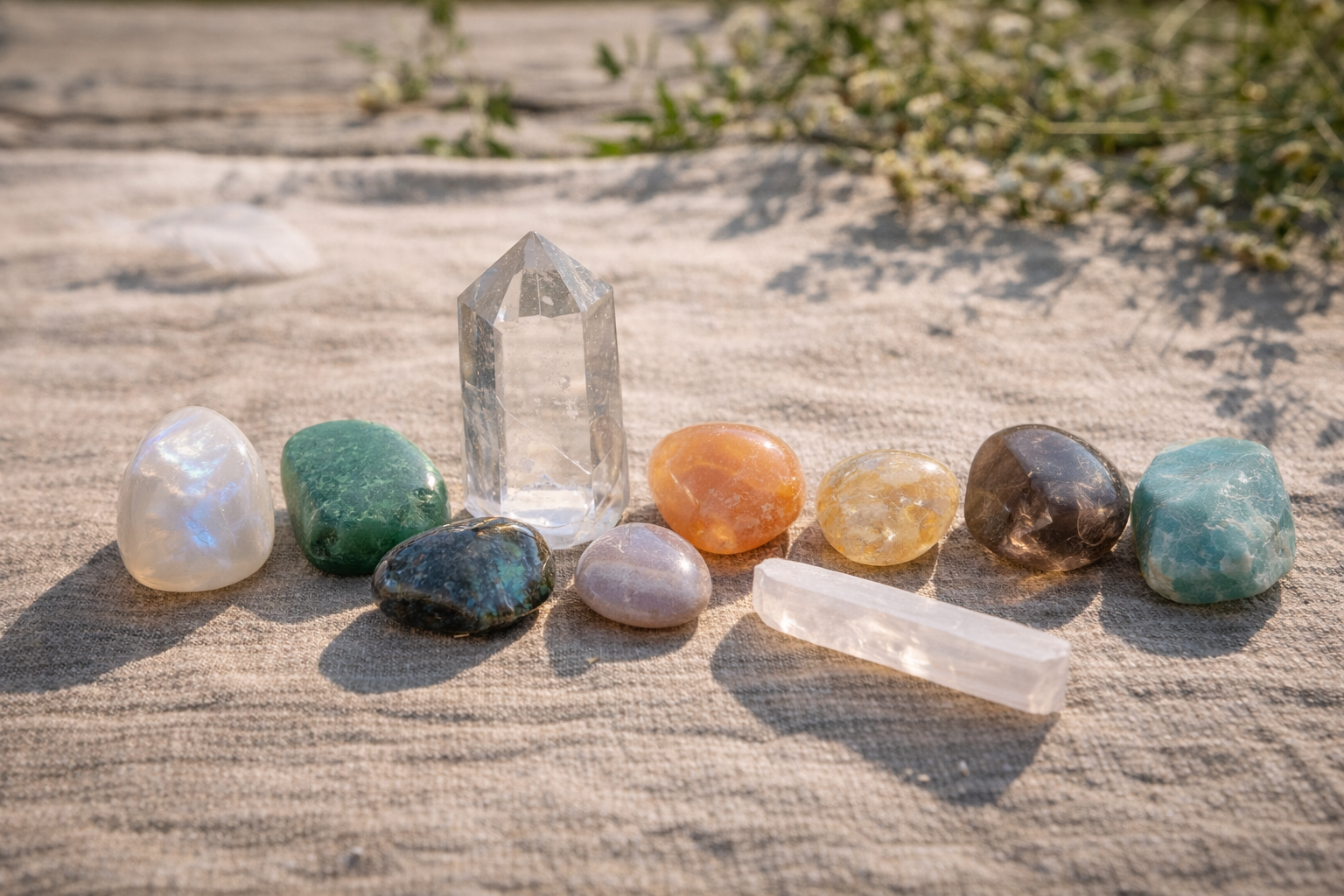
Here is the short list I would actually hand to a beginner.
| Crystal | Best for | Less ideal when | Best first form |
|---|---|---|---|
| Moonstone | Emotional renewal, life transitions, softer fresh starts | You need blunt action and bold momentum right now | Pendant or pocket stone |
| Green aventurine | Opportunity, fresh openings, career moves | The real problem is fear, grief, or overstimulation | Tumbled stone or bracelet |
| Labradorite | Crossroads, reinvention, finding a path | You want a very simple first crystal with broad use | Palm stone |
| Citrine | Confidence, abundance, visible movement | You need grounding before motivation | Pocket stone or desk piece |
| Clear quartz | Broad reset, clarity, one safe first pick | You want a very specific emotional tone | Palm stone or point |
| Carnelian | Action, creative restart, courage | You already feel overamped or frayed | Pocket stone |
| Smoky quartz | Grounding, fear-heavy change, stabilising first | You want a lighter, more buoyant feel | Pocket stone or home piece |
| Amazonite | Truth, boundaries, speaking up in a new chapter | Your main issue is not communication | Pendant or palm stone |
If you want one safe starting rule, use this: choose one lead stone for the main job and stop there. Moonstone is the gentlest all-round answer for emotional change. Clear quartz is the cleanest all-purpose answer when the goal is still half-formed. Green aventurine is the better pick when “new beginning” really means “I need openings and movement.”
How to Choose the Right Crystal for the Kind of Fresh Start You Want
Most crystal guides fall apart at this point. They tell you what each stone means, but not how to choose between two good options.
The easiest fix is to stop asking, “Which crystal is best?” and ask four smaller questions instead.
1. Name the job
Do you want calm, courage, clarity, grounding, self-trust, luck, or momentum? One word is enough. Two words if your life is messy, which, fair enough, it probably is.
2. Name the blocker
Are you scared, stuck, grieving, indecisive, tired, or spread thin? This part matters more than people think. A crystal for opportunity can feel flat if the real problem is fear. A crystal for confidence can feel noisy if the real problem is heartbreak.
3. Pick the emotional tone
This is the part competitors blur together. Moonstone and citrine can both suit a fresh start, but they do not feel the same in practice. Moonstone is softer and more inward. Citrine has more lift and push. Smoky quartz settles you down first. Carnelian nudges you forward.
4. Choose the form you’ll actually use
A pocket stone beats a dramatic cluster if you need something to touch during real-life moments. A pendant beats a tower if the whole point is carrying the reminder with you. I have watched people buy gorgeous altar pieces that never left the shelf. Then a plain little tumbled stone ended up doing the actual work because it was in a coat pocket every day.
Simple filter: one main job + one blocker + one realistic form = a better first crystal.
If your answer looks like this, the choice gets much easier:
- “I need softness and trust because this change feels raw.” Start with moonstone.
- “I need fresh openings because I’ve been static for months.” Start with green aventurine.
- “I know what I want. I just keep hovering.” Start with carnelian or citrine.
- “I feel unsteady and a bit all over the place.” Start with smoky quartz.
- “The goal is big, but still fuzzy.” Start with clear quartz.
That is why asking for the best crystal without naming the job is a bit like asking for the best shoe without saying whether you need it for a wedding or a muddy trail.
For a broader intention-led angle, a guide on best crystal for manifestation can help sort “new beginning” searches that are really about a bigger goal rather than one clear life change.
The Best Crystals for New Beginnings, Matched to the Job
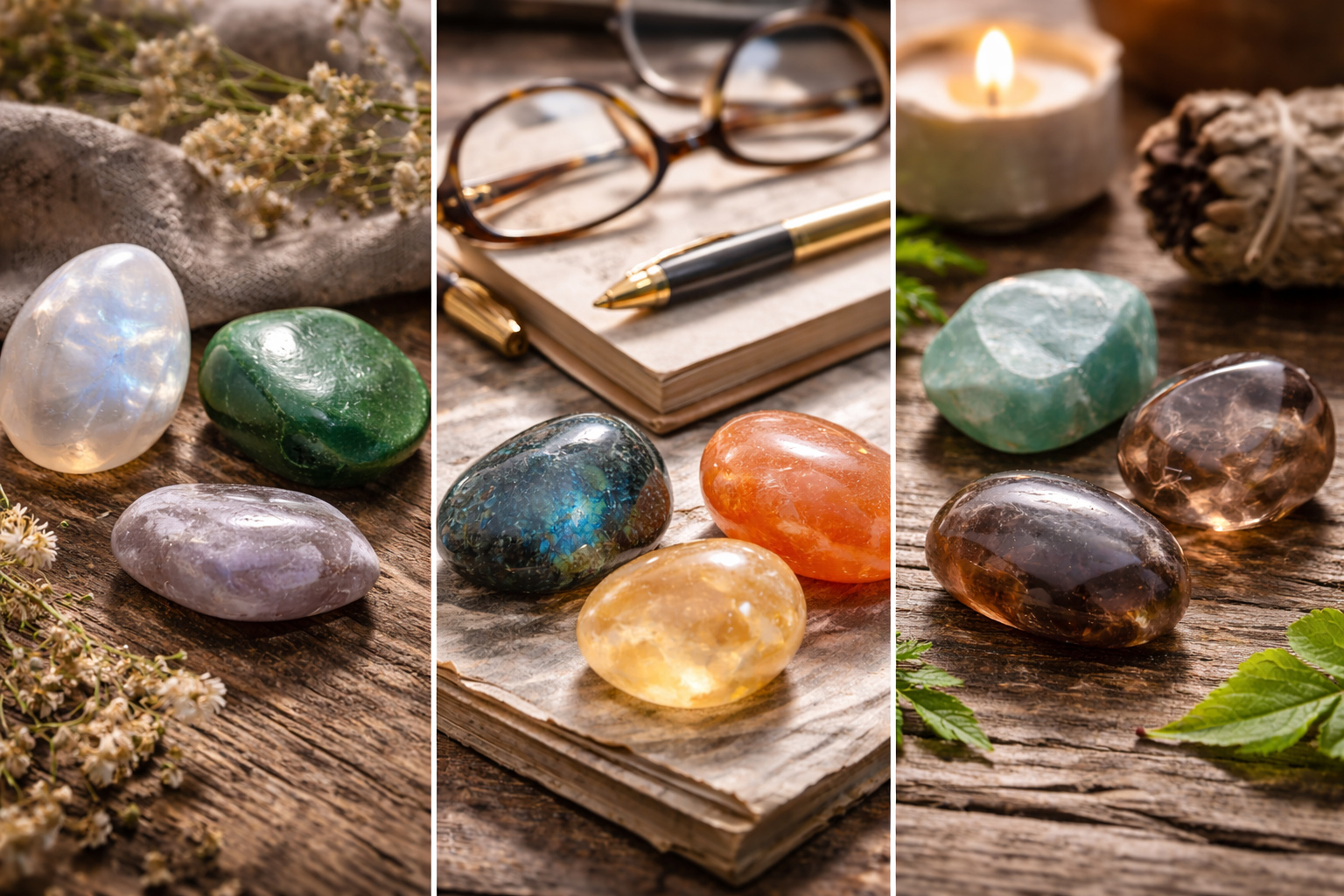
Here is the shortlist, but this time with actual distinctions.
Moonstone
Best when the fresh start feels emotional, private, or identity-heavy. Breakups, motherhood, grief shifts, a move that rattles your sense of home, a new role that feels meaningful but exposing. Moonstone suits change that needs softness and trust more than force.
Less ideal if you already know what you want and the only missing piece is action. In that case, moonstone can feel too misty as a first pick.
Green aventurine
Best when the new chapter needs openings. New job, new business, new social circles, new attempts after a stale patch. It has that “fresh air through the window” quality that a lot of people actually mean when they say they want renewal.
Less ideal when you are flooded, frightened, or mid-grief. It is good for movement, but not always for steadiness.
Labradorite
Best at crossroads. When you are changing shape, but the next form is not obvious yet, labradorite often makes more sense than a louder stone. It fits reinvention, uncertainty, and new paths that are still taking form.
Less ideal if you want the simplest beginner pick. Labradorite is lovely, but clear quartz is easier for broad use.
Citrine
Best for visible forward motion. Confidence. Money mindset. Interviews. Selling your work. Taking up more room. If the fresh start needs warmth, nerve, and a bit of brightness, citrine earns its place fast.
Less ideal when your nervous system already feels buzzy. Then smoky quartz or moonstone usually lands better.
Clear quartz
Best when the goal is broad or still forming. It is the least fussy stone on this list and often the best answer for people who hate overcomplication. If you want one crystal for a new chapter and do not want to overthink it, clear quartz is a very sensible first pick.
Less ideal if you want a crystal with a more distinct emotional flavor right away.
Carnelian
Best when procrastination is wearing a spiritual disguise. You are not “waiting for the right energy.” You are stalled. Carnelian works well for creative starts, nervous confidence, and doing the thing before the mood arrives.
Less ideal for raw emotional recovery.
Smoky quartz
Best when the fresh start scares you more than it excites you. Fear of change, too much noise, weak boundaries, shaky footing. Smoky quartz is rarely the flashiest answer, but it is often the honest one.
Less ideal if what you want is lift and optimism.
Amazonite
Best when the new beginning involves truth and voice. Leaving a bad job. Setting a boundary. Starting over after staying quiet too long. It is a smart pick when the chapter changes only after you say the thing.
Less ideal if the issue is not communication at all.
One useful rule: the more emotional and tender the transition, the softer the first crystal should be. The more action-based the transition, the more outward the first crystal can be.
Which Crystal Fits Your Situation Best?
This is where the choice usually clicks.
New job, interview, or career pivot
Start with green aventurine if the chapter is about openings, timing, and fresh movement. Start with citrine if the chapter is about confidence, visibility, or money. If the shift is exciting but scary, pair the brighter stone with smoky quartz, not with another “success” crystal.
A separate guide on crystals for abundance and prosperity is useful when the fresh start is mainly about money, career lift, or new income rather than life change in a broad sense.
Breakup, heartbreak, or emotional reset
Moonstone is the better first pick here more often than not. The emotional weather matters. Jumping straight to a high-energy stone can feel oddly harsh when what you need is room to process and loosen your grip on the old story.
If the heartbreak has also left you scattered or ungrounded, smoky quartz can support it well.
Moving house or rebuilding a sense of home
Moonstone works if the move feels tender or identity-shifting. Labradorite works if the move feels like a threshold into a new self. Smoky quartz is a smart add-on if the move is stressful, noisy, or plain exhausting.
Starting a project you keep delaying
Carnelian first. This is one of the clearest matches in the whole category. If the task also needs visibility, speaking up, or being seen, citrine can work as the second stone. But do not start with three “motivating” crystals at once. That is how the whole thing gets mushy.
General life reset when nothing is fully clear yet
Clear quartz is the cleanest first move. That can sound boring next to stones with more lore and personality, but broad resets call for a broad tool. Later, once the new beginning sharpens into “I need courage” or “I need softness,” you can swap to something more specific.
Speaking up, setting a boundary, or telling the truth that starts the new chapter
Amazonite fits this lane well. It is a good stone for fresh starts that begin with a sentence. Leaving a role, naming a need, changing a family pattern, saying no cleanly for once. That kind of beginning is not really about luck. It is about voice.
Fast match by situation
- Career shift: green aventurine or citrine
- Breakup: moonstone first
- Move: labradorite or moonstone
- Creative restart: carnelian
- Fear-heavy change: smoky quartz first
- Unclear new chapter: clear quartz
- Boundary-led fresh start: amazonite
If you feel strongly pulled toward a stone outside this list, do not ignore that. Just run it through the same filter. What job does it do? What blocker does it meet? How will it fit your real routine?
How to Use a New-Beginnings Crystal Without Making It Complicated

The best use method is the one you will repeat. That is the whole game.
The part many people miss is that a crystal works best as a cue inside a real practice. The National Center for Complementary and Integrative Health notes that meditation and mindfulness may help people improve the quality of their lives. That does not prove crystal meanings as lab facts, and it does give you a grounded reason to use a crystal as a tactile reminder inside a simple reflective habit.
Pick one sentence and get clear
Keep it plain. “I am leaving what is over.” “I am ready for a steadier start.” “I am acting on this new chapter.” Short beats poetic here.
Touch the crystal and make the moment real
Hold it for 20 to 30 seconds. Or wear it and pause with one hand on it before the thing you are trying to change. Interviews. Difficult calls. First drafts. First nights in a new home. That brief physical cue is what makes the practice sticky.
Attach one action to the ritual
This is the hinge. After the intention, do one concrete thing. Send the email. Pack the box. Walk into the class. Cancel the thing you already know is over. A crystal without action turns into decor fast.
Four easy ways to use a fresh-start crystal:
- Carry it in a pocket for moments of wobble
- Wear it as a pendant or bracelet if the reminder needs to travel with you
- Hold it during a 2 to 5 minute reflection or journal check-in
- Place it where the old pattern usually happens, like a desk, front door table, or bedside
If you want more structure around carrying, wearing, and placing stones, a guide on how to use crystals for healing lays out the basics in a very beginner-friendly way.
Remember: one crystal, one sentence, one action. That is plenty.
Can You Pair Crystals for a Fresh Start Without Muddying the Intention?
Yes, but keep it tight. One crystal is enough. Two is the practical ceiling for most people.
The cleanest way to pair stones is to give each one a different role. One leads. One supports. Once you start stacking five crystals that all promise change, abundance, courage, calm, intuition, and “high vibration,” the point starts to blur.
Pair one lead stone with one support stone
Moonstone plus clear quartz works when the start is emotional but you also want a clean sense of direction. Citrine plus smoky quartz works when you need drive without tipping into frantic. Green aventurine plus carnelian makes sense for opportunities that need action, not just hope.
Avoid brake-and-gas combinations for the same moment
If one stone is there to settle you and the other is there to rev you up, the pair can feel like mixed instructions. That is not some spooky universal law. It is just a messy cue system. A fuller guide on what crystals should not be together is helpful if pairing is the part that keeps going sideways.
Think about wear and care, not just symbolism
Physical tradeoffs matter too. GIA notes that moonstone is less durable than many common jewelry stones and can scratch or chip if knocked. That is why I like moonstone more as a pendant, pocket stone, or calmer everyday piece than as a ring you wear through gym bags, keys, and door handles.
So yes, you can use multiple crystals at once. Just keep the pairing honest. Same chapter, different jobs.
What to Look for When Buying Crystals for New Beginnings
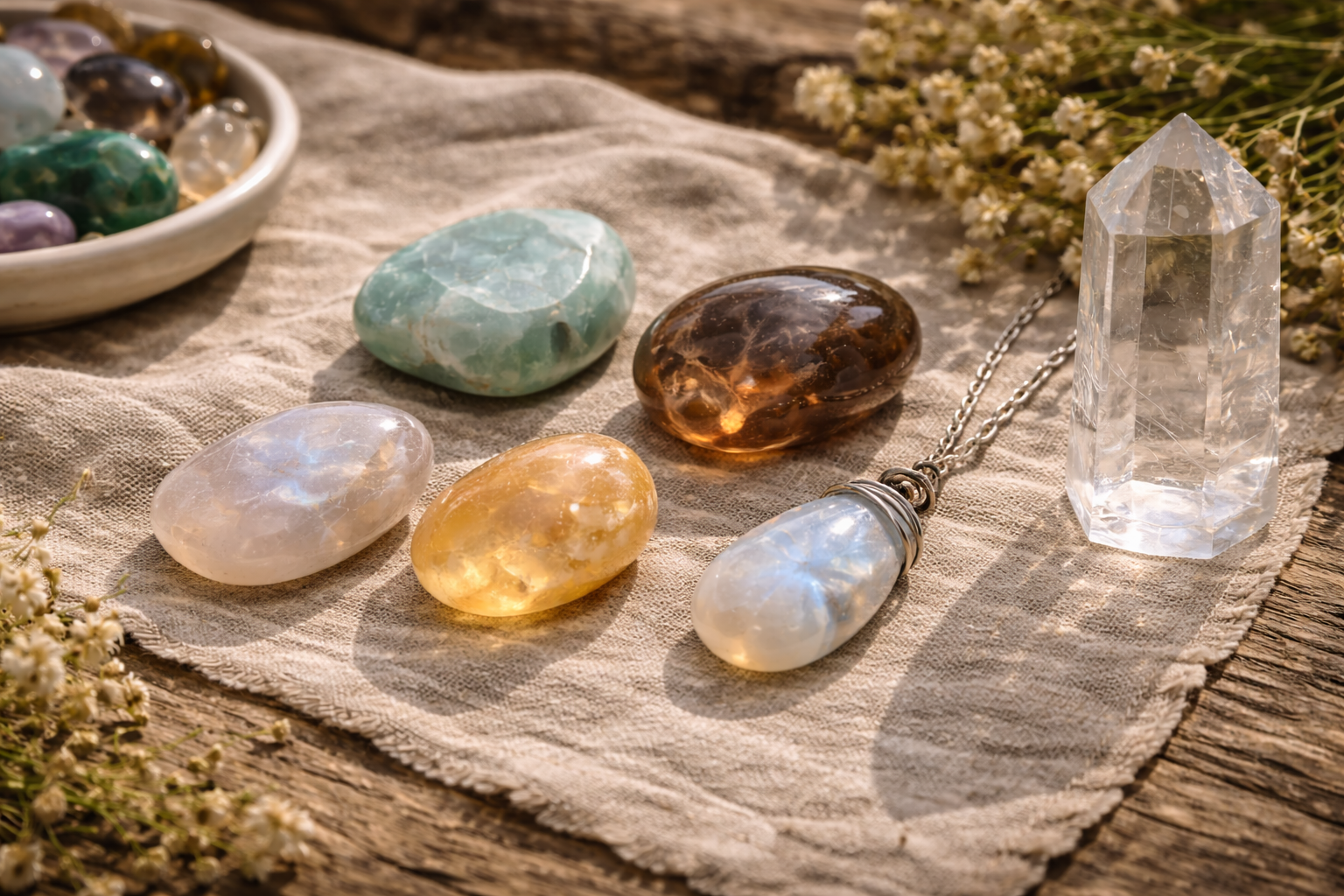
This is an informational search, so you do not need a giant shopping list. You do need a few sharp buying rules.
Buy the form that fits the habit
If the crystal is meant for daily touch, get a tumbled stone, palm stone, or pendant. If it is meant as a visual anchor on a desk or altar, then a point or small standing piece can work. Pretty but impractical is how a lot of beginner buys end up ignored.
Look for clear labeling, not dreamy copy
A good seller tells you what the stone is, whether it is treated, and what form you are getting. Vague blur like “high-frequency abundance crystal” tells you almost nothing.
Know when durability changes the choice
Moonstone is lovely, but it is not the knock-around option. That matters if you want something you will wear every day. Quartz family stones tend to be easier-care, and that is part of why clear quartz and citrine are such practical starters.
Be realistic about citrine
GIA notes that natural citrine is rare in nature and most citrine on the market is heat-treated amethyst. That does not make treated citrine fake. It does mean seller disclosure matters more than romantic wording. If the listing is cagey about what the stone is, move on.
Start modestly
Buy one first piece you will actually use. Not a giant set. Not seven stones because every page said something different. One decent, well-labeled stone beats a bowl of half-connected impulse buys.
Buying shortcut: habit fit first, clear labeling second, symbolism third.
The Mistakes That Make New-Beginnings Crystal Work Feel Vague
This section matters because most disappointment in crystal practice has less to do with the stone and more to do with fuzzy use.
Choosing by prettiness alone
Nothing wrong with liking a stone on sight. The trouble starts when appearance is the only reason. A beautiful moonstone ring can still be the wrong first tool for a career reboot that really needs citrine or green aventurine.
Buying too many at once
Beginners often buy a mixed set, then spread the job across six stones and no actual habit. One lead crystal gives your mind a clean cue. Five crystals give it a mood board.
Using a vague intention
“New beginnings” is not clear enough by itself. Better: “steady in this move,” “soft after the breakup,” “courage for the launch,” “clear after the old role.” Small, concrete, repeatable beats grand and misty every time.
Picking an amplifier when the real need is grounding
This is a sneaky one. People reach for citrine because they want motion. But if they are scattered, fried, or afraid, more brightness is not the first fix. Smoky quartz often does better work at the start because it gives the change somewhere to land.
Turning cleansing into a bigger ritual than the actual change
A gentle cleanse now and then is fine. But the care habit should stay smaller than the life habit. A guide on how do you cleanse your crystals is useful if that part feels muddled, especially for beginners who have picked up too many hard rules from random listicles.
Using smoke or incense without thinking about the room
Simple practical point: the Environmental Protection Agency says to use proper ventilation when burning candles and incense indoors. If smoke cleansing is part of the ritual, crack a window. Keep it basic.
Expecting the crystal to do the life change for you
This is the big one. A crystal can support focus, reflection, symbolism, and consistency. It cannot make the call, end the relationship, sign the lease, or speak the truth in your place. Once you accept that, the whole practice gets cleaner and, weirdly, more useful.
If you want the plainest rule from this whole article, it is this: choose the crystal that matches the next honest step, not the fantasy version of the chapter.
FAQ
Is moonstone or green aventurine better for new beginnings?
Moonstone is better when the change feels emotional, tender, or identity-heavy. Green aventurine is better when the change is about openings, opportunity, and fresh momentum. If you are torn between the two, ask whether the chapter needs softness first or movement first.
Can clear quartz be enough on its own for a fresh start?
Yes. Clear quartz is often the best one-stone answer when the new chapter is broad or still forming. It is flexible, easy to use, and less boxed-in than more mood-specific stones. Later, if the goal sharpens into courage, grounding, or emotional healing, you can switch to a more targeted crystal.
How long should you stay with one new-beginnings crystal?
Long enough to notice whether it still matches the job. For many people that means a few weeks or a full chapter, not a few days. If the life situation changes, the crystal can change too. The cleaner test is simple: does this stone still match the work in front of me?