
If you’ve ever sat down, closed your eyes, pictured a glowing red wheel, and still felt scattered five minutes later, the problem probably was not your imagination. The root chakra is not a light switch. For most people, “opening” it looks a lot more like getting back into your body than having a dramatic spiritual moment.
If you’re wondering how to open the root chakra, start with grounding your body, slowing your breath, and repeating one steady practice for a few days. The root chakra, or Muladhara, is tied to safety, stability, and your sense of footing. So the fastest path is usually physical first, symbolic second.
I learned that the clumsy way. The first time I tried root chakra work, I went straight to the red visualisation, mantra, and crystals. I felt more floaty, not less. A short walk, a longer exhale, and both feet flat on the floor worked better than the fancy stuff.
At a glance
| If this feels like you | Start here | Skip for now |
|---|---|---|
| Buzzing, anxious, too much in your head | Feet on floor, steady walk, slower exhale | Long closed-eye meditation |
| Numb, floaty, disconnected | Food, touch, movement, eyes-open grounding | Heavy visualisation and lots of ritual |
| Rigid, overcontrolled, always braced | Gentle hip movement, breath, softer affirmations | More force and more intensity |
- What “opening” the root chakra actually means
- How to tell the difference between blocked and overactive patterns
- Grounding practices that work fast when you feel unsteady
- A simple root chakra meditation and movement routine
- Which tools are optional, and which ones are actually useful
- A 7-day reset that does not ask you to turn life upside down
Quick rule: if a practice leaves you more present, steadier, and more able to deal with real life, it is probably helping. If it leaves you dreamy, avoidant, or more spun up, scale it down.
What Opening the Root Chakra Actually Means
According to Britannica’s overview of chakras as psychic-energy centres in Hinduism and Tantric Buddhism, this framework comes from spiritual tradition, not modern anatomy. And Cleveland Clinic says chakras are not recognized by Western science, though many people still use them as a metaphor for balance and well-being. That is the cleanest way to hold the idea: spiritually meaningful for some people, not a medical structure you can scan or measure.
So what does “open the root chakra” mean in plain English? It usually means you feel more grounded, more stable, less all over the place, and a bit safer in your own skin. Your nervous system is not solved forever. Your bills do not vanish. But your footing comes back.
That is why I prefer the word balance over open. “Open” makes people think they need an energetic fireworks show. The root chakra is more like a foundation under a house. A strong foundation is not exciting. It is what lets everything else stop wobbling.
The root chakra, or Muladhara, is traditionally linked to the base of the spine, the earth element, the color red, and themes like safety, security, and survival. When people say they want to unblock the root chakra, they are usually saying something simpler: “I want to feel steadier.”
Remember: the goal is not intensity. The goal is steadiness. If you chase sensation, you can miss the quieter signs that the practice is actually working.
Signs Your Root Chakra May Need Attention
Most people land here because something feels off. They feel anxious, ungrounded, over-stimulated, or weirdly disconnected from daily life. That does line up with classic root chakra language, but it helps to separate two patterns that often get mashed together.
| Pattern | Common feel | Better first move |
|---|---|---|
| Blocked or underactive | Floaty, tired, disconnected, unfocused, like your attention keeps leaving the room | Food, movement, sensory grounding, eyes-open practice |
| Overactive | Rigid, braced, hypervigilant, controlling, stuck in survival mode | Slower breath, gentler movement, softer language, less force |
A blocked root chakra is usually described as a lack of grounding. You might feel spacey, insecure, scattered, or unable to settle. An overactive root chakra has a different flavor. The energy is not absent. It is clenched. People in that mode can be overprotective, tense, suspicious, or stuck in “must stay in control” mode.
Cleveland Clinic’s root chakra profile ties Muladhara to groundedness, safety, and security, and notes that when it feels out of balance people may feel unstable or unable to find their footing. That is a useful cue, not a diagnosis.
Here is a quick self-check:
- Do you feel detached from your body after stress?
- Do basic routines like meals, sleep, and movement get messy when life speeds up?
- Do you swing between feeling checked out and feeling braced?
- Do money, housing, work, or family pressure hit you right in the gut?
- Do you keep reaching for more spiritual practices when what you really need is rest, food, or a walk?
If you answered “yes” to several of those, root chakra work makes sense as a starting point.
Important: panic, depression, trauma symptoms, chronic pain, insomnia, or persistent anxiety deserve proper support too. Chakra practice can sit beside care. It should not replace it.
Body-First Grounding Practices That Help You Feel Safer Fast

Cleveland Clinic’s guide to grounding techniques describes them as ways to bring attention back to the present through what you can see, feel, touch, and hear. It also notes that these practices can help when someone feels overwhelmed, disconnected, or stuck in overthinking. That is exactly why they fit root chakra work so well.
When your system does not feel safe, concrete sensation usually beats abstract ritual. Not always. But often enough that it should be your first test.
Start with one of these:
Put both feet on the floor and stay there for one minute
Sounds almost too basic. It works because you stop trying to “transcend” the moment and start inhabiting it. Press the soles down. Feel the chair under you. Loosen your jaw.
Take a steady walk and let your attention drop to your legs
Walking is one of the most under-rated root chakra practices around. You do not need a forest. A ten-minute loop around the block counts. Match your attention to the rhythm of your steps. That is the point.
Use a sensory exercise when your thoughts are racing
Cleveland Clinic suggests the 3-3-3 method: notice three things you can see, three you can hear, and three you can touch. Many people also know the 5-4-3-2-1 version. Either one works because it drags attention out of the spiral and back into the room.
Eat or drink something grounding
This one gets skipped in spiritual content, and it should not. If you are shaky, lightheaded, or “up in the clouds,” a real meal can do more for a root chakra imbalance than another twenty minutes of visualisation.
Connect with touch and temperature
A warm shower, a weighted blanket, a hand on your chest, lotion on your feet, a mug held with both hands. Simple sensory cues give your body something definite to register.
Start here if…
- You feel buzzy: walk, then breathe out longer than you breathe in.
- You feel floaty: eat, move, keep your eyes open, and name what is in front of you.
- You feel tense and overcontrolled: soften the pace, sway a little, and stop trying to do the practice perfectly.
Walking barefoot on grass or soil can be part of this too if it feels good and the place is safe. But do not turn “barefoot outside” into a rule. The rule is simpler: choose the grounding action you will actually do when your footing slips.
Root Chakra Meditation, Breathwork, and the LAM Mantra

The National Center for Complementary and Integrative Health says meditation and mindfulness practices are usually considered low risk, but it also notes that some people do report negative experiences such as anxiety or depression during meditation. That is worth knowing up front because “more meditation” is not always the right answer when someone already feels detached or overstimulated.
So keep root chakra meditation short and grounded at first. Five minutes beats twenty if the shorter practice leaves you steadier.
Try this simple root chakra meditation
- Sit with both feet on the floor or lie down with your knees bent.
- Feel the contact points first: feet, legs, seat, or back.
- Breathe in through the nose. Let the exhale run a little longer.
- Bring attention to the base of the spine or the pelvic floor area.
- Picture roots dropping into the earth, or a deep red glow if visualisation feels natural.
- Repeat “LAM” softly out loud or in your head for a minute or two.
- Finish by opening your eyes and noticing three solid things around you.
The mantra matters less than the effect. If chanting LAM helps you settle, keep it. If it makes you feel self-conscious, skip it. The root chakra meditation that works is the one that leaves you more present when it ends.
There are three useful versions here:
- Breath-first: best for anxious people who need the body to slow down before the mind will cooperate.
- Visualisation-first: best for people who already like symbolic or imaginal practices.
- Eyes-open grounding meditation: best for people who get floaty, dissociated, or sleepy during closed-eye work.
One small opinion here: longer exhales are often a better doorway than more esoteric breathwork. When readers say meditation “doesn’t work,” they are often trying to leap to transcendence when their body just needs a plain, boring signal that says, “you’re here, and you’re safe enough for this minute.”
Note: if meditation leaves you more spaced out, switch to eyes-open practice, shorten the session, and end with movement or food. That is adjustment, not failure.
Yoga and Movement for a More Grounded Root Chakra
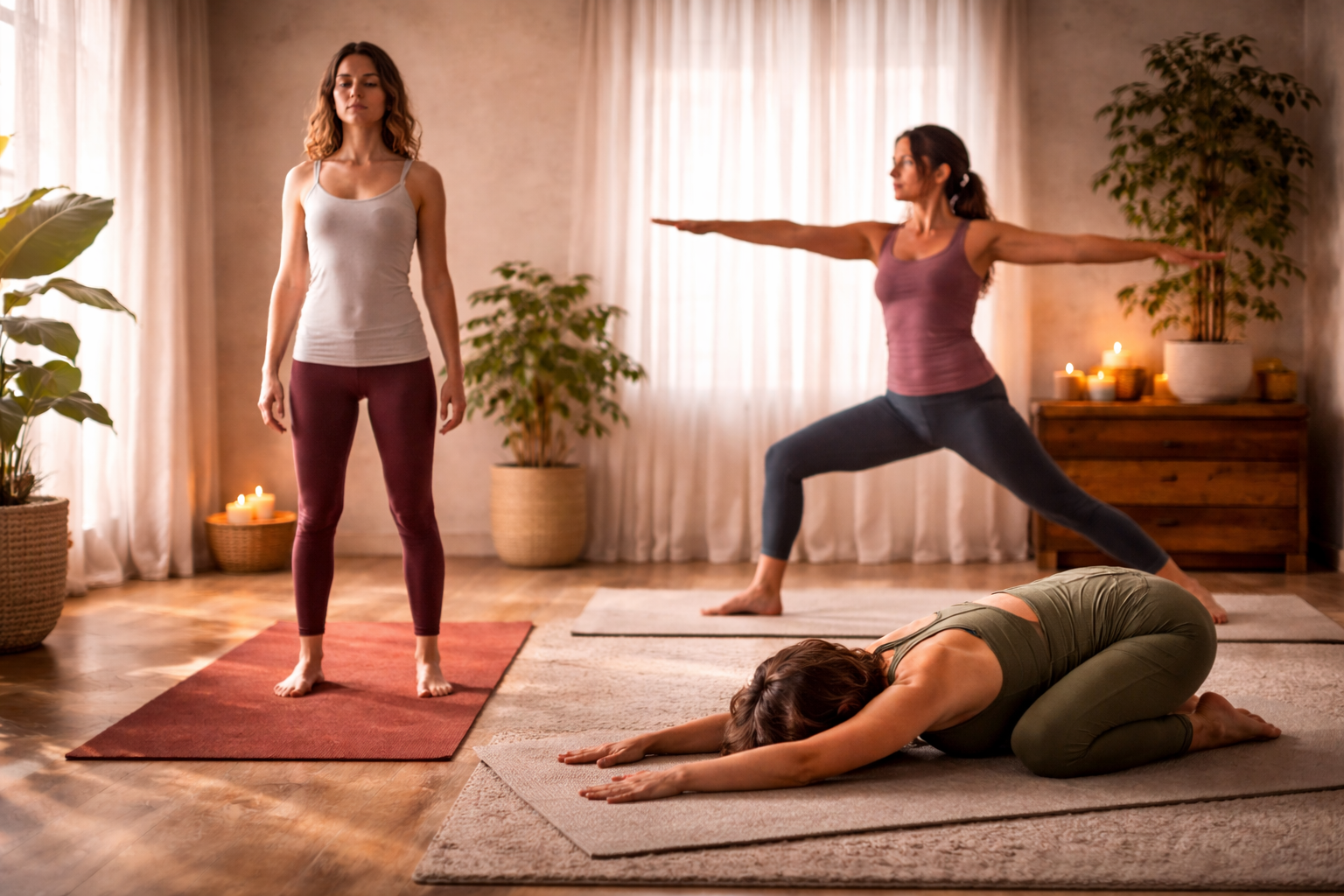
The National Center for Complementary and Integrative Health says studies suggest yoga may help with stress management, mental and emotional health, sleep, and balance. And Cleveland Clinic’s chakra guide links the root chakra to standing poses such as mountain pose and warrior II. That pairing makes sense. Standing poses ask your body to find steadiness, pressure through the feet, and a clear relationship with the ground.
You do not need a full yoga class for this. You need enough movement to make your body feel inhabited again.
Use this 3-pose sequence
Mountain pose for contact. Stand with both feet planted. Spread the toes. Let the knees unlock. Stay for 5 slow breaths.
Warrior II for strength. Step the feet wide. Turn one foot out. Bend the front knee a little and stretch the arms long. Stay for 3 to 5 breaths on each side.
Child’s pose for settling. Lower down and let the back body widen. Stay for 5 breaths if that feels restful, not collapsed.
If you do not like yoga, no problem. Marching in place, gentle squats, dancing in the kitchen, or a short walk all count. The root chakra is not checking whether your movement is branded as yoga.
People often overshoot here. They assume the more intense the movement, the more effective the root chakra healing. That is backwards. If hard exercise leaves you amped and wrung out, it is the wrong tool for this job. Root work tends to respond better to steady movement than to heroic effort.
A quick chooser
- Need calm: mountain pose, child’s pose, slow walk.
- Need strength: warrior II, chair pose, squats.
- Need softness: swaying, hip circles, cat-cow, floor work.
Optional Supports That Can Deepen the Practice
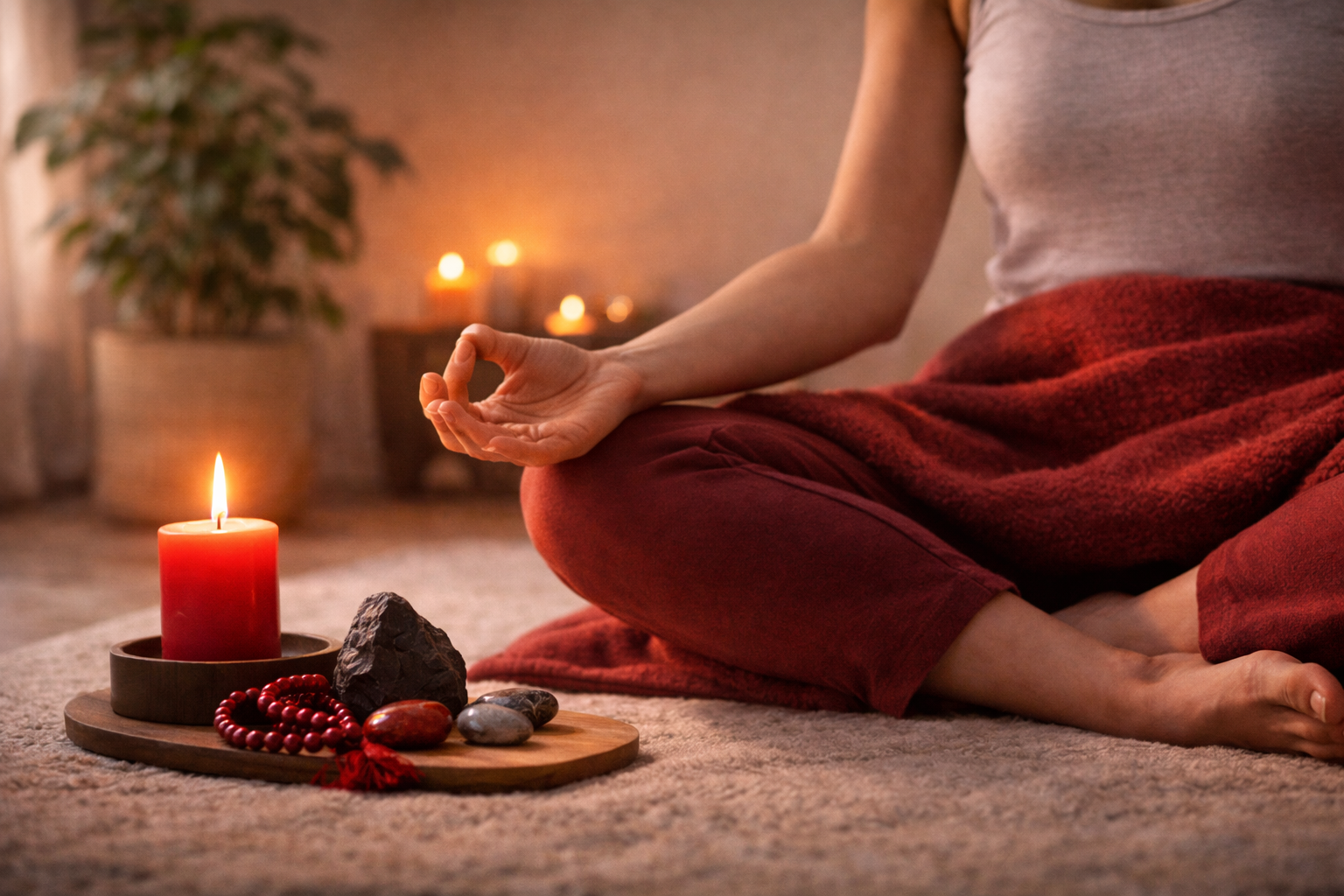
This is where many root chakra articles start. I think that is the wrong order. Affirmations, mudras, color cues, and crystals can help, but they work best when they are supporting a practice that already exists.
Use affirmations as anchors, not magic lines
Short, believable phrases land better than grand declarations. “I am safe in this moment.” “I can return to my body.” “I am allowed to take up space.” If an affirmation feels fake, your system will shrug it off.
Try a root chakra mudra if hand cues help you focus
Some people settle faster when the body has a shape to hold. A simple hand gesture during breathing can act like a bookmark for the nervous system. Keep it small. No need to collect five techniques at once.
Use red and earth symbolism lightly
Red clothing, a red candle, earthy scents, a heavier blanket, sitting near a plant, or placing attention on the lower body can all reinforce the theme of grounding. Symbolism is useful when it makes the practice easier to remember. It gets silly when symbolism replaces the practice itself.
Keep crystals in the support role
If stones are part of the ritual, choose for job, not hype. Black tourmaline is the classic pick for boundaries and grounding. Red jasper often suits people who want a warmer, steadier feel. Hematite can work well as a tactile focus stone. A deeper look at grounding crystals helps sort those differences without turning every black or red stone into the same thing.
For a broader map of which stones are usually linked with each chakra, crystals for chakra alignment gives the standard starter picture. And if the aim is less “which stone?” and more “what do I actually do with it once it is on the table,” a simple guide on how to use crystals for healing is the more useful next step.
There is also a cleaner article-level rule here. A chakra practice gets stronger when one action becomes repeatable. That is why a broader piece on how to heal a chakra can be a better follow-up than another shopping roundup.
Pro tip: one affirmation, one stone, one place to keep it. That is enough. A practice should be easy to repeat on a messy Tuesday.
A Simple 7-Day Root Chakra Reset You Can Actually Keep
This short reset is built for people who want root chakra work to feel practical. Each day takes about 5 to 15 minutes. The point is not perfection. The point is to notice which actions give you more footing.
Day 1. Spot the wobble and choose one anchor
Write down what feels least steady right now: sleep, money stress, scattered focus, tension, social overload, or that floaty disconnected feeling. Then pick one anchor only, such as a walk, feet-on-floor breathing, or a grounding meal.
Day 2. Use your feet to get back into the room
Stand for one minute with both feet planted. Then take 10 slow breaths and let the exhale run longer. If you can, add a 10-minute walk.
Day 3. Add sensory grounding
Use the 3-3-3 method or a 5-4-3-2-1 variation when your mind runs ahead. End the exercise by naming one task you can do in the next ten minutes.
Day 4. Keep meditation short and solid
Do a 5-minute root chakra meditation. Attention on the base of the spine. Longer exhale. Optional red visualisation. Optional LAM.
Day 5. Move the lower body and hold steady
Do mountain pose, warrior II, and child’s pose, or swap in a steady walk and a few bodyweight squats if yoga is not your thing.
Day 6. Add one optional support
Only now add an affirmation, a stone, a mudra, or a red visual cue. If the basics are not working, more symbolism will not fix that.
Day 7. Review what actually changed
Ask a blunt question: what made me feel more present? Track sleep, irritability, follow-through, body tension, and how quickly you can come back after stress. Keep the one or two practices that made a real dent.
That review day matters more than it looks. Plenty of people do chakra work for a week and only ask, “Did anything mystical happen?” A better question is, “Did I get steadier?” That is a much more honest metric.
Why Root Chakra Work Sometimes Feels Like It Is Not Working
Most of the time, the practice is not failing. The setup is.
Here are the five mistakes I see most often.
Using everything at once
Meditation, chanting, incense, crystals, yoga, journaling, sound baths, visualisation. It sounds devoted. It usually turns into mush. Pick one main practice and one support.
Measuring progress by fireworks
The root chakra often improves in boring ways. You stop doom-scrolling quite so hard. You eat before you crash. You get through a tense morning without floating out of your body. That counts.
Staying in your head
If all your root chakra work happens from the neck up, you are missing the point. This chakra is about the body, the floor, weight, breath, pressure, rhythm, contact.
Making the practice too airy for your actual state
When people feel dissociated or overloaded, long visualisation can make the gap worse. That is when food, movement, and sensory cues beat “higher” practices.
Thinking a hard week means you are back at zero
Life will knock your footing around. Travel, conflict, money stress, grief, sleep loss, too much screen time. None of that means the practice is fake. It means the foundation needs maintenance.
Think of it like building a house. You do not pour the foundation once, clap for yourself, and expect the ground never to shift. You check it. You maintain it. You stop pretending the front door matters more than the slab underneath.
Signs the work is helping
- You come back to yourself faster after stress.
- Your breathing slows more easily.
- You feel less floaty after meditation.
- Simple routines get easier to keep.
- You feel steadier, not more dramatic.
When Root Chakra Practices Help, and When You Need More Than Chakra Work
Root chakra work tends to help most during seasons of instability. Moving house. A breakup. A job wobble. Money fear. Too much travel. Too much noise. The weird thin feeling after weeks of living online instead of in your body. In those moments, practices linked to safety and grounding can be genuinely comforting.
But there is a line here, and it is worth saying plainly. If your symptoms are severe, persistent, or tied to trauma, more ritual is not always the answer. A therapist, doctor, or other qualified support may do more for your footing than another round of spiritual troubleshooting.
The best use of chakra work is not as an escape hatch. It is as a way back into contact with your life.
That is the rule I come back to: keep the practice if it helps you meet reality with a steadier body and a clearer mind. Change course if it mostly helps you avoid reality while feeling spiritual about it.
FAQ
Can you work on the root chakra every day?
Yes. Daily root chakra work usually works better when it stays small: a short walk, steady breathing, one grounding phrase, or five minutes of simple meditation. Everyday repetition tends to help more than a huge once-a-week ritual.
Do you need crystals to open the root chakra?
No. Crystals can support attention and symbolism, but they are optional. If the goal is grounding, movement, breath, food, sleep, and sensory presence do more of the heavy lifting.
Should you start with the root chakra before the others?
In many cases, yes. If you feel scattered, unsafe, or disconnected, starting with the root makes sense because it deals with basic steadiness. Building from the ground up is usually easier than chasing upper-chakra practices while the foundation still feels shaky.