
You can usually spot the moment someone starts looking for the best grounding crystals. They are not peacefully browsing. They feel scattered, buzzy, a little too up in the clouds, and every list on the internet keeps handing them the same pile of black stones with almost no help sorting them out.
So here is the fast answer. For most people, the best grounding crystals are black tourmaline, smoky quartz, hematite, red jasper, and obsidian. Black tourmaline is the best place to start if you want grounding plus protection. Smoky quartz is the easiest all-rounder if you want something gentler. Hematite is the sharpest pick for focus and mental clutter. Red jasper is steady and warm. Obsidian is powerful, but it can feel like a lot.
That stock answer still leaves out the part that actually matters: which one fits the way you feel right now. A stone for overthinking is not always the same stone that works best after a draining social day, and a crystal that looks dramatic on a shelf can be a terrible first buy for daily use.
At a glance
- Best for protection: Black tourmaline
- Best for gentle everyday grounding: Smoky quartz
- Best for focus and getting out of your head: Hematite
- Best for stamina and emotional steadiness: Red jasper
- Best for deep clearing and hard resets: Obsidian
| Stone | Feels like | Best when |
|---|---|---|
| Black tourmaline | A raincoat | You want grounding and protection |
| Smoky quartz | A dimmer switch | You feel wired and need calm without heaviness |
| Hematite | A paperweight | Your mind is racing and you need to focus |
| Red jasper | Solid walking shoes | You want steadiness, routine, and follow-through |
| Obsidian | A sharp reset | You want strong boundary energy, not softness |
Simple rule: if you want one no-regret beginner stone, start with smoky quartz or black tourmaline.
What this guide will help you do:
- Pick the right grounding stone for anxiety, protection, focus, or emotional steadiness
- See the real tradeoffs between black tourmaline, smoky quartz, and hematite
- Choose the right format, from palm stone to bracelet
- Use grounding crystals in a way that actually fits daily life
- Avoid the mistakes that lead to clutter, regret, and very pretty paperweights
Best Grounding Crystals at a Glance
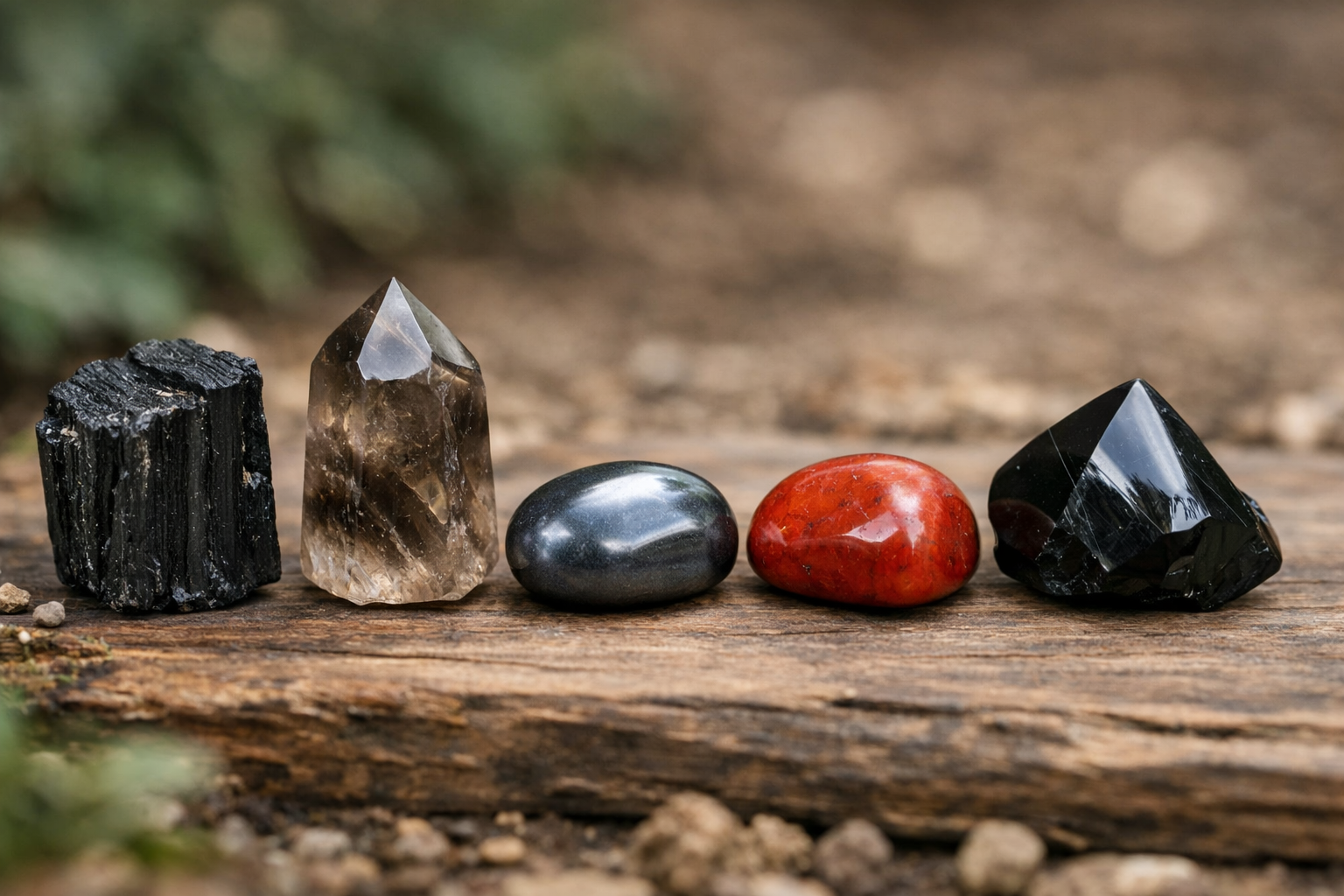
Most searches for “best grounding crystals” are really asking a slightly messier question: “Which stone will make me feel less spun out, less drained, or less floaty without me having to buy six things first?”
Here is the shortlist I keep coming back to:
- Black tourmaline: best for grounding plus protection, especially if crowded rooms, intense people, or chaotic spaces wipe you out.
- Smoky quartz: best for soft, steady grounding when you want to feel calmer, not armored.
- Hematite: best for focus, practical action, and the very specific feeling of “my brain won’t stop buzzing.”
- Red jasper: best for steadiness, patience, and getting your feet back under you.
- Obsidian: best for hard resets and strong boundaries, though it can feel intense for beginners.
Quick pick: If you do not know where to start, pick smoky quartz for gentle all-day grounding or black tourmaline for grounding with a protective edge.
The reason these five keep showing up is simple. They cover the main jobs people actually want from grounding stones: calm, protection, focus, steadiness, and reset. You do not need a giant collection to get there. One well-chosen stone usually beats a random starter pack.
If the goal is broader than grounding alone, this healing crystals guide covers the wider starter set that makes sense for stress, sleep, love, and protection too.
How to Choose the Right Grounding Crystal for Anxiety, Protection, or Focus
The easiest way to choose a grounding crystal is to stop asking which one is “strongest” and start asking what job it needs to do.
If you feel overstimulated by people, noise, or weird social residue, go for black tourmaline. It is the best crystal for empaths, or at least for people who feel porous in busy spaces. If your mind is loud and jumpy, hematite tends to work better. If you feel anxious, floaty, or disconnected after meditation, big conversations, or too much screen time, smoky quartz is often the smoother fix.
Here is a quick chooser that actually narrows things down:
Ask these 3 questions:
- Do I need calm, protection, or focus?
Calm points to smoky quartz. Protection points to black tourmaline. Focus points to hematite. - Do I want something gentle or strong?
Gentle points to smoky quartz or red jasper. Strong points to obsidian or black tourmaline. - Will I carry it, wear it, or place it somewhere?
Carry or wear points to smooth stones and bracelets. Placement points to raw chunks, palm stones, or towers.
There is also the root chakra angle. In crystal language, grounding stones are often treated as root chakra crystals because they are tied to safety, stability, and physical presence. That framing is useful as shorthand, but do not let it overcomplicate the buy. The better question is still practical: what helps you come back into your body fastest?
One mistake shows up all the time. People think protection and calm are the same thing. They are not. Black tourmaline can feel protective and firm. Smoky quartz feels quieter. That difference matters more than the stone’s reputation.
Black Tourmaline, Hematite, and Smoky Quartz Compared
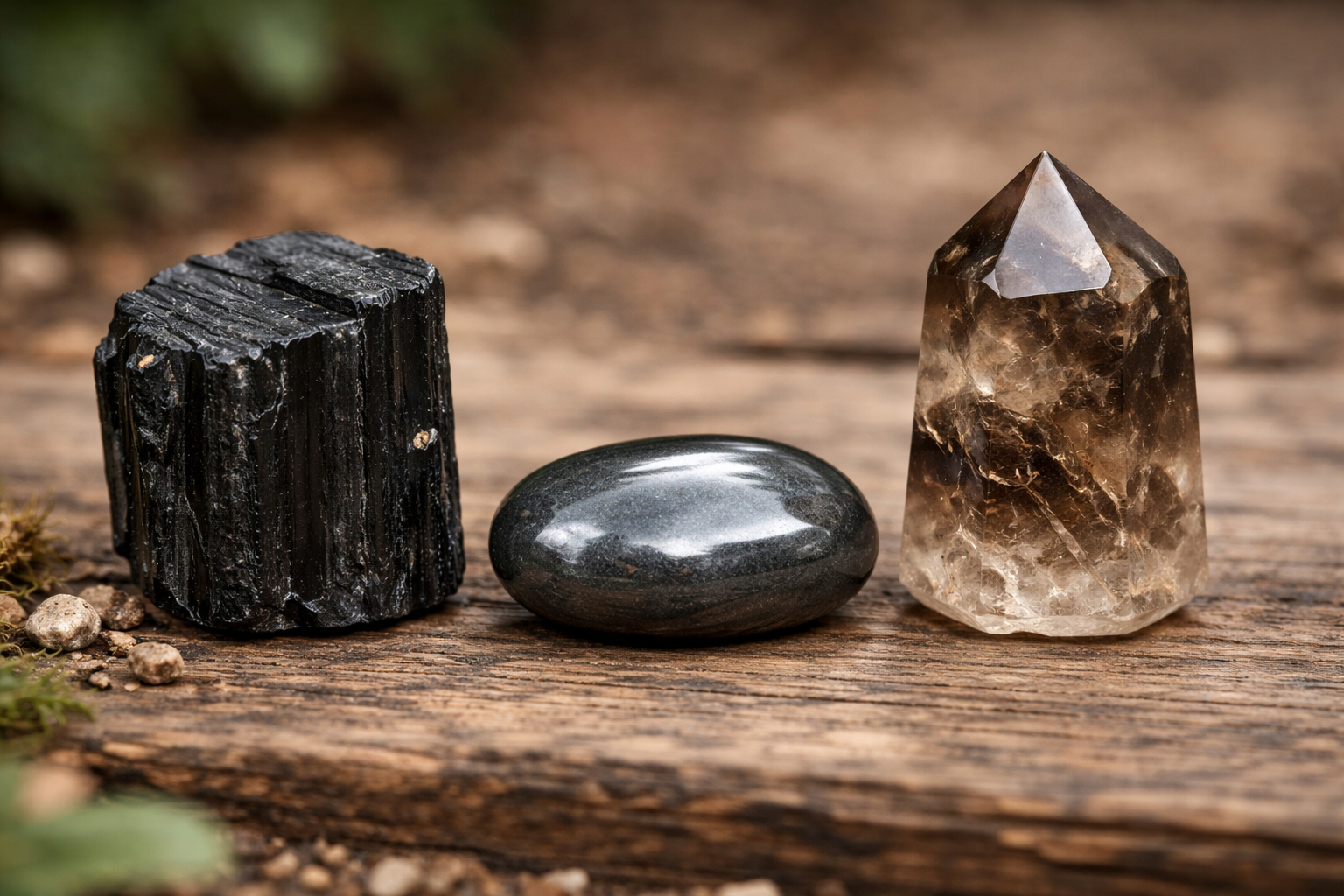
These are the real heavy hitters. If you compare grounding stones side by side, most beginner decisions land here.
Black tourmaline
Black tourmaline is the default answer for good reason. It is one of the best crystals for grounding and protection, and it shines when the problem feels external. Think crowded commutes, draining workplaces, tense family visits, or those days when everyone seems to be leaning on your nervous system at once.
In practice, black tourmaline feels firm. It has a “not today” quality. I like it most near an entryway, on a desk, or in a pocket during socially messy days. Where people get it wrong is using it when what they really want is softness. If you are already wound tight, black tourmaline can feel a bit hard-edged.
Hematite
Hematite is less mystical-feeling and more practical-feeling. That is part of its charm. It is the best crystal for overthinking if the overthinking has a sharp, mental, spinning quality. It feels weighty in the hand, which is why hematite palm stones and bracelets work so well. The body notices weight fast.
When I compare hematite with black tourmaline, the difference is pretty obvious. Tourmaline feels like a shield. Hematite feels like gravity. If your brain is doing laps and you need to answer the email, finish the task, or stop mentally hovering above your own day, hematite is usually the better tool.
Smoky quartz
Smoky quartz is the easiest stone here to live with. It grounds, but it does not slam the brakes. It is the one I reach for when the energy is anxious, jangly, or slightly unreal rather than actively hostile. A lot of people searching for grounding crystals for anxiety do better with smoky quartz than with a harsher black stone.
The tradeoff is that smoky quartz does not feel as boundary-heavy as black tourmaline, and it is not as bluntly focusing as hematite. That is fine. It is a better everyday companion for many people because it is less bossy.
Fast rule: If crowded spaces scramble you, choose black tourmaline. If your thoughts will not sit down, choose hematite. If you feel wired and want the edge taken off without feeling boxed in, choose smoky quartz.
The Other Grounding Crystals Worth Considering
The main trio covers most people. Still, a few other grounding stones earn their place.
Red jasper
Red jasper is steady in a warm, human way. Not flashy. Not severe. It works well when the goal is routine, patience, and emotional stamina rather than sharp protection. If black tourmaline feels too stern and hematite feels too metallic, red jasper often lands better.
Obsidian
Britannica describes obsidian as a natural volcanic glass formed by rapidly cooled lava, which is worth knowing because people often treat it like just another black crystal. It is not quite that. In practice, obsidian often feels more cutting and more confrontational. Some people love that. Others find it a bit much, especially at the start.
If you want a deep clearing stone, obsidian makes sense. If you want comfort, I’d skip it and go smoky quartz or red jasper instead.
Black onyx
Black onyx sits in a nice middle lane. It is disciplined, composed, and easy to wear. I like it for daily bracelets because it is simple and less fussy than some stones that chip, scratch, or feel too ceremonial for everyday use.
Shungite
Shungite gets pulled into every kind of claim online. I would keep it boring. Buy shungite if you like its heavy, earthy feel and want another grounding option. I would not buy it because someone promised tech-proof magic. That is where crystal shopping drifts off the road a little.
If cleansing rituals are part of the routine, this incense guide is a more useful companion than another random stone.
How to Use Grounding Crystals Without Making It a Whole Production
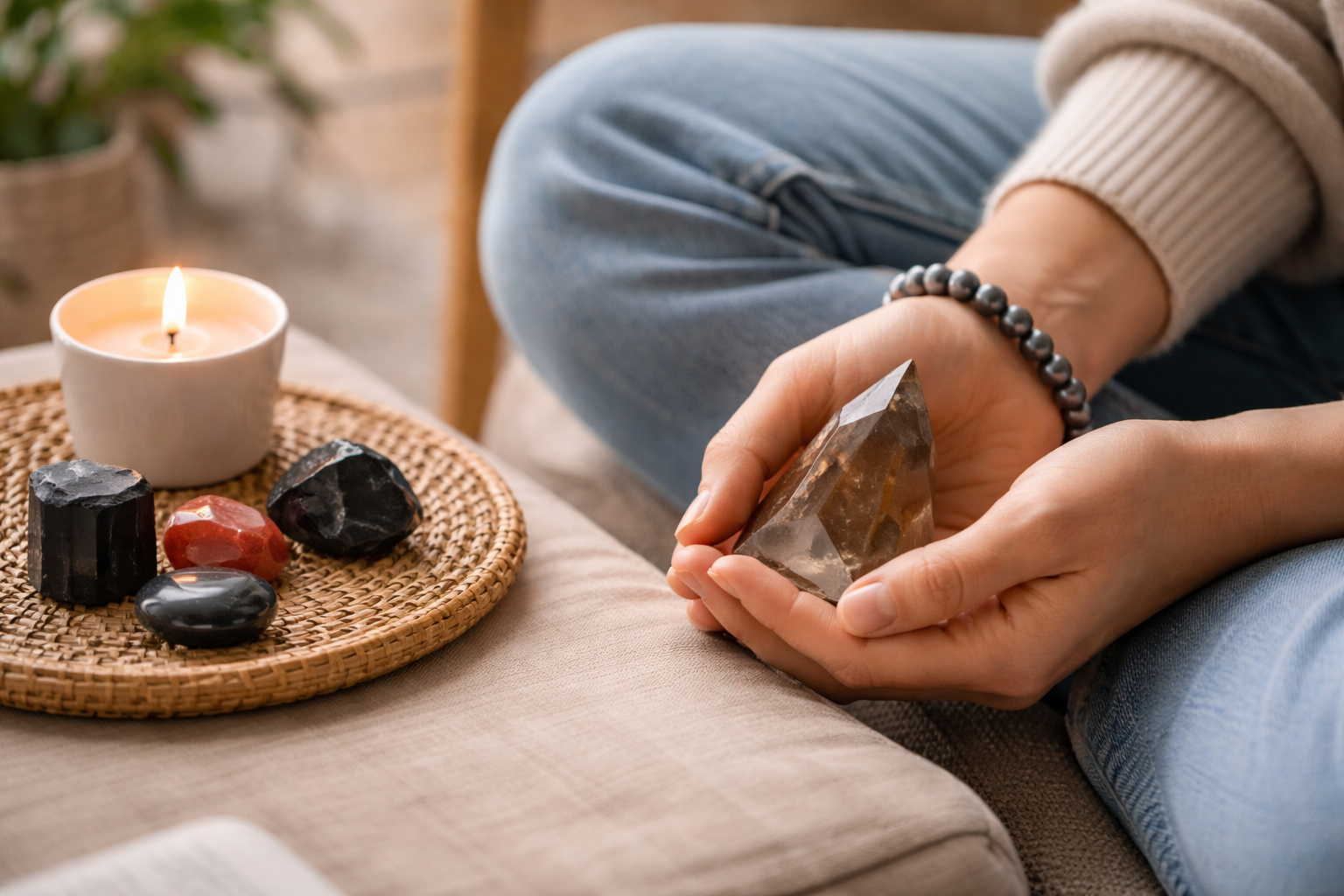
This part gets overcomplicated fast. You do not need a moon-phase spreadsheet and twelve steps before breakfast.
Carry it where the wobble happens. If your hardest moments happen outside the house, a pocket stone or bracelet makes more sense than a chunky display piece. If the problem shows up at a desk, put the crystal at the desk.
Pair it with a grounding action. Cleveland Clinic recommends sensory grounding methods like the 5-4-3-2-1 exercise, where you name five things you see, four you feel, three you hear, two you smell, and one you taste. That works beautifully with a stone because the crystal gives your hand somewhere to land while your attention comes back to the room.
Use it during breathwork or meditation. The National Center for Complementary and Integrative Health notes that mindfulness practices can help with stress and sleep for some people. So when a grounding crystal feels calming, part of that effect may come from the breathing, stillness, and repetition wrapped around it. That does not make the ritual worthless. It makes it easier to understand.
Place it where you transition. Entryways, bedside tables, desks, and meditation corners all make sense. A stone placed in a forgotten decorative bowl across the room usually does very little because you never touch it or notice it.
A simple 60-second grounding ritual
- Hold the stone in one hand.
- Press your feet into the floor.
- Breathe in for 4 and out for 6, three times.
- Name 3 things you can see, 3 things you can feel, and 3 things you can hear.
As for cleansing and recharge rituals, keep them simple. Set an intention. Wipe the stone down if needed. Use moonlight, breath, or smoke if that fits your practice. If sage is part of the ritual, this sage guide gets into the tradeoffs without turning it into cosplay.
What to Buy: Raw Stone, Palm Stone, Bracelet, Tower, or Starter Set
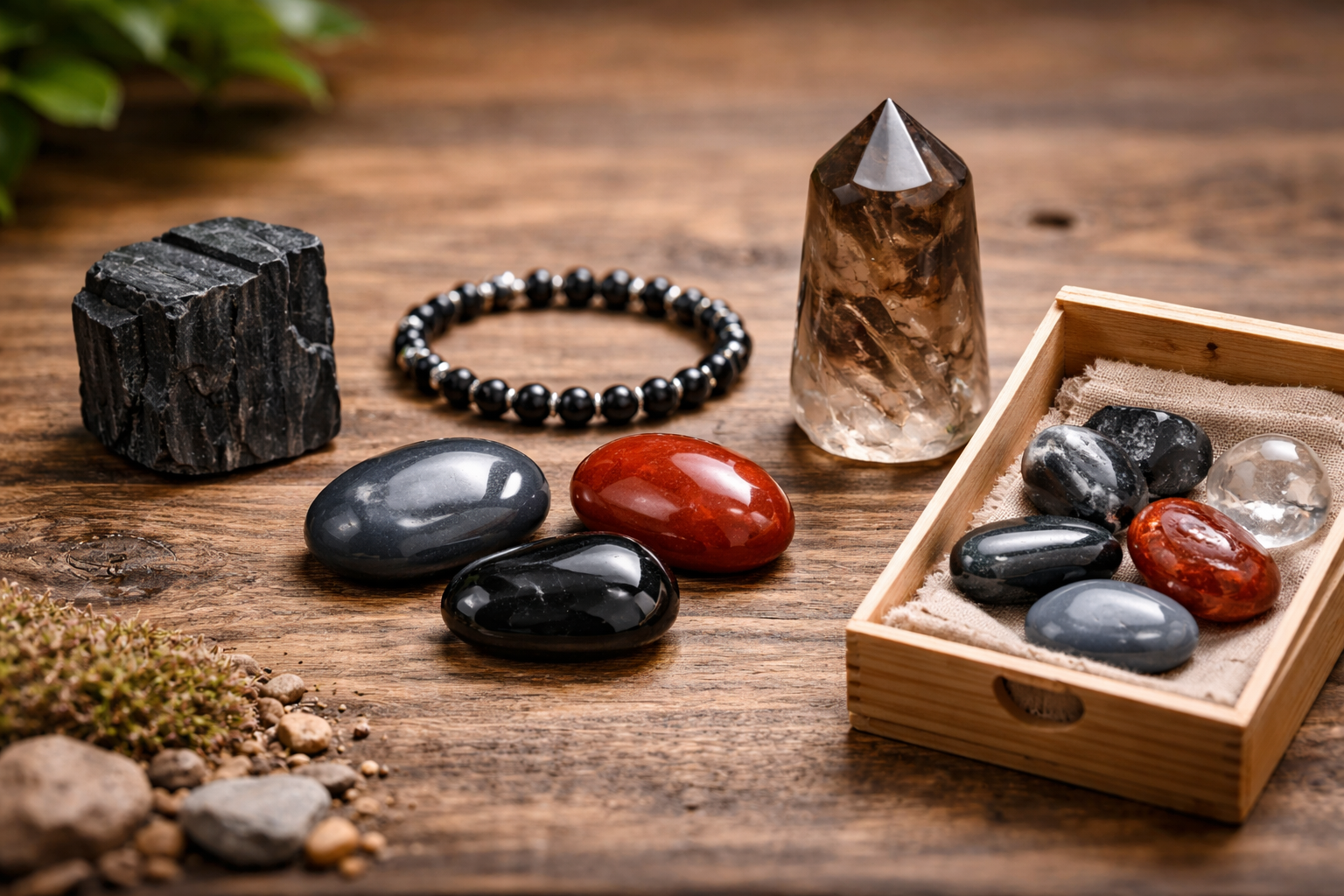
The smartest buy is not always the prettiest buy.
Palm stones and tumbled stones are the safest first pick for most people. They fit in a pocket, sit well in the hand, and make actual contact with you during tense moments. That sounds obvious, but contact is the whole game here.
Bracelets and pendants are best if you want an all-day reminder. Black onyx, hematite, and black tourmaline all work well in wearable form. The upside is access. The downside is that some bracelets are bought for the look and then never used with intention at all.
Raw chunks are great for placement. They work well on a desk, near a front door, or beside a meditation cushion. Raw black tourmaline in particular suits this format because it looks like a small geological boundary marker. Very satisfying, honestly.
Towers and points look dramatic and photograph well, but they are not my favorite first buy for grounding work. They are less tactile, more fragile, and easier to treat like decor.
Starter sets can work, but only when the set is curated by job. A set that gives you one calming stone, one protective stone, and one general all-rounder is useful. A random seven-chakra assortment often leaves beginners with several stones they do not know how to use.
Buying checklist: Look for a shape you will actually use, a size the seller states clearly, photos that show natural variation, and product copy that does not make wild medical claims.
One good stone beats a drawer full of maybe-laters. Every time.
Common Grounding Crystal Mistakes That Lead to Bad Picks
Buying for aesthetics only. A glossy tower can be beautiful and still be wrong for the job. If you need something during anxious moments, beauty matters less than grip, weight, and access.
Confusing protection with calm. This is the big one. People who need soft grounding often buy the toughest-sounding stone they can find. Then the crystal feels cold, too intense, or just off. Smoky quartz and red jasper are often better first buys than obsidian for that reason.
Starting with too many stones. When you buy five at once, it gets weirdly hard to notice what actually helps. Start with one. Use it for a week. Then add if you still feel a gap.
Expecting the stone to do all the work. A crystal can act like a cue, an anchor, a ritual object, a tactile reminder. It is much weaker when it is asked to replace sleep, boundaries, breathing, or actual support.
Choosing the wrong format. A desk stone helps at a desk. It does not help much on the train. A bracelet helps on the train. It does not do much for the front door unless you are wearing it.
The pattern underneath these mistakes is simple. The wrong grounding crystal is often not a bad stone. It is just a bad match.
What Grounding Crystals Can Help With, and What They Cannot
There is a clean way to talk about this without flattening the whole practice into cynicism.
A grounding crystal can help as a ritual anchor. It can give your hand something to hold, your attention somewhere to settle, and your day a tiny repeatable cue that says, “come back here.” That is real as an experience. A lot of spiritual tools work that way.
But there is a line, and it matters. The UK’s Advertising Standards Authority says crystal therapy should not be presented as a treatment for medical conditions without proper clinical evidence. That is a good standard. It keeps the language honest.
The same caution shows up in research. A 2025 study indexed in PubMed found that healing crystals did not outperform placebo for anxiety-related effects. Belief and expectancy mattered more than the crystal assignment itself. So if a grounding stone helps you slow down, breathe, and pay attention, that can still be meaningful. It just should not be sold as medicine.
Useful boundary: Grounding crystals can support a calming ritual. They are not a stand-in for mental health care, medical treatment, or the basics that keep a nervous system happier, like rest, food, movement, and safer boundaries.
That boundary does not ruin the magic. If anything, it makes the practice cleaner. You can enjoy the symbolism, the texture, the rhythm, and the quiet little shift a stone helps create without pretending a tumbled rock is a prescription.
FAQ
What is the best grounding crystal for beginners?
For most beginners, smoky quartz is the easiest place to start because it feels gentle, easy to carry, and less intense than obsidian or black tourmaline. If protection matters as much as grounding, black tourmaline is the better first pick.
Where should grounding crystals go in a home?
Put grounding crystals where you actually feel dysregulated or where you transition in and out of the day: near the front door, on a desk, beside the bed, or in a meditation corner. Placement works best when the stone is visible and easy to touch.
Can you wear grounding crystals every day?
Yes. Bracelets and pendants are often the most practical way to use grounding stones daily. Hematite, black onyx, black tourmaline, and smoky quartz all work well in wearable form, as long as the piece is comfortable enough that you will actually keep it on.