If you’re wondering what crystals are good for anxiety, the short answer is this: amethyst is the safest all-round first pick for racing thoughts and bedtime tension, rose quartz is better for self-criticism and emotional rawness, and black tourmaline or smoky quartz make more sense when the feeling is buzzy, scattered, or boundary-drained. Lepidolite is the one people often reach for when they feel stretched thin. Sodalite can be a smart side door for social anxiety. And clear quartz is less a star player than a useful backup.
The reason this question gets messy fast is simple. Anxiety is not one feeling. The crystal that helps when your mind won’t stop replaying a conversation at 1:17 a.m. is often the wrong one for a crowded train, a shaky work presentation, or that bruised, tender feeling after an argument.
I’ve made that mistake myself. Years ago I kept grabbing amethyst for everything because every list said to. Pretty stone. Fine advice. But it wasn’t the best fit on the days I felt overexposed and fried. A palm-sized smoky quartz helped more because I didn’t need “more calm.” I needed to get back in my body.
- Which crystal fits the kind of anxiety you’re dealing with
- The 7 stones most worth knowing and where each one falls short
- How to choose between calming, grounding, and comforting crystals
- What works better for sleep, social anxiety, and draining environments
- How to use a crystal so it becomes a real cue, not shelf decor
- What crystals can support and what they should never replace
Anxiety crystal quick-match
| If the feeling is… | Start with | Better backup | Why it fits |
|---|---|---|---|
| Racing thoughts at night | Amethyst | Lepidolite | Gentle, cooling, and easy to keep by the bed |
| Emotionally scraped raw | Rose Quartz | Moonstone | Softens self-judgment and settles the heart-first kind of anxiety |
| Buzzy, ungrounded, overstimulated | Smoky Quartz | Black Tourmaline | Helps when calm is not enough and you need steadiness |
| Social nerves or shaky voice | Sodalite | Blue Lace Agate | A better fit when anxiety shows up in your throat and timing |
| Stretched thin and frayed | Lepidolite | Clear Quartz | Useful when the mood is “I cannot hold one more thing” |
Simple rule: one stone for one job beats a random starter bundle every time.
What crystals are good for anxiety? Start with these 7
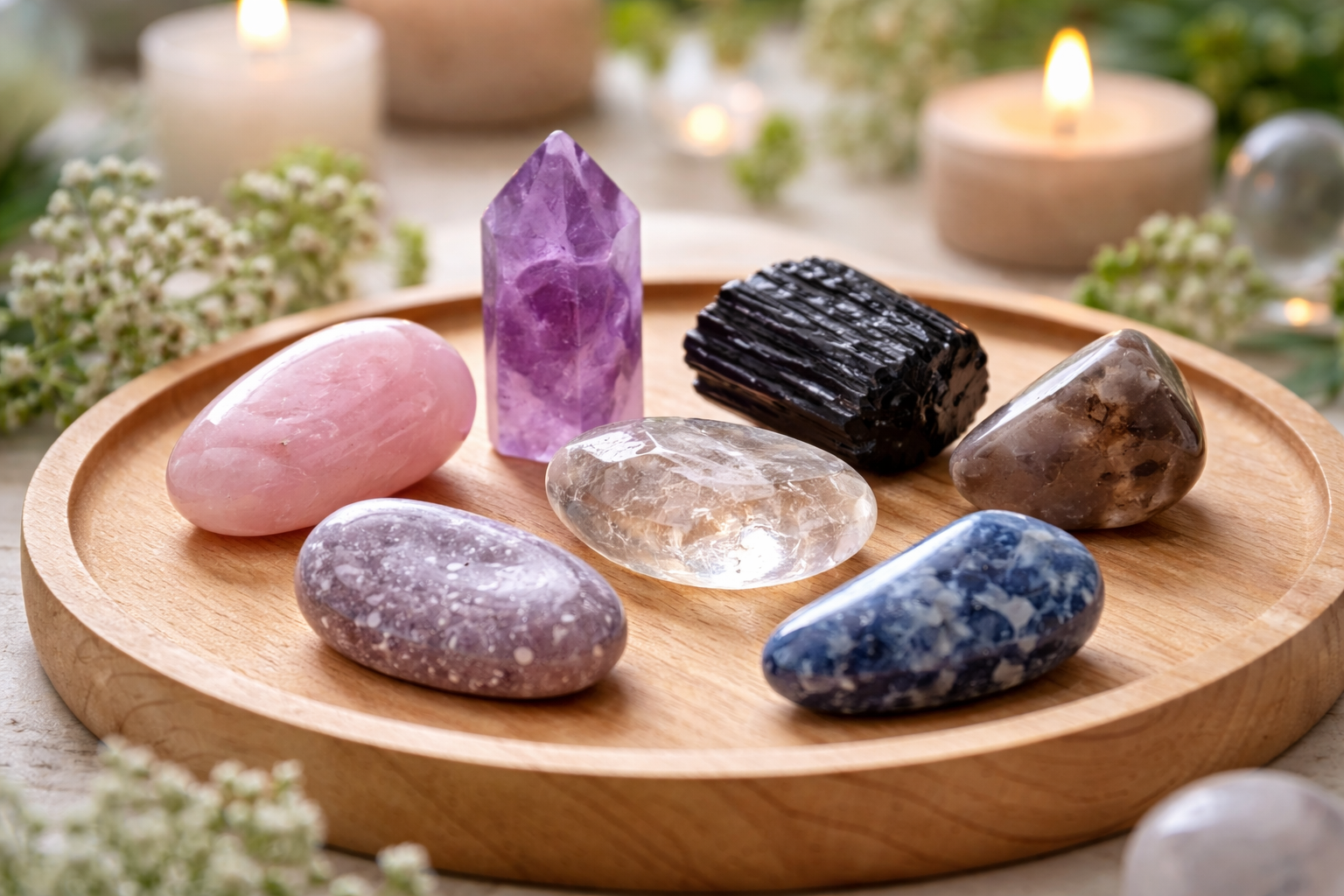
If you want a clean shortlist and not a mystical scavenger hunt, start here: amethyst, rose quartz, black tourmaline, smoky quartz, lepidolite, clear quartz, and sodalite.
That group covers the main jobs people actually need help with. Not every list gets that part right. Some toss twenty stones into a bowl and call it helpful. It isn’t. You don’t need more options. You need a shorter bench and a better way to choose.
Amethyst is the first pick for a loud mind. It suits anxious overthinking, bedtime spirals, and the feeling that your brain is running five tabs at once.
Rose quartz is the soft landing. It fits anxiety that feels tied to hurt, self-blame, conflict, or old emotional bruising.
Black tourmaline is the harder shield. It makes the most sense when the feeling is environmental. Crowds. Draining people. Too much noise. Too much static.
Smoky quartz is grounding without being stern. I like it for travel days, busy weeks, and that floaty “I am here but not fully here” mood.
Lepidolite is the stone people often pick when they feel frayed at the edges. It gets recommended a lot for good reason, though the reason is often explained badly.
Clear quartz is a flexible helper, not always the first answer. It pairs well with a more targeted crystal when you want extra focus or a clearer ritual.
Sodalite earns its place because some anxiety is not about calm at all. It’s about speaking, being seen, and staying coherent when nerves hit the throat.
Best beginner move: pick one crystal that matches your main anxious pattern for the next seven days. Don’t buy three “just in case.” That usually turns clarity into clutter.
Match the crystal to the kind of anxiety you are actually feeling
This is where most articles stop being useful. They treat anxiety like one blob. It isn’t. The better question is not “Which stone is strongest?” It’s “What exactly is going wrong in my system right now?”
1. Loud, wired, overthinking anxiety
Go with amethyst first. If the mind is looping but your body also feels worn out, try lepidolite next. These are the stones I reach for when the problem feels mental before it feels emotional.
2. Emotionally raw anxiety
Choose rose quartz. This is the kind that shows up after hard conversations, rejection, grief, or a week when everything hits a little too hard. A grounding stone can feel too cold here. Rose quartz works because it doesn’t ask you to toughen up.
3. Scattered, buzzy, overstimulated anxiety
Start with smoky quartz. Move to black tourmaline if the setting itself feels like the problem. Think airports, offices, public transport, waiting rooms, or a family gathering that makes your shoulders creep toward your ears.
4. Social anxiety and shaky communication
Pick sodalite if your mind blanks out when you need words. Pick rose quartz if the social fear is more about self-worth than speech. If it is both, pairing those two can work well.
5. Frayed, thin-skinned, “I cannot absorb one more thing” anxiety
Try lepidolite. Not because it is magic in a geologic sweater, but because many people use it like a quieter emotional buffer. It suits transition-heavy periods. New job. Breakup. Family stress. The whole low-battery mess.
The best distinction to remember is this: calming crystals lower the internal noise. Grounding crystals bring you back to earth. Comforting crystals soften the emotional sting. Those are three different jobs.
Pairing rule: if you want to combine crystals, use one for calm or comfort and one for grounding. Don’t stack two sleepy stones and expect better results. That can feel muddy fast.
If mixed moods are the norm, a page like crystals for anxiety and depression makes a better next stop than another generic roundup. Mood texture matters more than hype.
The best crystals for anxiety, with the tradeoffs most lists skip
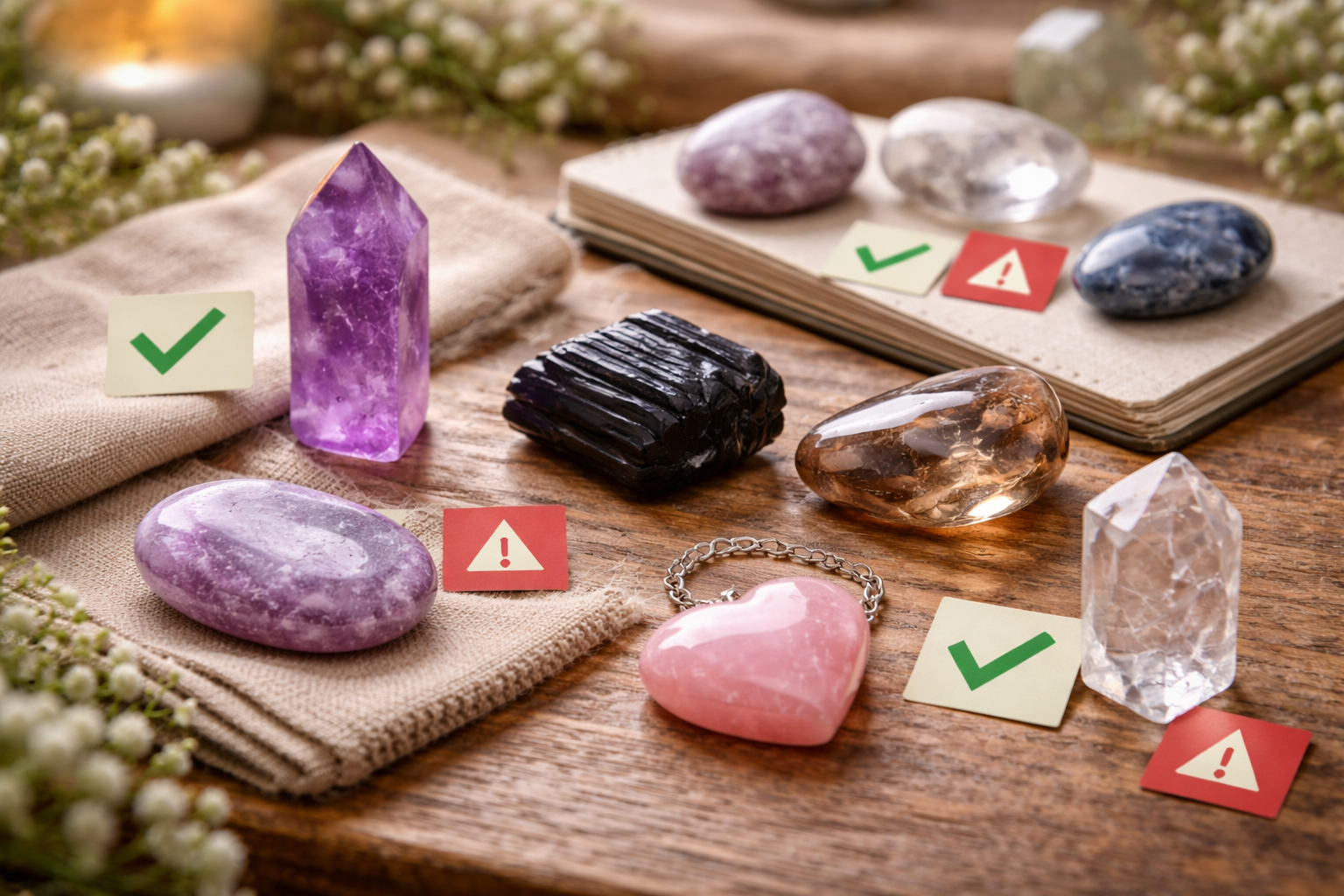
Every crystal on the shortlist does something well. Every crystal also has a point where it stops being the smart pick. That’s the part worth knowing.
| Crystal | Best for | Where it falls short | Best first form |
|---|---|---|---|
| Amethyst | Racing thoughts, bedtime worry, mental clutter | Can feel too floaty if you need grounding more than calm | Small palm stone or bedside piece |
| Rose Quartz | Self-criticism, conflict, emotional tenderness | Too soft for boundary-heavy stress | Worry stone or heart-area pendant |
| Black Tourmaline | Crowds, draining environments, protection-minded use | Can feel a bit stern if your anxiety is heartbreak-shaped | Pocket stone or desk piece |
| Smoky Quartz | Overstimulation, floaty stress, decompression | Less “soft” than rose quartz and less blunt than black tourmaline | Palm stone or bracelet |
| Lepidolite | Frayed nerves, transitions, stretched-thin mood | Often oversold because of its mineral makeup | Tumbled stone or bedside piece |
| Clear Quartz | Pairing, focus, all-purpose ritual use | Too general if you need a direct answer | Tumbled stone or small point |
| Sodalite | Social anxiety, speaking nerves, self-expression | Not the best bedtime choice if you mainly want softness | Pocket stone or pendant |
Amethyst is popular because it earns it. If anxiety lands in your head first, amethyst is a very fair starting pick. I like it most by the bed or in the hand during quiet-down time. I like it less for a packed commute or a brutal Monday morning. That is smoky quartz territory.
Rose quartz works best when anxiety is entangled with hurt. Not all anxious states want “protection.” Some want gentleness. Rose quartz is the better tool when the inner talk is sharp and the nervous system feels emotionally sore.
Black tourmaline is the classic grounding and protective crystal for anxiety. That reputation makes sense. Still, I would not hand it to everyone as the first answer. If your problem is feeling tender, exposed, and easily upset, black tourmaline can feel like boots when you needed a blanket.
Smoky quartz is often the more forgiving grounding choice. It steadies without coming in too hard. When people ask me for a crystal for anxiety and stress that they can carry every day, smoky quartz is one of the least fussy answers.
Lepidolite gets talked about in a slightly sloppy way online. Mindat describes lepidolite as a Li-rich mica. That is a mineral fact. It is not a reason to treat the stone like pocket-sized lithium therapy. So use it if the feel suits you. Just don’t buy it on a pseudo-medical sales pitch.
Clear quartz is a helper crystal. Useful. Flexible. But usually too broad to be your main anxiety pick. I like it beside a more targeted stone, not instead of one.
Sodalite is underrated. If anxiety shows up as a tight throat, rushed speech, awkward pauses, or the feeling that your words arrive two beats late, sodalite can make more sense than the usual “calming crystal” suspects.
Quick call: a crystal can be good and still be wrong for the job. That is why “best” lists feel weirdly unhelpful after the fifth one.
Which crystals make more sense for sleep, social anxiety, and overstimulating places
These are the high-friction scenarios that keep showing up in searches. Fair enough. The crystal for an anxious bedtime is not always the crystal for a networking event or a crowded supermarket.
For anxiety and sleep: start with amethyst. That is still the safest first answer for most people. A 2024 study indexed on PubMed found sleep disturbance and anxiety are mutually causal and poor sleep pushed anxiety even harder, which is why bedtime deserves its own crystal choice instead of a throwaway mention. If the mind keeps replaying conversations, lepidolite or howlite can be a nice second try. If the bedroom stress feels softer and more emotional, moonstone can work. A focused guide to the best crystal for sleeping helps more once the sleep problem is pinned down.
For social anxiety: start with sodalite. It suits the kind of nervousness that tangles speech and timing. Blue lace agate and aquamarine live in the same neighborhood. If the hard part is not speaking but feeling “less than,” rose quartz is the better move.
For overstimulating places: use smoky quartz if you want a softer daily carry and black tourmaline if you want a firmer protective feel. A deeper look at grounding crystals or protective crystals makes sense here because this is where grounding and shielding overlap.
For panic-prone moments: use a crystal as a tactile cue, not a treatment. Something smooth like a worry stone or palm stone can help give your hands a job while you ground through the moment, but that is not the same as treating panic.
Good shortcut: bedtime anxiety wants a quieter stone. Social anxiety often wants a communication stone. Crowded-space anxiety wants grounding first.
How to use crystals for anxiety so they become a ritual, not shelf decor
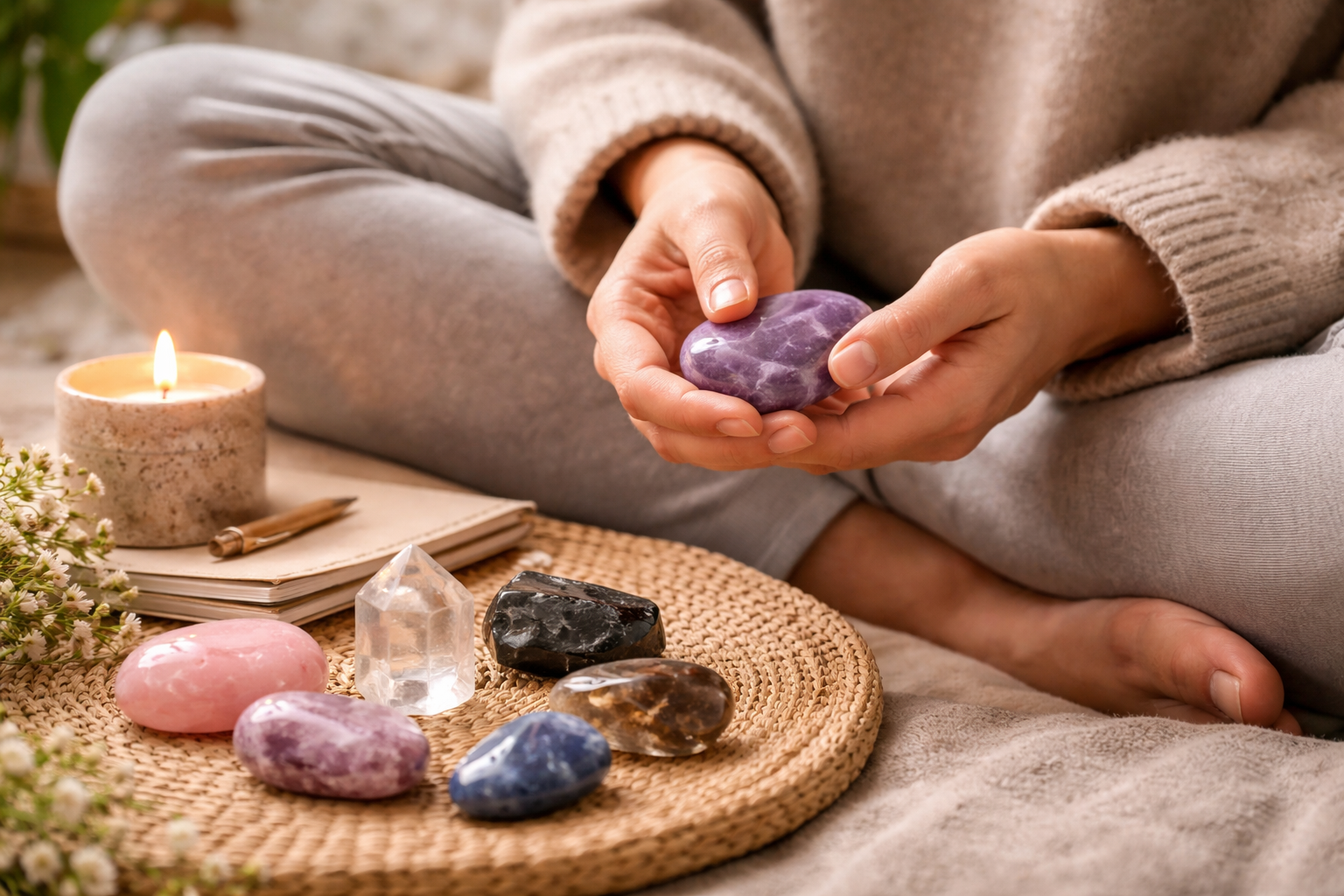
The stone matters. The routine matters more.
The most useful way to use a crystal for anxiety is not fancy. It is repeatable. The National Center for Complementary and Integrative Health notes that mindfulness-based practices may help manage anxiety symptoms. That does not prove crystal energy. It does tell you why pairing a crystal with a simple grounding habit can feel more effective than just owning one.
Here’s the four-step routine I come back to:
Step 1. Hold the crystal and slow the signal
Put it in your hand before the feeling spikes too far. A smooth palm stone or worry stone works best because your thumb can keep moving. That tiny bit of texture matters more than people think.
Step 2. Name the feeling and shrink the fog
Say one thing, not six. “Racing.” “Tender.” “Scattered.” “Social.” Naming the pattern helps you choose the right tool next time too.
Step 3. Give the crystal one job and cut the fluff
Not “protect me from all negative energy forever.” More like, “help me stay steady through this train ride” or “help me stop replaying that conversation for the next ten minutes.”
Step 4. Pair it with one body cue and make it stick
Long exhale. Feet on the floor. Shoulder drop. One slow lap of the thumb over the stone. Keep it dead simple.
A simple 7-day crystal test
- Pick one crystal for one anxious pattern.
- Use it in the same setting each day if you can.
- Keep the ritual under two minutes.
- Note one line after: “helped,” “neutral,” or “wrong fit.”
- At the end of the week, keep it, reassign it, or drop it.
That test sounds almost too plain. That’s why it works. If a ritual needs moonwater, three affirmations, incense, and perfect lighting, it won’t survive a bad day. A good crystal routine should still work when you’re tired, irritable, and a bit over it.
Pick the crystal form that fits the moment anxiety hits
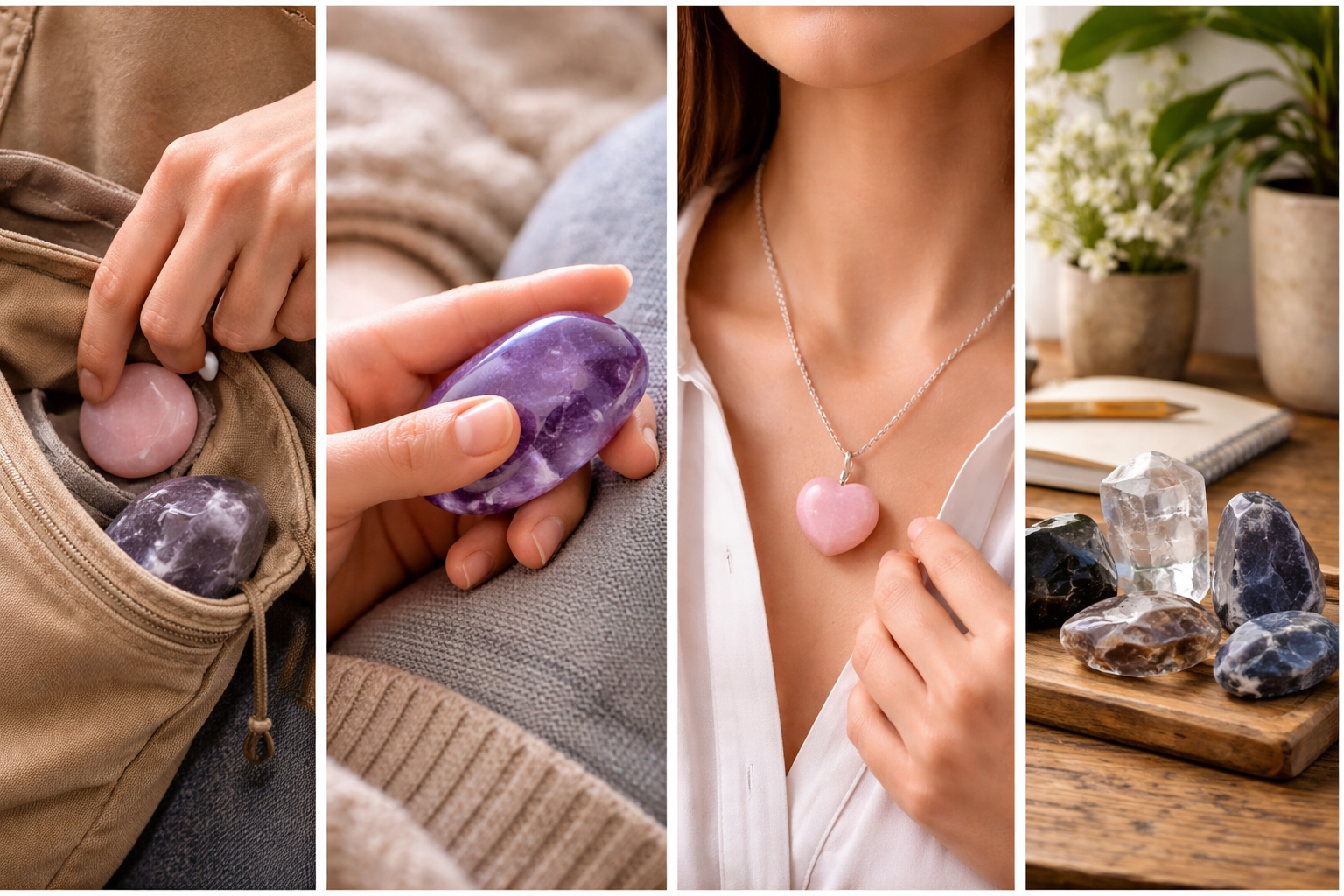
Shape matters more than a lot of crystal content admits. Not for mystical reasons. For friction reasons.
Palm stones and worry stones are the best first form for most anxious states because they are tactile. They give restless hands something to do. If you’ve ever rubbed the edge of a mug or picked at a sleeve when nervous, you already understand why these work so well.
Tumbled stones are the easy daily carry. Pocket, pouch, bag, coat. They’re small and low-drama. Good if you want a crystal bracelet for anxiety but know you might stop wearing jewelry after three days.
Bracelets and pendants are handy for forgetful people. The best one is not the “most spiritual” piece. It’s the one you actually keep on. For social anxiety, a pendant you can touch near the collarbone can be weirdly helpful.
Rough desk pieces work well when the anxious pattern happens in one place. Work desk. Entry table. Bedside. They are less helpful for on-the-go stress. Pretty, yes. Portable, no.
Towers and display pieces are often bad first buys for anxiety. They look the part but they do very little when the wobble point is a commute, a queue, or a bathroom break before a presentation.
| Form | Best use | Weak spot |
|---|---|---|
| Worry stone | Acute nerves, restless hands, meetings, travel | Easy to misplace |
| Palm stone | Bedtime, decompression, quiet reset | Less subtle in public |
| Tumbled stone | Everyday carry | Can feel too small to engage with |
| Bracelet or pendant | Habit-friendly daily reminder | Not everyone likes jewelry under stress |
| Tower or display piece | Desk or bedside mood-setting | Usually the wrong first buy |
Use this rule: buy for the moment anxiety hits, not for the shelf where crystals look nicest.
What crystals can support, and what they should never replace
Here is the clean version. Crystals can be a soothing ritual object. They can work as a tactile cue. They can help you pause long enough to breathe, label the feeling, and interrupt the spiral.
That is not the same as saying crystals treat anxiety disorders.
A 2025 randomized controlled trial indexed in PubMed found that healing crystals did not show anxiolytic effects beyond placebo. People who already believed in them felt better more often. Nonbelievers did not show reliable improvement. So the honest conclusion is not “crystals cure anxiety.” The honest conclusion is that belief, ritual, expectancy, and context probably do a lot of the lifting here.
That still leaves room for a crystal to be useful. A placebo-like effect is not the same as “nothing happened.” But it is a reason to stay grounded about claims.
The National Institute of Mental Health says anxiety disorders can interfere with job performance, schoolwork, and relationships. When anxiety is doing that kind of damage, the next step is not a “stronger” crystal. It is actual care. Therapy. Medical guidance. A proper mental health plan. Same goes for panic that feels frequent, sleep loss that keeps stacking up, or fear that is shrinking your life.
If you like crystal work, the safest frame is this: use crystals as support tools inside a wider routine. Breath work. Sleep hygiene. Therapy. Journaling. Walking. Medication if that is part of the picture. Crystals can sit on that bench. They should not be asked to play the whole game.
When a crystal is not enough
- You are sleeping badly for days or weeks and anxiety is getting louder.
- You are avoiding school, work, people, or normal routines because of fear.
- Panic, dread, or hopelessness is making daily life feel unsafe or unmanageable.
The mistakes that make anxiety crystals disappointing fast
Buying by hype instead of by feeling.
This is the big one. People buy amethyst because it is “the anxiety crystal” and then wonder why it sits unused. If the feeling is overstimulation, smoky quartz may be the better fit. If the feeling is shame or tenderness, rose quartz usually makes more sense.
Using too many stones at once.
A bundle sounds generous. In practice it often muddies the signal. You cannot tell what feels helpful because everything is happening at once. One primary stone first. One secondary stone later if it has a different job.
Confusing comfort with protection.
This is subtle and it trips people up. Rose quartz comforts. Black tourmaline protects and grounds. Smoky quartz steadies. If the whole problem is “I absorb the room,” comfort alone may not do much.
Buying the wrong form.
A dramatic tower is not much use when anxiety hits in the car park or on a lunch break. For most people, a worry stone or small palm stone beats a beautiful altar piece. Not glamorous. Very useful.
Falling for pseudo-medical sales copy.
Lepidolite gets this a lot. So do stones sold as if they can replace therapy or medication. That kind of pitch is not just sloppy. It can be harmful.
Expecting a crystal to fix a panic spike on its own.
A crystal can give your hands and attention somewhere to go. It cannot do the job of treatment. Keep that distinction clean and you avoid a lot of disappointment.
The beginner rule I trust most is plain: start with one stone, match it to one anxious pattern, test it for a week, and only add another if it serves a different job. Not fancy. Not mystical. Just sane.
FAQ
Can you use more than one crystal for anxiety at the same time?
Yes, but two is usually the ceiling for beginners. Use one crystal for the main job and another only if it serves a different job. A good pair is rose quartz for emotional softness plus smoky quartz for grounding. A messy pair is two crystals that both aim at the same sleepy, vague kind of calm.
What crystal is best for anxiety and sleep?
Amethyst is still the safest first pick for anxiety that gets louder at night. If the problem feels more like mental replay than raw nerves, lepidolite or howlite can be worth trying next. If the bedtime mood is emotional and tender, moonstone can suit better.
Do crystals work for anxiety if you are skeptical?
They can still work as a tactile cue or ritual anchor, but the evidence does not support crystal-specific anti-anxiety effects. If skepticism means you will never use the ritual, the crystal probably won’t do much. If skepticism just means you want a grounded frame, treat the crystal like a physical reminder to pause, breathe, and settle your attention.