
It is weirdly easy to spend half an hour shopping for a protection necklace and come away with less clarity than you started with. One pendant says “evil eye,” another says “hamsa,” a third leans Christian, a fourth has black tourmaline glued into a cap, and by tab five it all starts to blur.
If you want the short answer, the best protection necklace for women is the one that matches the kind of protection you actually mean and the life you actually live. For most women, that lands in one of five lanes: an evil eye necklace for envy and harsh attention, a hamsa necklace for broader blessing-and-protection symbolism, a faith-based medal or cross for devotional reassurance, a crystal pendant for grounding, or a combined-symbol piece when both meanings genuinely matter.
That generic answer is only half useful. The symbol can be right while the necklace itself is wrong. I’ve seen that happen a lot with gifts and impulse buys. A bold pendant feels meaningful in the listing photo, then it sits in a box because the wearer only likes subtle jewelry. And as GIA puts it, it cannot support the idea scientifically, which is a healthy line to keep in view. Buy symbolic jewelry for meaning, devotion, comfort, and daily connection. Do not treat it like a scientific shield.
- Which symbol fits which kind of protection
- Whether evil eye or hamsa makes more sense
- When saint medals or crystal pendants are the better answer
- Which metals are worth paying for
- How to avoid cheap, regrettable buys
- How to wear and care for the piece without turning it into a project
Fast pick filter
| Necklace type | Best for | Skip if |
|---|---|---|
| Evil eye | You mean envy, bad vibes, or harsh attention aimed right at you | You want a broader blessing symbol rather than a focused talisman feel |
| Hamsa | You want protection with a gentler, broader feel | You want a tiny minimalist pendant and dislike hand motifs |
| Saint medal or cross | Faith and devotion are the point, not vague spirituality | The recipient’s beliefs are unclear |
| Crystal pendant | You already lean toward stone-based grounding or energetic symbolism | You want low-maintenance jewelry with no setting worries |
| Combined-symbol pendant | Both symbols matter to you and the design still looks clean | The necklace starts to look busy or costume-like |
Simple rule: choose by meaning first, then metal, then whether you will actually wear it three days a week or more.
What is the best protection necklace for women?
There is no single winner here, and that is not a cop-out. “Best” changes with the symbol, the wearer’s beliefs, and the roughness of daily wear. A slim evil eye pendant can be the best pick for one woman and a poor one for another if she wanted a devotional piece or hates visible symbolism.
The cleanest way to choose is a three-part filter:
Fast pick: symbol fit x material quality x wear frequency. If one of those is off, the necklace usually becomes a regret buy.
Symbol fit asks what kind of protection you mean. Material quality asks whether the piece will still look good after a month of skin, perfume, and drawer friction. Wear frequency is the part people skip, and it matters more than they expect. The necklace that never leaves the box is not the best necklace, no matter how pretty the listing photo looked.
If you want the safest default, start with a small evil eye necklace in sterling silver, solid gold, or good gold vermeil. It is usually the easiest entry point because the symbol is widely recognized, the pendants are often compact, and the visual language reads clearly. For a broader blessing feel, hamsa is often the better buy. For devotional meaning, pick the faith route and do not dilute it with generic “energy” language.
And if you already know the wearer shops by stones, not symbols, skip the eye-and-hand aisle and go straight to a crystal pendant. A guide like best necklace for protection against evil can help if the evil-eye lane already feels right.
Choose the symbol that matches the kind of protection you mean
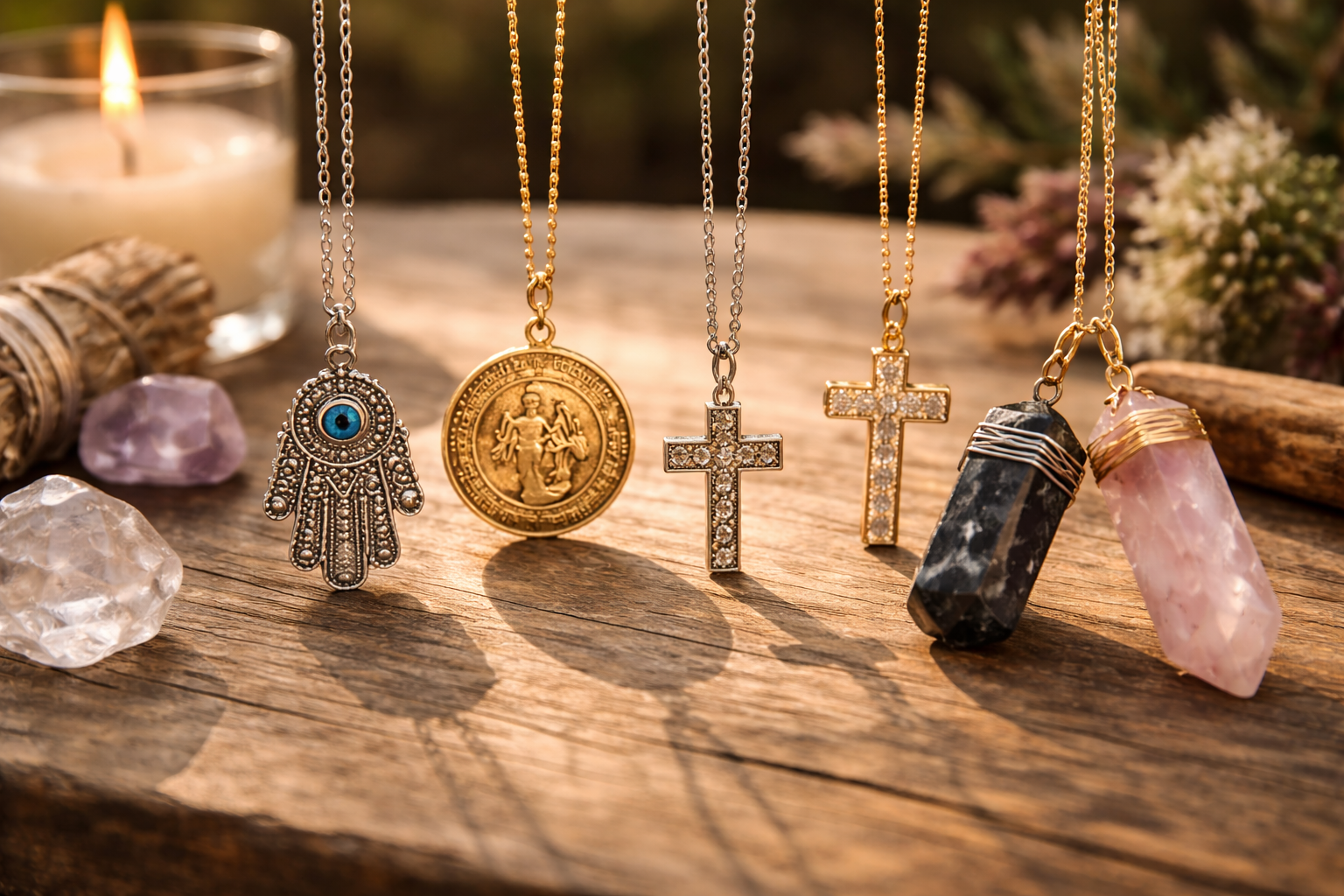
A lot of confusion starts with the word “protection” itself. It sounds precise, but people use it to mean very different things. One person means envy and spite. Another means blessing, steadiness, or spiritual reassurance. Another wants a grounding object for crowded places and emotionally heavy days.
That is why the symbol comes first.
Evil eye is the most direct answer when you are thinking about envy, ill will, or negative attention. Britannica describes belief in the evil eye as ancient and widespread, and it ties the idea to a glance believed to cause harm. That long history is part of why evil eye jewelry feels so instantly legible. It says one thing, and it says it fast.
Hamsa is broader. The British Museum catalogues a Palestinian necklace of stylised amuletic hands, or khamsa, described as protection against the “eye of envy” in its collection notes. That khamsa or Hand of Fatima example tells you something useful: the hamsa can overlap with evil-eye protection, but it usually feels less narrow and a bit more blessing-oriented. If the evil eye is a locked front door, the hamsa is more like a well-lit house.
Saint medals and crosses belong in a different lane. They work best when the woman wearing the necklace already has a Christian devotional frame. A Saint Christopher medal, Miraculous Medal, or cross is not “basically the same thing” as an evil eye necklace with a churchy twist. It is a faith object first.
Crystal pendants sit in yet another lane. A black tourmaline pendant or obsidian pendant tends to make sense when the shopper already talks in crystal language: grounding, shielding, calm, boundary support, heavy rooms, draining people. If that sounds more like the real need, a piece like crystal for psychic protection may help narrow the stone before the jewelry style.
Use this four-question chooser
- Do you want faith-based meaning, symbol-based meaning, or crystal-based meaning?
- Are you guarding against something specific, or do you want a broader blessing-and-comfort feel?
- Do you want the symbol to be obvious or subtle?
- Will this be an everyday necklace or an occasional one?
The common mistake is buying the prettiest charm before you answer those questions. That is like buying shoes because the leather looks good and forgetting to check the size. Beautiful, yes. Useful, not so much.
Evil eye, hamsa, saint medals, and crystal pendants are not interchangeable
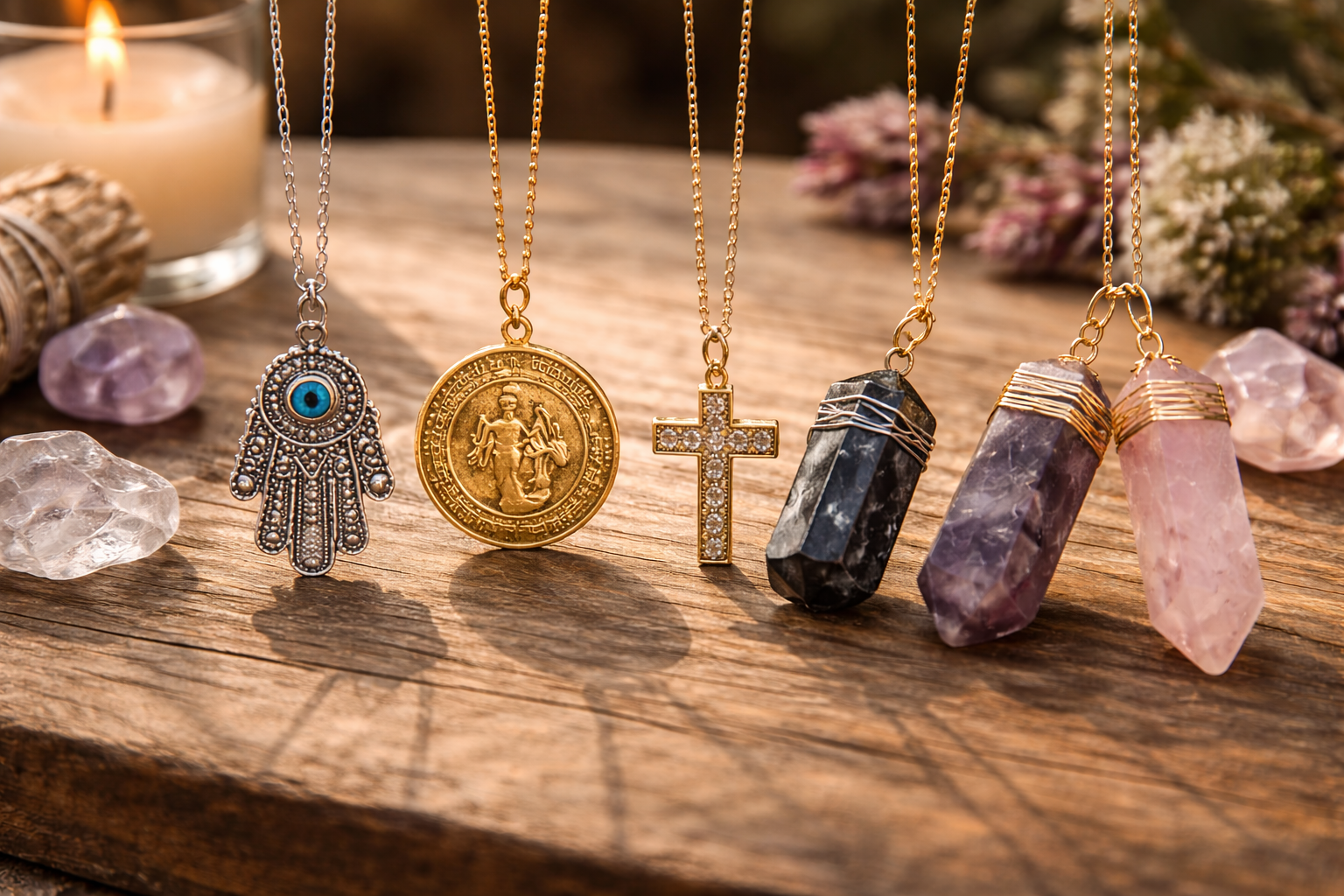
Search results blur these together because all of them sit under the loose umbrella of “protective jewelry.” In real use, they behave differently. They tell different stories on the body, and they suit different buyers.
| Type | What it usually signals | Best for | Watch out for |
|---|---|---|---|
| Evil eye | Focused protection against envy or harsh attention | Women who want one clear, readable symbol | Cheap enamel and thin chains |
| Hamsa | Broader protection, blessing, steadiness | Women who like symbolic jewelry with softer edges | Overly ornate pendants that stop being wearable |
| Saint medal or cross | Devotional reassurance and faith identity | Women who want a specifically Christian piece | Buying it as a generic gift when faith is not clear |
| Crystal pendant | Grounding, boundary support, stone-based practice | Women already comfortable with crystals and crystal care | Loose caps, glued stones, bulky shapes |
The biggest comparison people ask about is evil eye versus hamsa. Here is the short version. Pick evil eye when you want the message to feel direct and a little sharper. Pick hamsa when you want the necklace to feel broader, gentler, and less literal. Neither one is “more powerful” in a way anyone can prove. One just fits your frame better.
Can you wear both together? Yes, if both symbols mean something to you and the necklace still looks coherent. Where people go wrong is stacking symbols with no visual hierarchy. A small eye inside a hamsa can look intentional. Three pendants fighting for attention on one chain just looks noisy, and the meaning gets muddied.
Saint medals and crosses are a different case. If faith is the reason for the necklace, let that stand on its own. Piling on general spiritual symbols can make the piece feel uncertain, almost like it was built by committee.
The best protection necklace styles by daily-wear need
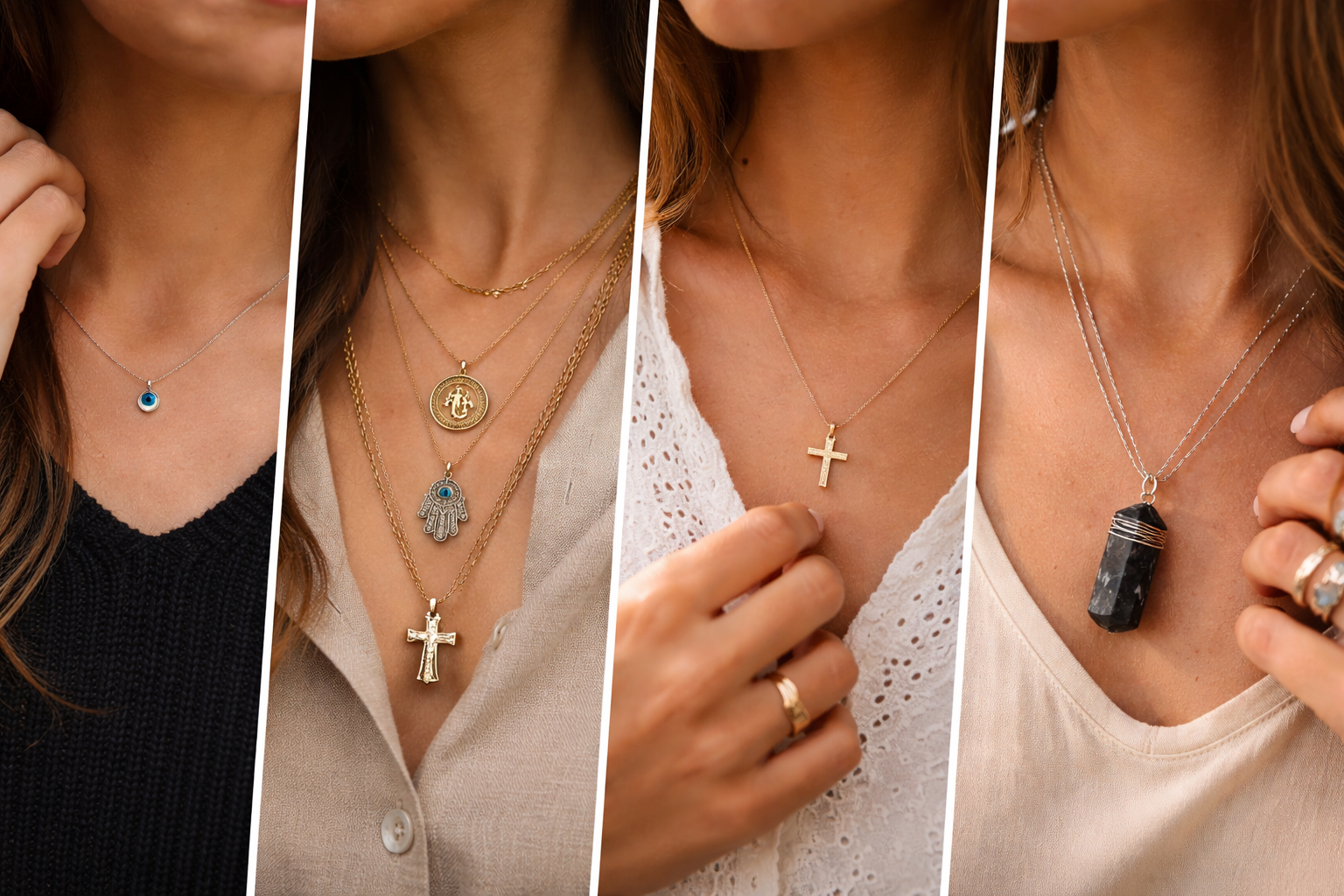
Once the symbol is right, style comes next. This is where the article stops being abstract and starts being useful. The right protection necklace for a woman who lives in black knitwear, low-fuss hair, and tiny hoops is not the same as the right one for someone who loves layered chains and statement pendants.
For minimalist daily wear: go small. A mini evil eye, a slim hamsa, or a petite saint medal tends to win because it disappears into your routine. These are the necklaces that get worn on sleepy mornings, not just on good outfit days.
For faith-based daily wear: a cross, Saint Christopher, or Miraculous Medal usually makes more sense than a hybrid spiritual charm. Clean design matters here. A devotional necklace looks best when it is not over-designed.
For layering: pick a flat pendant, fine but not flimsy chain, and a symbol that reads well from a slight distance. Tiny eye pendants and smaller medals layer more easily than bulky hamsas or rough-cut stones.
For crystal-centered wear: choose a capped black tourmaline or polished obsidian pendant with a secure setting. Raw crystal points can look striking, but they snag sweaters, swing hard when you bend, and feel less polished with office clothes. If the crystal lane feels right, best black crystal for protection helps sort the stone before you commit to the necklace style.
For gifting: play it a touch safer than you think. If beliefs are unclear, a simple hamsa or understated evil eye is usually easier to gift than a saint medal. Devotional jewelry can be beautiful, but it works best when it is personal, not guessed at.
Fast pick: shop for the woman’s actual wardrobe, not the fantasy version of it. If she never wears big pendants now, this will not be the necklace that changes her entire jewelry life.
For travel, crowded spaces, and transitional seasons: women who think devotion-first often gravitate to Saint Christopher or a cross. Women who think symbol-first tend to reach for the evil eye. Women who think stone-first usually prefer black tourmaline. None of that is mysterious. It is just a cleaner match between meaning and habit.
Metal quality matters as much as symbolism
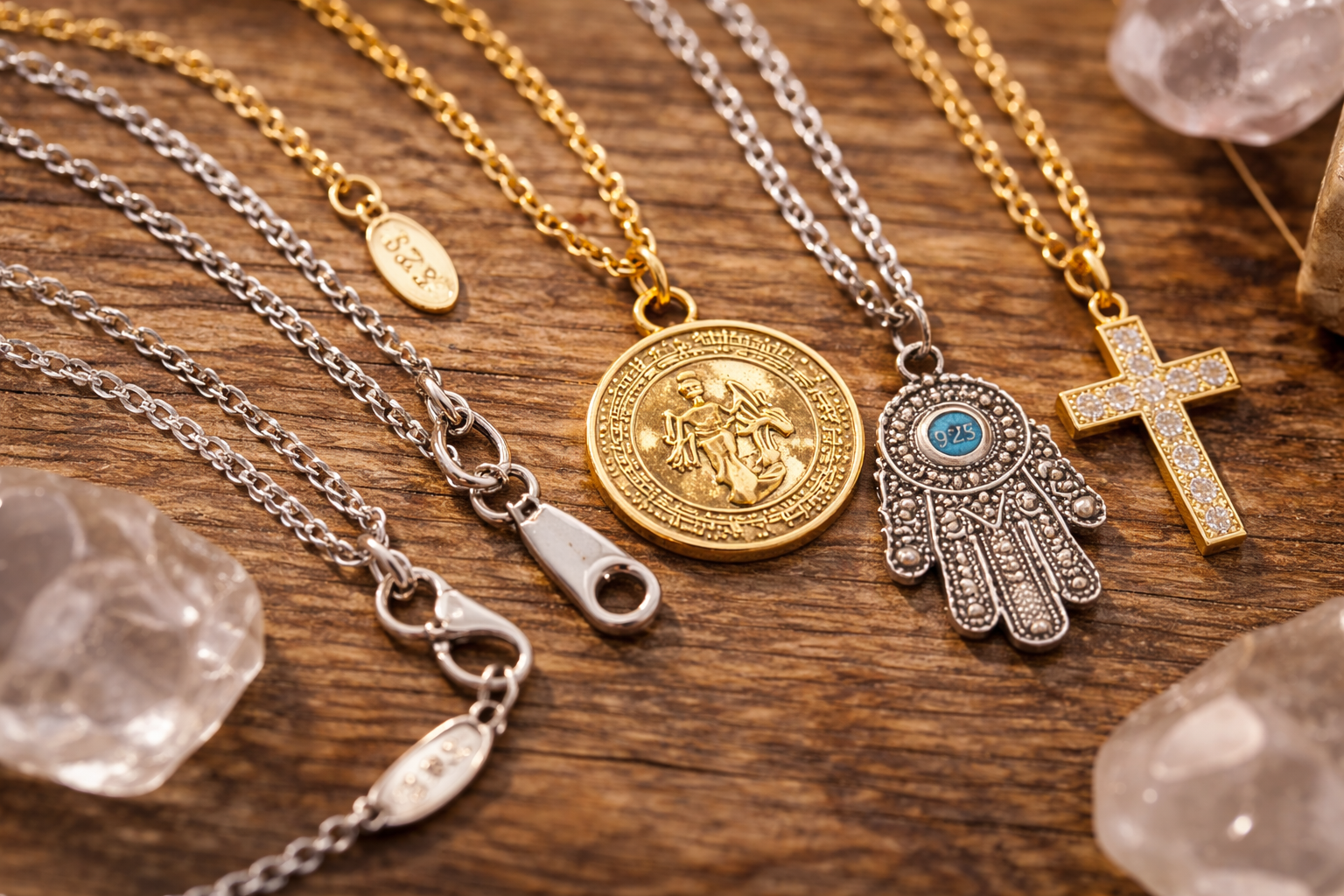
This is where a lot of “best necklace” advice goes a little wonky. The symbol gets all the attention. The metal gets one vague line, maybe “premium quality,” and then you are supposed to fill in the blanks yourself. That is a fast way to overpay for a charm on a weak chain.
The Federal Trade Commission gives a much cleaner footing. In its jewelry guidance, sterling silver means 92.5% pure silver and is often marked 925. The same guidance says vermeil is a gold-plated product with a sterling silver base. That matters because vermeil and solid gold do not age the same way, and plain plated pieces can wear through faster.
Use these if/then rules when you read a product listing:
- If the necklace will be worn most days, then sterling silver, solid gold, or good gold vermeil are safer bets than vague plated alloy.
- If the listing never states 925, karat, vermeil, or base metal, then assume the metal story is not helping you.
- If the pendant is small but the chain is whisper-thin, then the weak point is probably the chain, not the charm.
- If a brand says “waterproof” with no real metal detail, then read that as marketing language, not a free pass for showers, sweat, perfume, and neglect.
Also check the clasp. I know, not glamorous. Still, a secure lobster clasp and sensible chain thickness do more for daily satisfaction than most mystical copy ever will. I have seen beautifully symbolic necklaces fail at the boring part. The ring opens. The chain kinks. The pendant flips backward all day. That kind of thing drains the meaning right out of a piece.
What to look for on the listing
- 925, 14K, 18K, or clear vermeil language
- Base metal stated, not hidden
- Lobster clasp or another secure closure
- Close-up photos of chain links and pendant bail
- No fuzzy words like “quality alloy” standing in for real info
The most common buying mistakes with protection necklaces
Buying by look instead of by meaning. This is the big one. A necklace can be lovely and still be the wrong symbolic fit. If the wearer thinks in devotional terms, a generic talisman may never feel quite right. If she likes crystal practices, a saint medal may feel equally off.
Choosing a pendant that overpowers her normal style. Plenty of women love meaningful jewelry and still want it quiet. A large hamsa hand or chunky raw crystal may look perfect in a styled product photo and then feel too loud with ordinary clothes.
Ignoring the metal and chain. Protection jewelry gets sold on symbolism, which makes it easy to forget the plain mechanics. A weak chain makes a good pendant irrelevant.
Buying a crystal pendant with a shaky setting. This is common with budget crystal jewelry. If the cap looks glued on, the stone swings oddly, or the point has no real protection at the tip, pass.
Treating spiritual copy like a proof claim. A necklace can be meaningful, grounding, or devotional. That does not turn it into measurable physical protection. The moment a listing starts sounding like it can replace ordinary common sense, close the tab.
Gifting a highly specific symbol without knowing the wearer. An evil eye or hamsa is usually easier to gift than a saint medal when beliefs are murky. A saint medal can be a beautiful gift. It just needs a clearer personal link.
Remember: if the necklace only works in theory, in a photo, or in somebody else’s aesthetic, it is the wrong necklace.
How to wear and care for a protection necklace without overcomplicating it
Symbolic jewelry works best when it can live inside a normal life. That means easy on, easy off, easy storage. Not a whole production.
For layering, let one meaningful necklace lead. If the protection necklace has a visible symbol, keep the rest lighter and quieter. A second fine chain is usually enough. Once you have three pendants competing at the collarbone, the eye no longer knows where to land.
For physical care, do the boring things well. GIA advises storing sterling silver in an anti-tarnish bag or cloth and not tossing jewelry loose into a drawer. That is especially relevant for necklaces because chains knot, scratch, and kink faster than people think.
A simple routine works:
- Wear it. That sounds obvious, but ritual value comes from use, not from admiring it in the box.
- Wipe it. A soft cloth after wear helps with skin oils and perfume haze.
- Store it. Keep it hanging, flat, or in its own pouch.
If intention matters to you, keep that part simple too. A short prayer, a quiet moment before putting it on, or a brief blessing is enough. Crystal wearers who like cleansing practices can borrow a gentler routine from how do you cleanse your crystals, but physical care still comes first. Tarnished metal and a loose bail do not become charming just because the moon was full.
When a necklace is not the best protection piece for the job
This part gets skipped in a lot of buying guides, and I think that is a mistake. Sometimes a necklace is not the right format. It may be the right symbol and still the wrong object.
If the real goal is room or home protection, a wearable piece may not scratch that itch. A home object, cleansing practice, or stone kept nearby can be a cleaner fit. Something like best crystals for negative energy removal is closer to that need than another pendant search.
If the wearer dislikes necklaces, works in clothing that snags chains, or gets irritated by anything at the collarbone, switch formats. A bracelet, ring, or small devotional object may serve the meaning better.
And if what you are really asking for is relief from anxiety, fear, or a safety concern, keep your footing. A protection necklace can be symbolic comfort. It cannot stand in for practical safety steps, medical care, or real support. That line matters.
The simple rule is this: choose the symbol that fits your meaning, then choose the piece that fits your life. If either side of that equation is off, the necklace will feel wrong pretty fast.
Common questions
Is it disrespectful to wear a protection necklace from a tradition you were not raised in?
It can be, if the symbol is treated like a costume piece with no curiosity or respect behind it. The safer path is to learn what the symbol means, avoid flattening different traditions into one vague “spiritual” bucket, and skip symbols that feel too tied to a faith or practice you do not actually engage with. In day-to-day shopping, the problem is usually not malice. It is carelessness.
Can you wear an evil eye and hamsa together?
Yes, if both symbols matter to you and the design still looks intentional. A small eye inside a hamsa or a two-charm stack with clear spacing can work well. Where it falls apart is visual clutter. If the symbols start competing, the necklace stops feeling grounded and starts feeling random.
What does it mean if a protection necklace breaks?
People read that moment in different ways. Some see it as a sign that the piece has done its job. Some see it as plain wear and tear, which is often the most practical answer if the chain was thin or the clasp weak. Before turning it into a big omen, check the mechanics. A bent jump ring is usually just a bent jump ring.