
You can spot the bad advice fast. Someone buys a pretty purple stone, slips it under the pillow, and then lies awake getting annoyed at both the crystal and the internet.
If you want the clean answer, the best crystal for sleeping is usually amethyst. It is the safest all-round first pick for general calm. But that stock answer gets thin fast. A stone for a buzzing mind is not always the right stone for heartbreak, nightmares, or a bedroom that just feels a bit “off.”
That is where most roundups lose the plot. They rank stones by popularity. Sleep does not work like that. You need to match the crystal to the reason you are still awake.
Sleep crystal match card
| If this sounds like your night | Start with | Best first placement |
|---|---|---|
| Your mind will not stop replaying things | Lepidolite or howlite | Nightstand or inside pillowcase corner |
| You feel emotionally heavy or tender | Rose quartz | Nightstand |
| The room feels edgy, unsafe, or nightmare-prone | Black tourmaline | Beside the bed or under the bed |
| You want calmer sleep with one easy starter stone | Amethyst | Nightstand |
| You want dreamwork more than knock-out sleep | Moonstone | Nightstand |
- Which stone fits racing thoughts, emotional stress, nightmares, or dream-heavy sleep
- Why some crystals feel calming and others feel grounding
- Where to put sleep crystals so they help instead of annoy you
- How to build a 5-minute bedtime ritual that actually gets used
- What crystals can support, and what they cannot do
Best Crystal for Sleeping at a Glance
For most people, the best place to start is amethyst. It is the best all-rounder because it sits in the middle. It is calming without feeling syrupy. It is spiritual enough for people who want that angle, but it is also simple enough for someone who just wants the bedroom to feel less buzzy.
That said, “sleep” is too broad. If your issue is a head full of tabs that won’t close, lepidolite or howlite makes more sense. If the problem is emotional spillover from the day, rose quartz often lands better. If the room feels weird or you keep waking from bad dreams, black tourmaline is usually the smarter pick.
Simple starting rule: begin with one stone, one job, one placement. If you start with three crystals in three spots, you will not know what helped, what annoyed you, or what did nothing at all.
If you only want one crystal and do not want to think too hard, choose amethyst in a small, smooth tumbled form and keep it on the nightstand for a week. That is the least fussy starting point.
Match the Crystal to What Is Actually Keeping You Awake
Picking a sleep crystal by popularity is like buying “medium shoes” because medium sounds sensible. Medium for what foot? That is the problem here. The stone changes with the problem.
If your mind is noisy, go with lepidolite or howlite. These are the stones people usually mean when they say they need help with overthinking, loops, or that half-awake replay reel. If the nighttime spiral is tied to a bigger mood slump, the sorting logic in best crystals for anxiety and depression follows the same pattern: the right stone changes once the feeling changes.
If your chest feels heavy, rose quartz usually fits better than amethyst. It is softer. Less “clear your mind,” more “stop clenching around the day.” That difference matters. A crystal that is perfect for mental static can feel oddly cold when what you want is comfort.
If the room feels edgy or you wake from bad dreams, black tourmaline or smoky quartz is often the better lane. These are grounding stones. They do not usually feel dreamy or floaty. They feel solid, which is exactly the point.
If you want dream recall or a more intuitive night practice, moonstone makes sense. But it is not the first thing I would pick for somebody who just wants to fall asleep fast. Moonstone leans into the night. It does not always quiet it.
Fast diagnosis: if the problem lives in the mind, start with lepidolite or howlite. If it lives in the heart, start with rose quartz. If it feels like a room problem, start with black tourmaline.
The 7 Best Sleep Crystals and the Tradeoffs Between Them
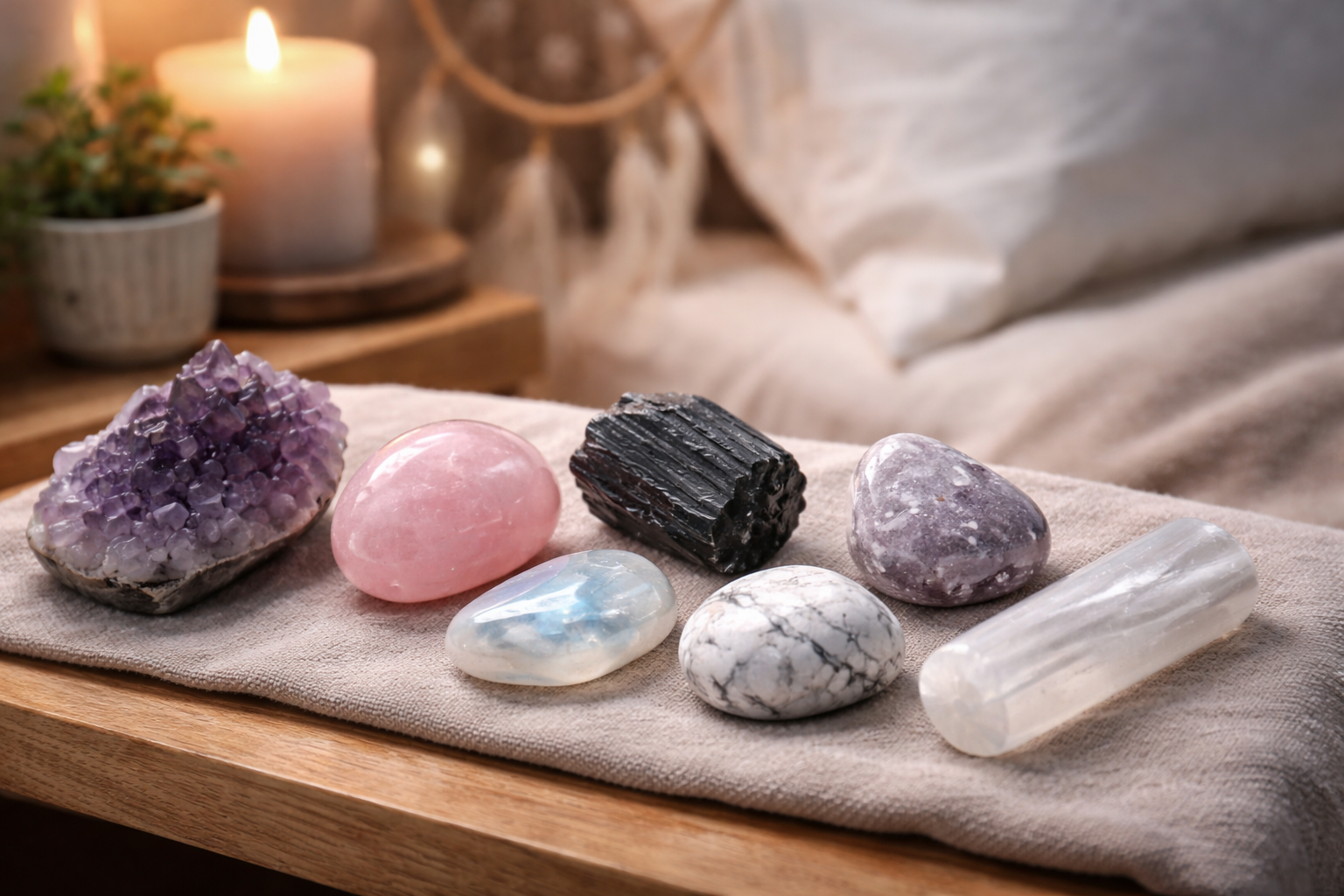
This is the shortlist that covers most real-life sleep situations without making the choice harder than it needs to be.
Amethyst
Best for: general calm, restless evenings, and people who want one easy starting point.
Amethyst keeps showing up for a reason. It is the most balanced choice on the board. It works for people who feel mentally busy, a bit emotionally loaded, or just mildly wired at bedtime. That broad fit is why it keeps landing as the default answer in search results.
Tradeoff: broad fit can also mean bland fit. If your nights have a very clear pattern, a more targeted stone can beat it. For straight-up heartbreak nights, rose quartz is warmer. For nightmare-prone sleep, black tourmaline is stronger. For dreamwork, moonstone is more specific.
Best placement: nightstand first. Under the pillow is fine only if the piece is small and very smooth.
Lepidolite
Best for: racing thoughts, mental loops, and the “I am tired but my brain refuses to clock out” problem.
Lepidolite earns its place because it maps neatly to the kind of sleep trouble that starts in the head. It is the one I would put in front of somebody who keeps reading one more thing, thinking one more thought, replaying one more conversation.
Tradeoff: the internet gets sloppy with this stone. Lepidolite is a lithium-bearing mica, but that does not mean a bedside piece acts like medicine. A rough piece can also be flaky or crumbly, which makes it less friendly in bed than a polished piece.
Best placement: smooth tumbled piece on the nightstand, or tucked into the pillowcase corner if it is small and rounded.
Howlite
Best for: mental chatter with less emotional heaviness attached to it.
Howlite is the quieter cousin in this category. It suits people who want their bedroom to feel still, plain, and low-drama. If lepidolite feels a little too loaded with online lore, howlite is the simpler pick.
Tradeoff: it is less grounding than black tourmaline and less emotionally soothing than rose quartz. So if your sleep problem is not really a thinking problem, howlite can feel a bit beside the point.
Best placement: under the pillow only if the stone is smooth and flat. Otherwise, the nightstand wins again.
Rose Quartz
Best for: emotional stress, tenderness, breakup sleep, and nights when your body feels like it is still carrying the day.
Rose quartz is often dismissed as the obvious “love crystal,” but for sleep it has a more practical use. It can soften the emotional tone of the room. That matters on nights when your brain is not racing so much as your chest just feels tight and tired.
Tradeoff: it will not always cut through analytical overthinking. If your problem is mental tabs left open, this can feel lovely and still not be the right tool. On nights shaped by heartbreak or tenderness, though, it often makes more sense than a sharper calming stone. The same logic shows up in best crystals for love, where rose quartz is a starter stone but not the answer to every kind of ache.
Best placement: nightstand or held for a minute before lights out.
Black Tourmaline
Best for: nightmares, feeling on edge, and bedrooms that feel too “open” or unsettled.
Black tourmaline is not a soft, fluffy pick. That is why it works. It has a firmer feel than the comfort stones. When sleep trouble feels less like sadness and more like vigilance, this is where I would look first.
Tradeoff: some people find it too stern right next to the head. Under a pillow, it can feel heavy in every sense. By the bed or under the bed, it usually behaves better. The same protective logic is explored in protective crystals for home, sleep, and boundaries, where black tourmaline keeps earning the first spot because it is easy to place and hard to misunderstand.
Best placement: beside the bed, under the bed, or near the bedroom door.
Moonstone
Best for: dreamwork, transitions, and nights when you want gentleness more than grounding.
Moonstone is the softer, mistier option in this lineup. It can suit people who want to feel more held by the night rather than pinned down by it. That is a real preference, and it is not silly.
Tradeoff: dreamy is not the same thing as sleepy. If your main goal is to fall asleep quicker, moonstone can be a bit sideways. It often suits people who already sleep but want the night to feel more intuitive or emotionally fluid.
Best placement: nightstand. I would not make this the first under-pillow experiment for a light sleeper.
Selenite
Best for: clearing the bedside vibe and keeping the room feeling quiet.
Selenite works best as a room stone. That is the cleanest way to use it. It can make a bedroom feel less cluttered energetically, which is handy if the space is doing some of the overstimulating.
Tradeoff: most decorative “selenite” pieces sold for home use are forms of gypsum. Britannica notes that selenite is a well-developed crystalline form of gypsum, which helps explain why it scratches and wears more easily than many quartz-family stones. So yes, it is lovely. No, it is not the stone I would grind under a pillow all week.
Best placement: on the nightstand, dresser, or windowsill.
Smoky Quartz
Best for: people who want grounding without black tourmaline’s harder edge.
Smoky quartz misses the core seven on some lists, but it deserves a mention because it fills a useful gap. It is grounding, but it does not always feel as severe. If black tourmaline feels too heavy and rose quartz feels too soft, smoky quartz is a tidy middle ground. That same middle-ground role is why it keeps surfacing in grounding crystals for calm, protection, and focus.
Use a 5-Point Scorecard Before You Buy a Sleep Crystal
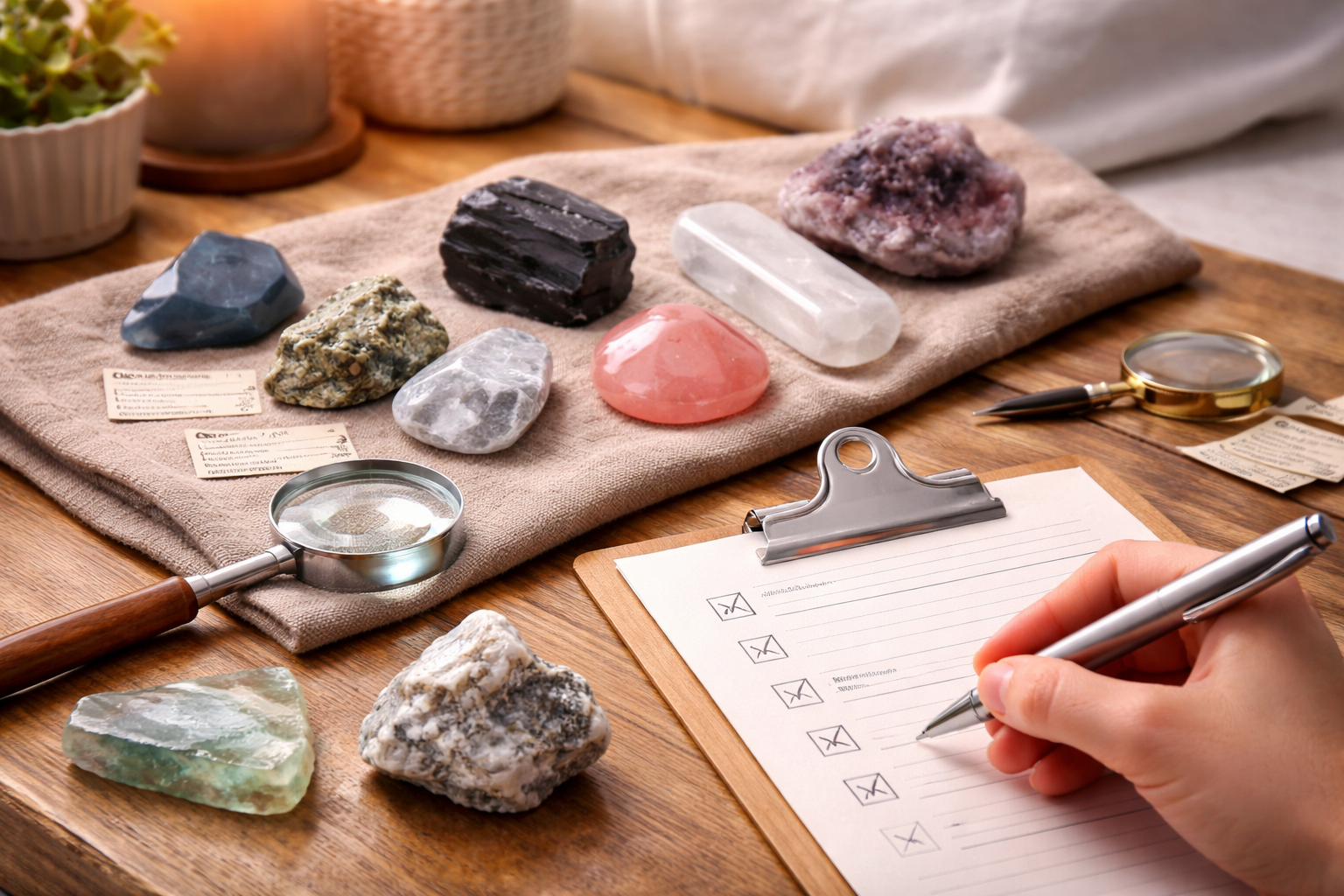
This guide is comparing crystal types and common formats, not rating sellers or pretending every polished stone is the same. Before you buy anything, run it through this quick scorecard.
| Scorecard point | What to ask | Why it matters at night |
|---|---|---|
| Job fit | Is this for mental chatter, emotional stress, nightmares, or dreamwork? | A good crystal for one sleep problem can be the wrong one for another |
| Comfort in bed | Would this annoy me under a pillow or in a pillowcase? | Sharp, chunky, or fragile pieces get old fast |
| Placement fit | Is this better by the bed, under the bed, or on the pillow? | The wrong placement can make a good crystal feel useless |
| Durability | Will it scratch, flake, chip, or dislike moisture? | Bedroom crystals get handled more than shelf crystals |
| Will I actually use it? | Does this fit a real bedtime routine, or just look pretty in photos? | The best stone on paper loses to the one that fits your life |
Format matters more than people think.
A small tumbled stone is the easiest starter format. A worry stone or palm stone makes sense if you like holding something for a minute before sleep. A rough chunk suits grounding stones near the bed. A point or cluster looks dramatic, but that is often a display purchase, not a bedtime purchase.
If a stone is going anywhere near fabric, hair, or skin, smooth wins. Every time.
Note: the prettiest sleep crystal is often the wrong one. A dramatic jagged piece may photograph well, but a flat, boring tumbled stone usually works better in actual bedrooms.
That is why selenite is usually a bedside or room stone, not an under-pillow stone. Rose quartz, amethyst, and howlite in smooth polished form are easier to live with physically. Lepidolite is worth checking closely if the finish is rough or flaky.
Put Sleep Crystals Where They Help, Not Where They Annoy You
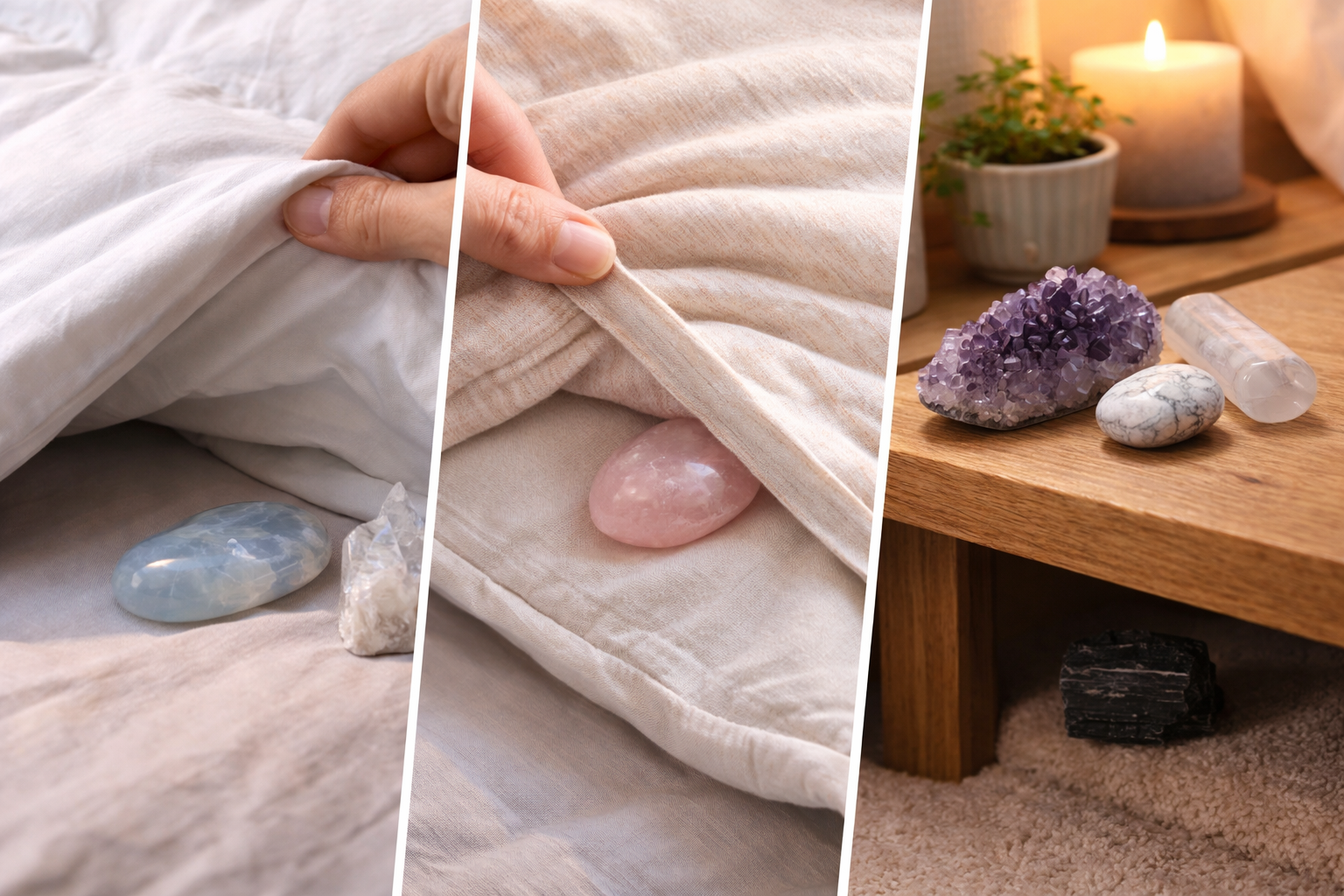
Placement changes the whole experience. People often blame the crystal when the real problem is that it is in the wrong spot.
Under the pillow sounds intimate and effective. Sometimes it is. But it only works if the stone is small, smooth, and genuinely comfortable. Light sleepers often hate this setup by night two. A pointy crystal under the pillow is not mystical. It is just bad planning.
Inside the pillowcase corner is a better version of the same idea. The stone stays close, but it is less likely to poke, shift, or get launched onto the floor at 3 a.m.
On the nightstand is the safest default. It keeps the crystal in the ritual without turning the bed into a geology project. This is where I would put amethyst, rose quartz, moonstone, and selenite first.
Under the bed works best for grounding stones. Black tourmaline and smoky quartz make more sense here than under the pillow. They shape the space without sitting right under your face.
In the hand for a minute before sleep suits worry stones and palm stones. If you like the feel of a crystal but do not want it in bed, this is the easiest compromise.
| Placement | Best for | Skip it if |
|---|---|---|
| Under pillow | Very small smooth stones | You wake easily or hate extra texture |
| Inside pillowcase corner | Close contact without direct pressure | The stone is chunky, jagged, or brittle |
| Nightstand | Most sleepers and most crystals | You never remember to use it there |
| Under the bed | Grounding and protective stones | You want to hold or see the stone at bedtime |
A good test is simple: keep the same crystal for 2 or 3 nights, and only move the placement. If the setup improves, the stone was not the problem.
Build a 5-Minute Bedtime Crystal Ritual That Supports Sleep
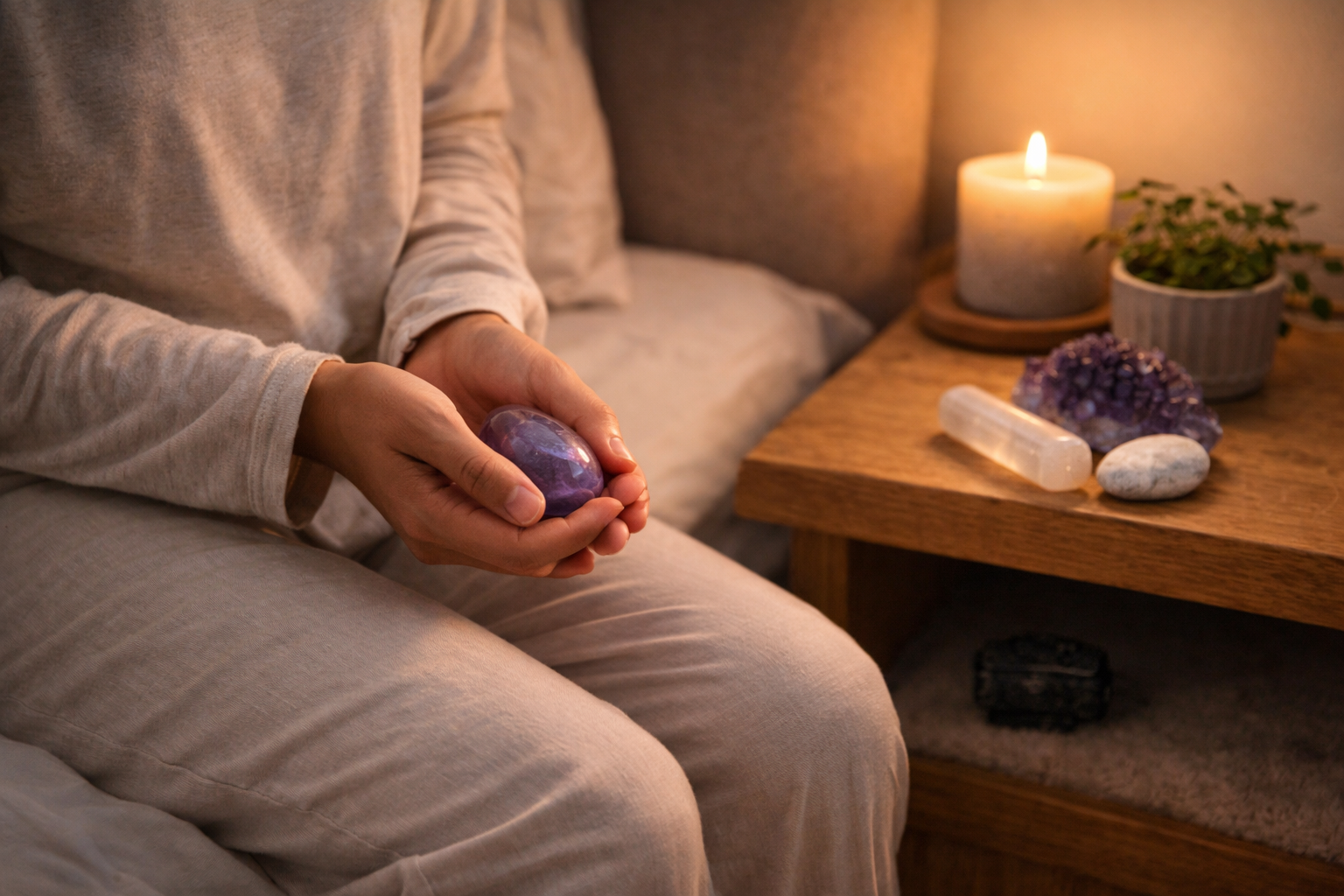
Crystals work best as bedtime cues. That is the useful frame. Not magic sleep buttons. Cues.
The National Heart, Lung, and Blood Institute recommends using the hour before bed for quiet time and keeping the bedroom quiet, cool, and dark. That gives a crystal ritual a sane place to live. It belongs inside a real wind-down routine, not instead of one.
Pick one job and cut the guesswork
Choose one crystal for one reason. “I want less mental chatter” is clear. “I want calmer sleep, nicer dreams, more protection, and emotional healing” is how setups get messy.
Dim the room and tell your brain what is next
Put the phone down. Lower the lights. Sit on the edge of the bed or stand by the nightstand. The crystal is not doing all the work here. The repetition is doing a lot of it too.
Hold the stone and slow your breathing
Take six slow breaths. That is enough. You do not need a guided ceremony unless you enjoy one. A plain sentence works better than a dramatic script: “I am done for today.” Or, “Let this room feel calmer than my head.”
Place it and stop fiddling with it
Set the crystal in its spot. Then leave it alone. Constant adjusting, comparing, and over-reading the setup can turn a calming ritual into another bedtime task.
Track it for 7 nights and look for patterns
Use a tiny note on your phone or paper. Write down three things only: the crystal, the placement, and a quick sleep note. “Fell asleep faster.” “Dreams too vivid.” “Forgot it was even there.” That is enough data.
7-night test
- Nights 1 to 3: same crystal, same placement
- Nights 4 to 5: same crystal, new placement
- Nights 6 to 7: decide whether the crystal helped, the placement helped, or the routine helped
The blunt truth? A decent routine often matters more than the “perfect” crystal. But that does not make the crystal pointless. It makes it part of a system.
Know What Sleep Crystals Can Support, and What They Cannot Do
This part gets fuzzy online, so let us make it plain.
The National Center for Complementary and Integrative Health says the most strongly recommended treatment for insomnia remains cognitive behavioral therapy for insomnia, often shortened to CBT-I. It also notes that relaxation techniques on their own have only a small amount of low-quality evidence for helping with insomnia. That is useful because it puts bedtime crystal rituals in the right box: a supportive cue, not a treatment.
The line gets sharper when you look at expectation effects. A 2025 paper indexed on PubMed found that healing crystals did not show anxiety effects beyond placebo, and symptom change was linked to expectancy and conditioning. That does not mean the ritual is worthless. It means the calmer bedtime pattern may be doing more of the lifting than the mineral itself.
That is not an insult to the practice. Plenty of useful bedtime habits work because they cue the nervous system and reduce friction. Warm baths, low light, familiar music, a fixed wind-down order. Crystals can sit in that same lane for many people.
What they should not do is replace proper help when sleep trouble keeps dragging on. The NHS says to see a GP if changing sleep habits has not helped, if trouble sleeping has lasted for months, or if it is affecting daily life. That is the right line. A crystal can support the room. It cannot diagnose why you are awake.
If you want a broader starter set rather than a sleep-only stone, best healing crystals lays out the usual beginner shortlist without turning it into a giant shopping pile.
Worth keeping in mind: “contains lithium” is not a shortcut to a medical claim. Lepidolite can still be a good sleep crystal for racing thoughts, but that is very different from saying it behaves like lithium medication.
Common Sleep Crystal Mistakes That Waste Money or Make Nights Worse
Mistake one: picking by hype. Amethyst is not wrong. It is just not always specific enough. If the problem is emotional pain, rose quartz can be the better call. If the room feels tense, black tourmaline usually fits faster.
Mistake two: using too many crystals at once. This is the fastest way to turn a bedtime aid into clutter. Four stones around the pillow may look intentional. It often feels messy. The room starts asking for attention when the whole point was to ask less of you.
Mistake three: forcing under-pillow placement. People treat this like the “real” way to use sleep crystals. It is not. Nightstands exist for a reason. So do pillowcase corners. If a setup annoys you physically, it is already failing.
Mistake four: choosing dream-heavy stones when the goal is plain old sleep. Moonstone is lovely. But if you are already a vivid dreamer who wakes often, it may not be the first experiment to run.
Mistake five: mixing up comfort and protection. Rose quartz and black tourmaline are not interchangeable. One softens. One steadies. That is why the sleep problem matters first.
Mistake six: bringing daytime stones into a night setup without thinking. Clear quartz, carnelian, and tiger’s eye have their place, but for some people they feel too bright, too focused, or too “on” for right before bed. Not dangerous. Just not very sleepy.
The easiest rule to remember: one stone, one job, one placement. If a setup breaks that rule, there should be a very good reason for it.
FAQ
Can you combine two sleep crystals, or is one better?
You can combine two, but start with one. A single crystal makes testing cleaner. If one stone settles the mind and another suits the room, that can work well later. A simple pairing is rose quartz on the nightstand and black tourmaline under the bed. Just do not start with a six-stone experiment and expect a clear answer.
Does lepidolite help because it contains lithium?
No, that is the wrong way to think about it. Lepidolite is often chosen for racing thoughts because of how people use and interpret it in crystal practice. A bedside stone is not delivering lithium like a medication. Treat it as a ritual object, not a pharmacology hack.
Do sleep crystals need cleansing?
Only if that helps you keep the ritual tidy and meaningful. Some people reset a sleep crystal weekly. Others never bother. For this topic, placement and consistency matter more than elaborate cleansing routines. If a quick wipe, a little moonlight, or a simple reset phrase helps you use it again, that is enough.