
A lot of “protection necklaces” look interchangeable until you actually try to pick one. Then it gets messy fast: a blue eye charm, a hamsa hand, a black crystal pendant, a saint medal, and five sellers all claiming theirs is the one that keeps bad energy away.
If you’re searching for the best protection necklace for women, the short answer is this: there is no one best piece for everyone. The right necklace depends on what kind of protection you mean. For envy and harsh attention, an evil eye necklace is the clearest fit. For broader blessing-and-guarding symbolism, a hamsa often makes more sense. For devotional wear, a St. Benedict medal or St. Michael pendant fits better. And if you want a grounded, less overtly symbolic option, a black tourmaline pendant is usually the smarter pick.
That sounds abstract until you have to wear the thing every day.
I’ve seen the same pattern with symbolic jewelry over and over: people obsess over the pendant and forget the life around it. Skin sensitivity. Chain length. Whether the symbol actually feels like theirs. Whether the clasp is flimsy. The “best” necklace on paper becomes drawer jewelry in a week if any of that is off.
- How to choose between evil eye, hamsa, faith-based, and crystal necklaces
- Which style works best for daily wear, gifting, and minimal outfits
- What materials hold up better and which ones disappoint fast
- How chain length and pendant size change whether you’ll wear it
- What to do if the necklace breaks or starts irritating your skin
Fast match: choose the lane before you choose the necklace
| Type | Best for | Tradeoff |
|---|---|---|
| Evil eye necklace | Protection from envy, attention, and “bad vibes” in a widely recognized form | Can feel trendy if the design is too fashion-first |
| Hamsa necklace | Broader blessing-and-protection symbolism | The hand motif is more visually obvious |
| Faith medal | Prayerful, devotional protection close to the body | Only feels right if the faith connection is genuine |
| Black tourmaline pendant | Grounding and energetic boundary-minded wearers | Bulkier and more care-sensitive than flat charms |
| Combined-symbol piece | Women who sincerely connect with both symbols | Can look cluttered or spiritually mixed-up |
How I judge a good protection necklace: meaning first, then material honesty, then daily wear. A necklace that feels right but irritates your skin, flips sideways, or tarnishes after two weeks isn’t a good buy. It is a good idea wearing a bad necklace.
Best Protection Necklace for Women? Start With the 5 Styles That Actually Fit Different Needs
The fastest way to get this right is to stop asking “Which necklace is strongest?” and ask “Which kind of protection am I actually looking for?” That one shift clears up most of the confusion.
Pick an evil eye necklace if you want the most familiar protective symbol for envy, harsh attention, or that feeling of being energetically “looked at.” The evil eye is an ancient belief found across multiple cultures, which is why the motif still shows up so often in modern protection jewelry.
Pick a hamsa necklace if you want a broader amulet. It tends to read less like “deflect that one thing” and more like “guard the whole field.”
Pick a faith medal if protection and prayer are tied together for you. St. Benedict medals and St. Michael pendants are not just decorative shapes. They carry devotional meaning, and that changes how the necklace feels when you wear it.
Pick black tourmaline if you want grounding more than visible symbolism. For some women, that is the better move. The necklace feels protective without broadcasting a symbol to everyone else.
Pick a combined-symbol necklace only if both parts matter to you. An evil eye on a hamsa can work. A hamsa with a crystal drop can work. But once a design starts stacking symbols like toppings on a pizza, the meaning gets muddy and the look usually goes with it.
Simple rule: if the necklace matches your meaning, your skin, and your wardrobe, you will wear it. If it only wins on symbolism, you probably won’t.
What “Protection” Means Changes the Right Necklace
This is where a lot of shopping guides go soft. They talk about protection as if it is one neat category. It isn’t.
Some women want protection from envy, gossip, weird attention, or the sense that too many eyes are on them. That is where the evil eye necklace earns its place. The symbol is tightly connected to warding off that kind of harmful gaze. If that is your concern, an evil eye pendant is not a random trend buy. It is the most direct symbolic match.
Some want broader guarding and blessing. That is where the hamsa tends to land better. In the British Museum’s collection, khamsa hand amulets were used to ward off the eye of envy, which gives the symbol a stronger historical footing than the usual “good luck hand” summary you see in shopping copy.
Some want the protection to be explicitly religious. That is a different lane. A St. Benedict medal is not interchangeable with a crystal point just because both get marketed under “protection necklace.” One is devotional. One is symbolic and ritual-based. If your comfort comes from prayer, sacramentals, and faith practice, the faith medal will feel more rooted.
And some women want a necklace that feels like an energetic boundary without any obvious cultural or religious marker. That’s where a grounding crystal pendant starts to make sense. If you’re still sorting meanings, this guide on what different crystals mean helps narrow the field without turning it into a giant crystal soup.
There is one more thing here, and it matters. Old symbols are not blank aesthetic stickers. You do not need to become a historian to wear them, but it helps to know what you are putting around your neck. That little bit of respect tends to lead to better choices anyway.
Evil Eye, Hamsa, Faith Medals, and Crystal Pendants Compared
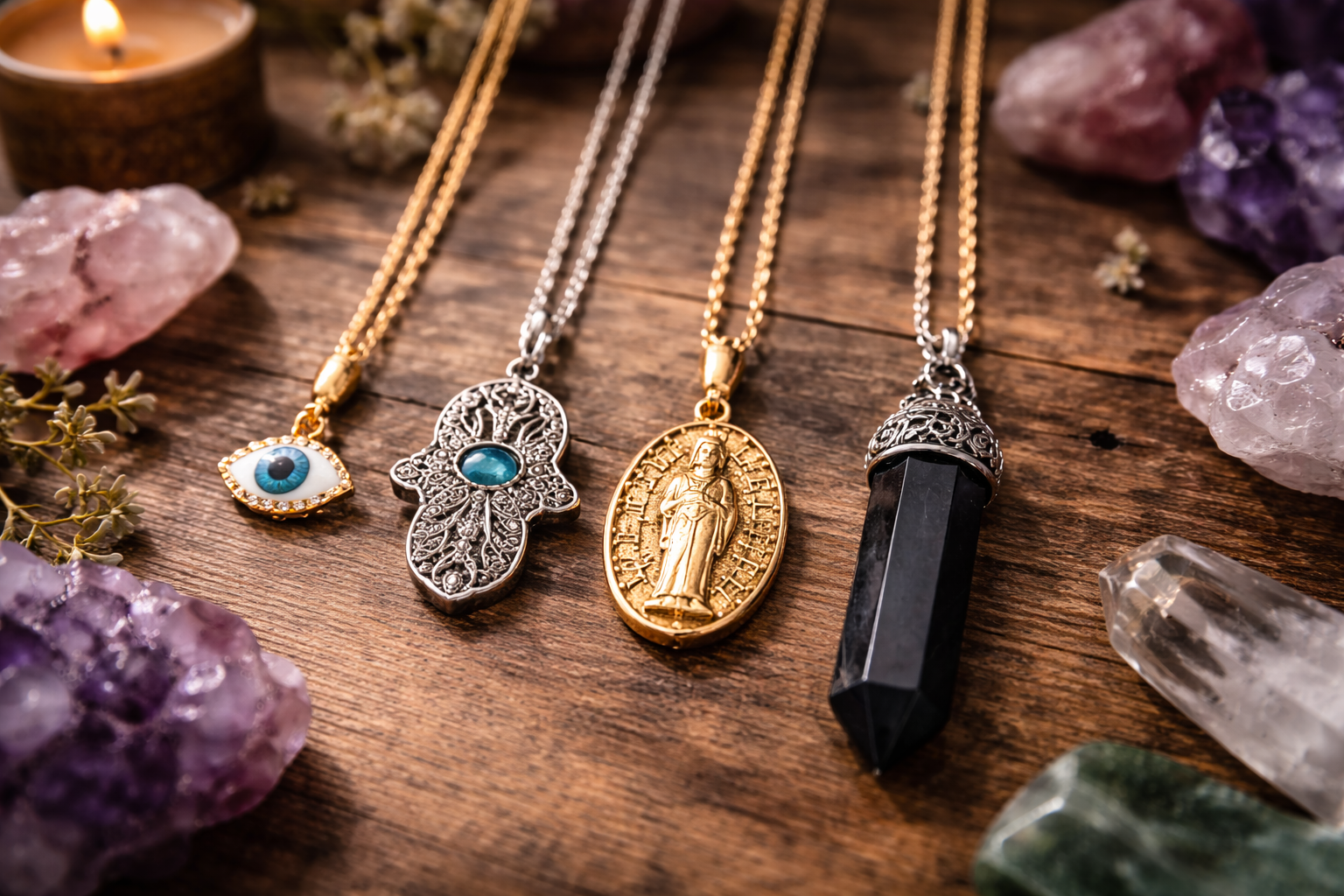
If you want the easiest everyday answer, start here: an evil eye necklace is the safest mainstream pick for most women. It is widely recognized, easy to find in delicate styles, and simple to wear with modern jewelry.
For gifting: a small evil eye or a clean hamsa usually works better than a faith medal or a large crystal point. It is easier to style, easier to understand, and less likely to clash with the recipient’s beliefs. Gift jewelry gets weird when the giver is doing the symbolism for the other person.
For minimal style: a tiny evil eye pendant or a slim St. Benedict medal wins. Both can sit quietly at the collarbone and still feel intentional. A hamsa tends to be more legible from a distance. A crystal pendant tends to read more boho or earthy unless the setting is very refined.
For broad symbolism: the hamsa is the strongest choice. It covers more ground than the evil eye and usually feels warmer, less defensive. If the evil eye says “don’t bring that here,” the hamsa says “keep me guarded and blessed.” That difference is subtle, but it changes what many women gravitate toward.
For faith-based wear: go with the medal. Do not talk yourself into a symbol that is “close enough” if what you actually want is a prayerful object. You will feel the mismatch every time you put it on.
For grounding: black tourmaline wins the crystal lane because it is familiar, visually understated, and easy to pair with other jewelry. If you want to go deeper into that branch, this guide to the best black crystal for protection breaks down where black tourmaline fits against other dark stones.
Quick comparison
- Evil eye: best all-rounder for most shoppers
- Hamsa: best for broader symbolic protection
- Faith medal: best for devotional wear
- Black tourmaline: best for grounding and subtle energy work
One underrated point: the most wearable necklace often beats the most “powerful” one on paper. I have watched women pick the loftier symbol, then reach for the simpler piece every morning because it just fits their life better. That matters. A necklace only works as daily protection jewelry if it actually gets worn.
Choose Materials You Will Still Like After the First Week
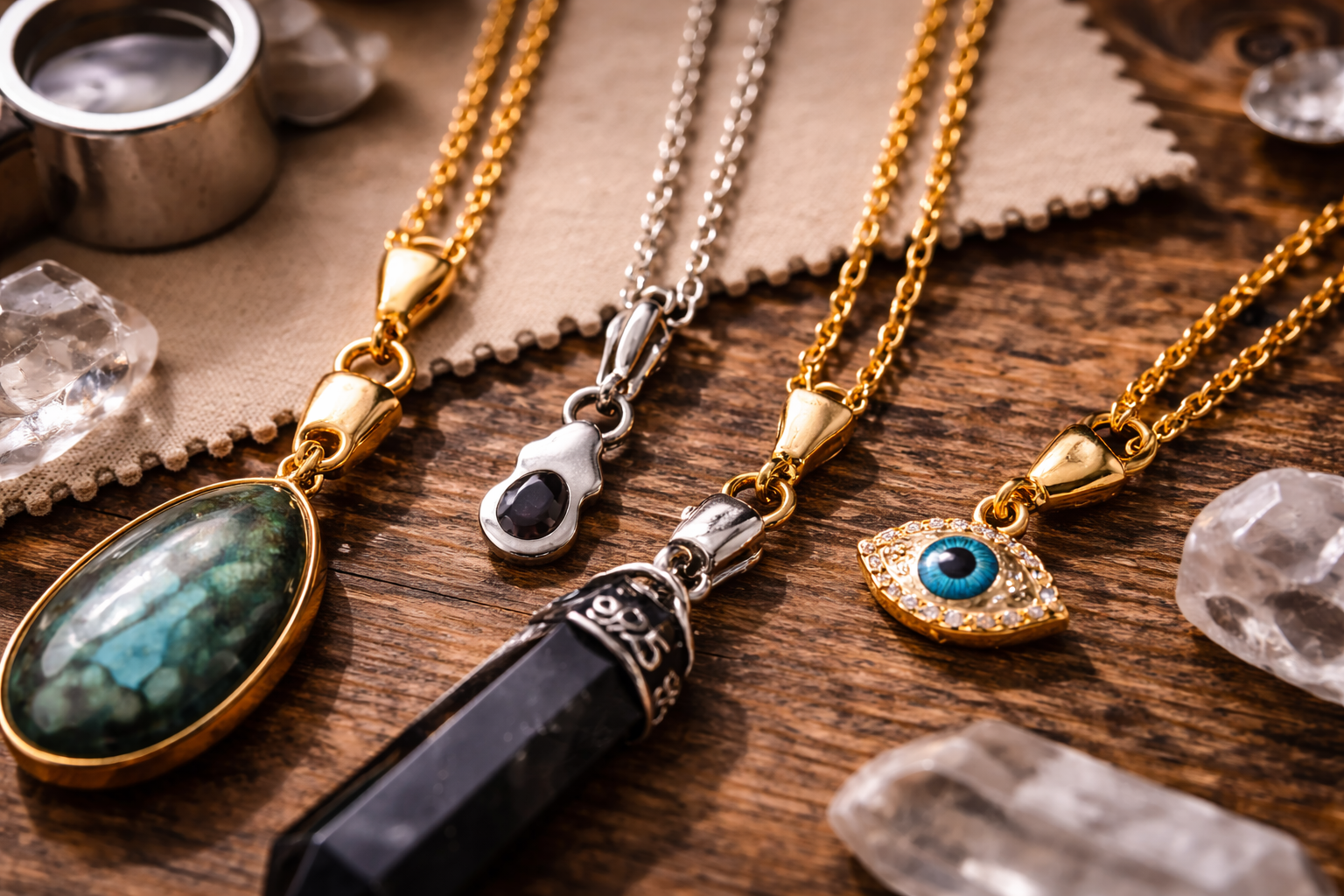
Material honesty is where pretty listings start to separate. Some necklaces are good symbols made with tired, irritating hardware. Some are plain, almost boring, but hold up beautifully.
If you want the longest-wearing option and the budget allows it, solid gold is the cleanest answer. For most women, though, sterling silver and gold vermeil are the smarter middle ground. The key is knowing what the words mean. The Federal Trade Commission says gold vermeil is sterling silver coated with gold, which puts it above vague “gold plated” language that does not tell you much about the base metal or thickness.
Sterling silver should be marked 925. That mark matters. It is not romantic, but it is one of the easiest ways to spot whether a seller is being straight with you. If you are shopping plated pieces, ask what sits under the plating. “Hypoallergenic” with no material detail can mean almost anything.
Skin sensitivity changes the whole buying decision. The American Academy of Dermatology recommends watching for nickel-free or hypoallergenic metals if you react to jewelry. If your neck gets itchy from mystery metal earrings, do not gamble on a protection pendant with an unknown chain. That is how meaningful jewelry turns annoying real fast.
The chain deserves more attention than it gets. Most sellers photograph the pendant like the chain is just there to keep it airborne. In actual wear, the weak point is often the clasp, jump ring, or ultra-thin chain. A solid pendant on a flimsy chain is like buying good tires for a car with a dodgy axle. The nice part isn’t the part that fails.
Best value mix for daily wear: sterling silver if you like cooler tones, or verified vermeil if you want gold colour without jumping straight to fine-jewelry pricing.
Pendant Size, Chain Length, and Layering Can Make or Break the Choice
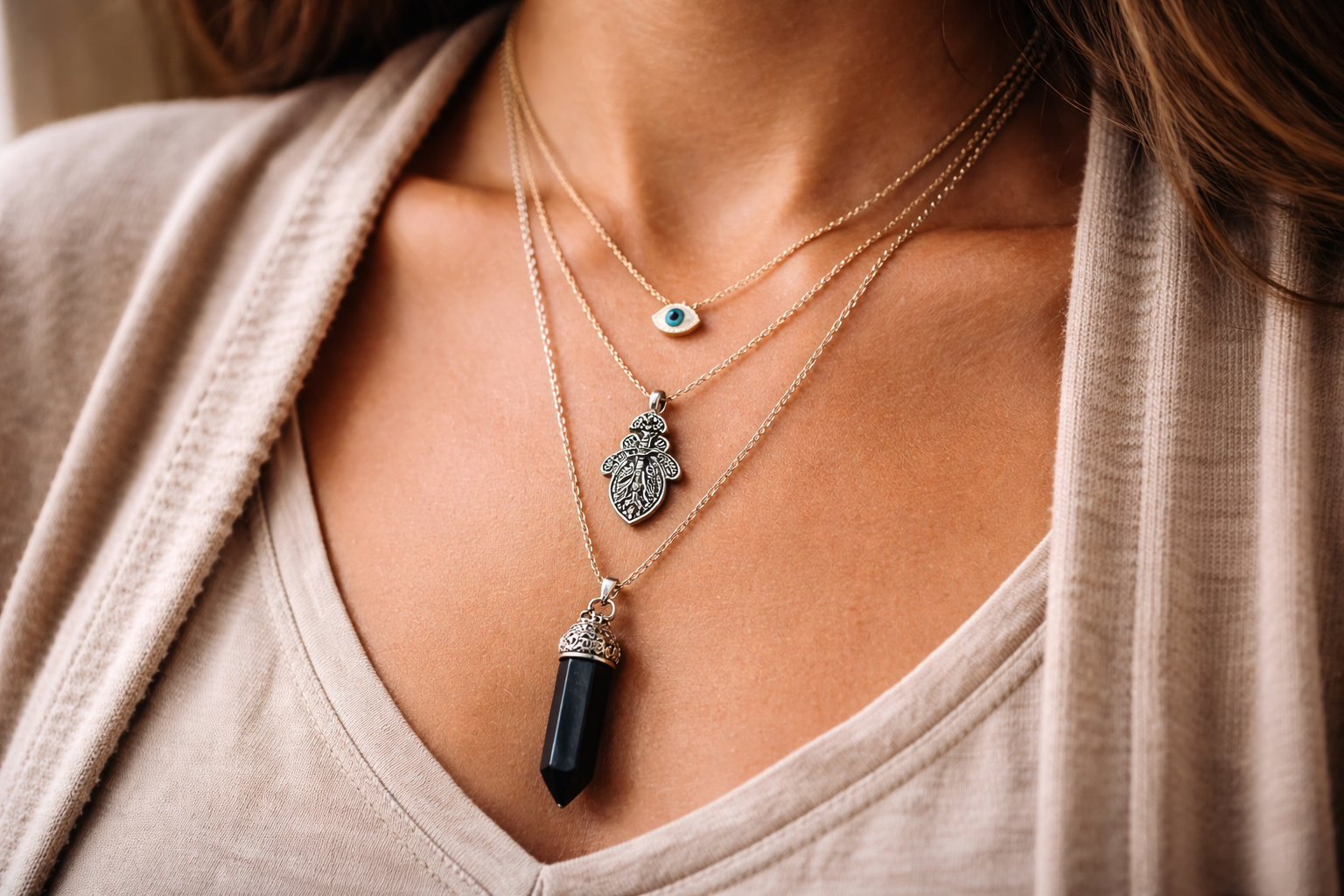
Fit is not a styling side note. It changes whether a protection necklace feels natural or costume-y.
For most women, 16 to 18 inches is the easiest everyday range. That usually puts the pendant around the collarbone or just below it, which makes the piece visible enough to matter but easy enough to forget in a good way. If you want a longer drop or a layered look, 20 to 24 inches gives you more room.
Smaller pendants work better for daily wear than many people expect. A delicate evil eye or medal can stay on through work, errands, dinner, and travel without feeling like it is performing. Oversized symbols are gorgeous in photos and tiring in real life, especially if they flip, catch, or bang against the chest.
Layering can help, but only when there is a little breathing room. One short symbolic pendant with one slightly longer chain usually looks composed. Three similar lengths with three different symbols can look like you raided a trinket box at 7 a.m. in a panic. Harsh, maybe, but true.
If your wardrobe is mostly open necklines, a hamsa or evil eye has room to read. If you live in crewnecks, knits, and office layers, a smaller medal or minimal crystal pendant often sits better. That is why “best” is never just about the symbol itself. It is about the symbol in motion, on your body, in your actual week.
Fast fit check
- Want it subtle? Stay small and keep the chain around 16 to 18 inches.
- Want the symbol to read clearly? Avoid pendants so tiny they disappear.
- Want to layer? Stagger lengths, not just symbols.
When a Crystal Protection Necklace Is the Better Pick
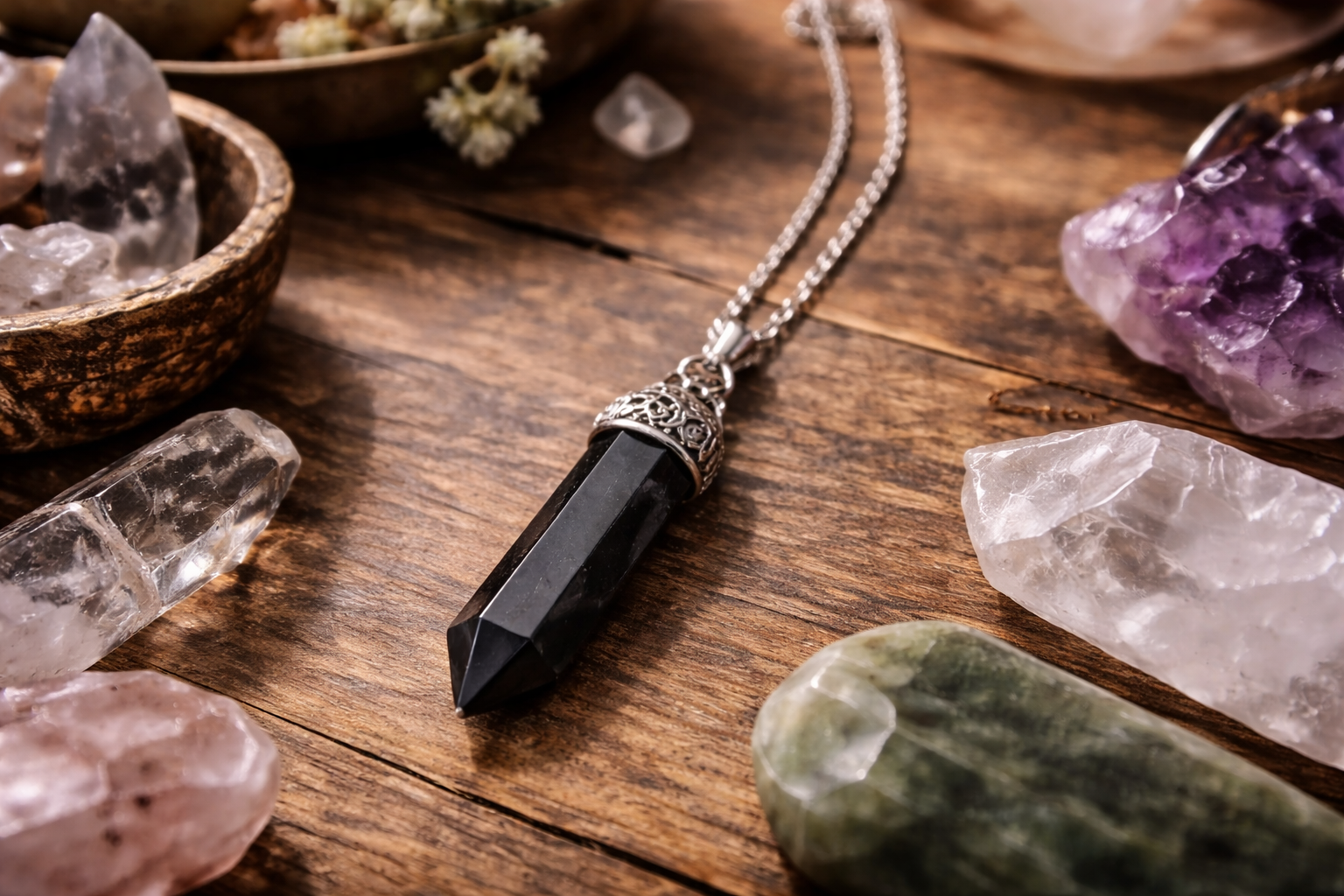
Crystal pendants are not the default answer for everyone, but they are often the better answer for a specific kind of wearer.
If you do not want a culturally coded symbol, a black crystal pendant gives you a quieter route. It can feel private. It can feel less like a sign and more like a tool. For women who already work with stones, meditation, or grounding practices, that difference is not small.
Black tourmaline usually sits at the front of this category because it is familiar, dark without being flashy, and easy to pair with silver or gold-toned findings. It also avoids one problem some symbolic necklaces run into: you do not have to explain it to anyone unless you want to.
The tradeoff is physical, not just spiritual. Crystal pendants are often thicker, heavier, or more fragile than a flat charm. Raw stones can catch on fabric. Wire wraps can feel crafty in the wrong way. Some look beautiful in a product shot and a bit clunky on the neck.
If this lane speaks to you, black tourmaline is the best first stop. And if you are choosing between stones rather than symbols, this guide to a crystal for psychic protection goes into when black tourmaline, obsidian, and other stones make more sense.
One boundary matters here: crystal jewelry can carry personal, spiritual, and ritual meaning, but it should not be sold like measurable protective equipment. That distinction keeps the whole topic sane.
For readers comparing stones rather than necklaces, the roundup on best crystals for negative energy removal is a helpful next step.
Care, Cleansing, and What to Do If the Necklace Breaks
There are really two kinds of care here: physical care and symbolic care. Mixing them up causes half the confusion.
Physical care is simple. Take the necklace off before showering, swimming, heavy workouts, and perfume-heavy routines. That is even more true for plated jewelry and for crystal pendants with glued caps or delicate wire work. The Gemological Institute of America advises that separate storage and careful cleaning help prevent scratching and damage, and that boring advice is usually the advice that saves your favorite pieces.
Symbolic care is more personal. Some women like to set an intention when they first wear a protection necklace. Some say a short prayer. Some leave a crystal under moonlight. Fine. What helps is choosing a ritual that feels natural instead of copying a dozen random cleansing tips from social media and hoping one sticks.
If the necklace is crystal-based, use a little caution. Not every stone likes water, salt, or sun exposure. If that part matters to you, this guide on how to cleanse crystals is a much safer starting point than the usual one-size-fits-all advice.
And what if the necklace breaks? People often read that as a sign the piece “did its job.” Maybe. But sometimes a jump ring was weak, the chain got snagged, or a plated clasp gave up. I wouldn’t force one meaning onto it. If the necklace had real emotional weight, repair it if the structure allows. If it was cheap, irritating, or already failing in three places, replacement is the better call.
Worth remembering: not every break is mystical. Sometimes metal gets tired. Sometimes jewelry just loses the plot.
7 Buying Mistakes That Turn a Protection Necklace Into Drawer Jewelry
1. Choosing the trendiest symbol instead of the right one.
If you want prayerful reassurance, do not buy an evil eye because it is easier to style. If you want broad symbolic protection, do not force yourself into a saint medal because it sounds more serious.
2. Paying for vague plating language.
“Gold finish” tells you almost nothing. Look for sterling silver, 925, vermeil, stainless steel, or actual karat details.
3. Ignoring skin sensitivity.
A necklace can be meaningful and still be unwearable. If your skin reacts easily, unknown base metals are not worth the gamble.
4. Buying a pendant scale that fights your life.
Some women love a visible amulet. Most wear a smaller piece more often. The necklace you wear three days in a row beats the dramatic one you admire twice a month.
5. Overstuffing the symbolism.
A hamsa with an evil eye can work. A hamsa with an evil eye, moon, crystal drop, angel wing, and affirmation disc usually looks like a spiritual junk drawer.
6. Gifting your symbolism instead of hers.
Protection jewelry makes a good gift when the recipient already connects with the symbol. It makes a strange gift when the giver is assigning meaning like homework.
7. Expecting symbolism to rescue bad craftsmanship.
A good meaning does not fix a scratchy chain, a stiff clasp, or plating that flakes. This one sounds obvious, but people miss it all the time because the pendant gets all the romance.
If you want one last filter, use this: would you wear this with three normal outfits next week? If the answer is no, keep shopping. That test is annoyingly effective.
Protection Necklace FAQ
Can you buy a protection necklace for yourself?
Yes. A protection necklace does not lose meaning because you bought it for yourself. In fact, self-buying often leads to a better match because you are choosing the symbol, material, and fit that actually feel right on your neck.
Is an evil eye necklace better than a hamsa necklace?
Not across the board. An evil eye necklace is better when you want a focused symbol for envy and harsh attention. A hamsa is better when you want broader protective meaning and a more expansive feel.
What metal is best for everyday wear?
Solid gold is the long-wear winner if budget is no issue. Sterling silver is the most balanced everyday choice for many women. Verified gold vermeil can also be a good middle lane. Unknown plated base metals are where disappointment tends to start.