
You know that moment when a room feels off, but you cannot point to one reason? Maybe there was an argument near the kitchen table. Maybe a guest left and the whole place still feels crowded. Maybe the bedroom is clean, but it still has that stale, prickly mood.
That is where most people first meet sage. They buy a little dried bundle, light one end, and then wonder if they are doing a spiritual ritual or just making the room smoky.
If the question is “what are sage smudge sticks used for”, the plain answer is this: sage smudge sticks are commonly used for spiritual or symbolic cleansing of rooms, homes, objects, and personal energy. People burn them before meditation, after stress, when moving into a new space, when cleansing crystals or ritual tools, or when a room feels heavy and emotionally loaded.
The better answer has a few guardrails. Sage is not a medical treatment. It is not a guaranteed air sanitizer. And white sage, in particular, carries cultural and sourcing questions that deserve more than a tiny disclaimer at the bottom of the page.
- What sage smudge sticks are actually used for
- When sage makes sense and when it is too much smoke
- What the smoke can and cannot honestly claim to do
- How to use a sage bundle without turning the room into a campfire
- What to know about white sage, blue sage, cedar, and other options
- How to finish the ritual so the space feels changed, not just perfumed
At a Glance: The Sage Smudge Stick Decision Map
| If the goal is… | Use sage for… | Watch out for… |
|---|---|---|
| A heavy room reset | After conflict, stress, grief, or a difficult visitor | Too much smoke in a small room |
| A meditation cue | Marking the start of prayer, journaling, tarot, yoga, or quiet reflection | Using a strong bundle when a lighter scent would do |
| Object cleansing | Passing smoke around crystals, jewelry, altar tools, or secondhand items | Holding delicate items too close to ash or heat |
| A shared or smoke-sensitive home | A symbolic reset only if ventilation is good and everyone consents | Pets, asthma, smoke alarms, leases, and closed windows |
Simple rule: if the room needs a deep ritual reset, sage can fit. If the room only needs freshness, air, or calm, a lighter method might do the job with less fuss.
What Sage Smudge Sticks Are Used For
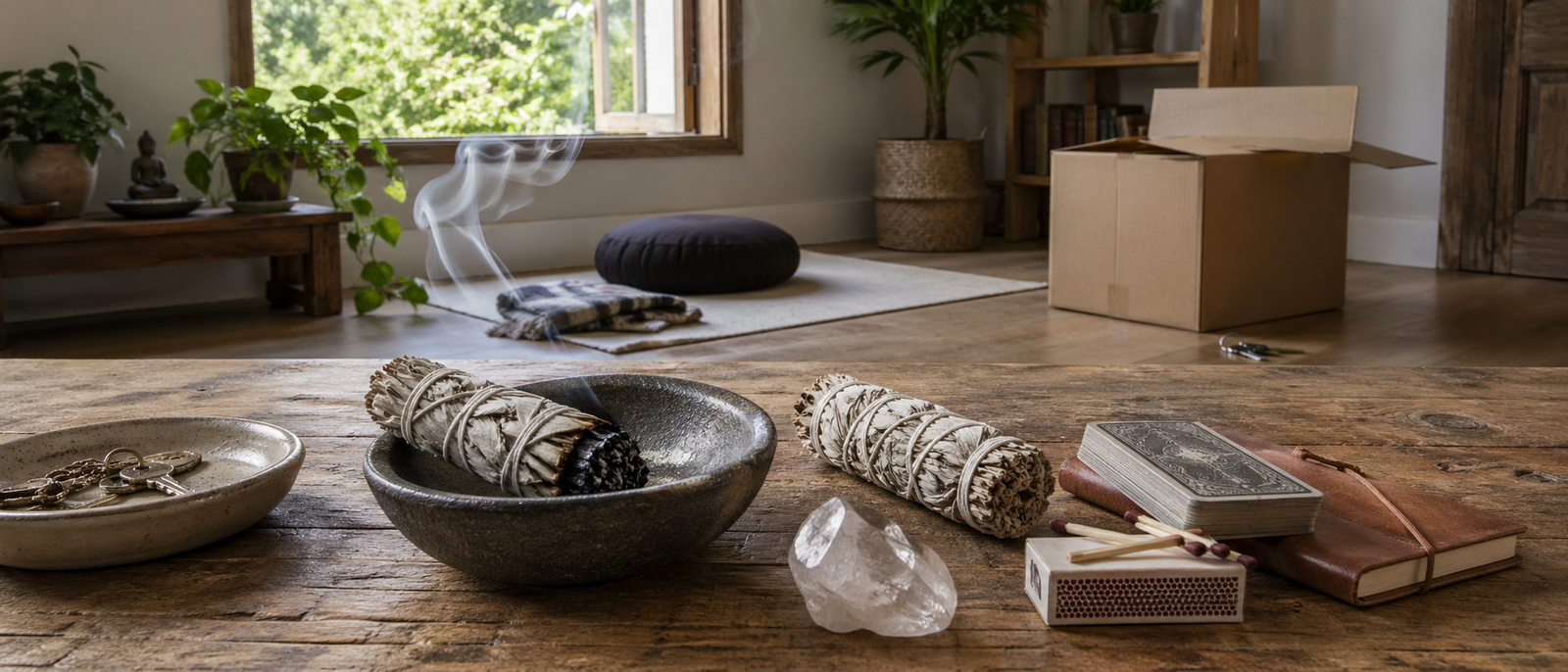
A sage smudge stick is a dried bundle of sage leaves, often white sage, tied together so it can be lit and used as a smoke-cleansing tool. The smoke is moved around a space, object, or person as part of a ritual. In most modern spiritual wellness settings, the purpose is symbolic cleansing rather than physical cleaning.
People usually reach for sage when they want to shift the feeling of a space. Not fix the plumbing. Not cure anxiety. Shift the feeling. That distinction matters.
Common uses include:
- Clearing stagnant energy from a room: after a tense conversation, illness, grief, bad sleep, or a long period of stress.
- Preparing for meditation or prayer: the scent and ritual mark a clean start, like dimming lights before a film.
- Resetting a new home: many people burn sage after moving in, especially before unpacking personal items.
- Cleansing objects: crystals, tarot decks, jewelry, gifts, secondhand finds, and altar tools are common examples.
- Marking a transition: a breakup, a new job, the end of a hard week, a new moon ritual, or the start of a new habit.
Useful way to think about it: sage is a ritual reset button. It gives the mind, the room, and the moment a clear dividing line between “before” and “after.”
That is why sage can feel powerful even when the room itself looks exactly the same. A good ritual changes how you enter the room again. It gives you a cue: something has been acknowledged, cleared, and closed.
Match the Sage Ritual to the Moment Instead of Using It for Everything
White sage can be a strong tool. Using it for every faint stale feeling is like wearing hiking boots to make tea. Great boots, wrong job.
Start with the job you need the ritual to do.
| Moment | Best use | Better move first |
|---|---|---|
| After an argument | Clear emotional residue from the room | Open a window and tidy the main surface |
| Before meditation | Create a sensory cue for stillness | Use a tiny amount of smoke |
| Moving into a new home | Mark the space as yours | Ventilate and clean before the ritual |
| A room feels stale | Light smoke cleansing if the feeling is emotional | Check airflow, clutter, laundry, bins, and dampness |
| Cleansing crystals or tools | A short smoke pass around the item | Keep delicate items away from direct heat |
In small apartments, I have seen sage go from meaningful to annoying in about two minutes. The room gets cloudy, the scent clings to fabric, and the ritual starts feeling like a mistake. A short pass of smoke around the room often works better than a long dramatic walk-through.
The cleanest order is: clean first, cleanse second. Take out the rubbish. Open the window. Clear one surface. Then use the sage. Smoke over clutter feels like spraying perfume on laundry you did not wash.
For a deeper step-by-step version, the guide on how to use sage for cleansing breaks the ritual into six simple moves.
Pro tip: If the problem is a messy room, wipe one table before lighting anything. The ritual will land better when the space is not fighting back.
What the Smoke Can and Cannot Claim to Do
Sage smoke has a long spiritual reputation, but a few claims around it get stretched until they snap.
The clearest supported statement is modest: burning sage can act as a ritual cue, a scent cue, and a symbolic cleansing practice. It can help a person feel like a room has been reset because scent, movement, intention, and attention are all being used at once. That is not nothing. It is also not the same as proving that sage removes “negative energy” in a lab.
The popular claim that sage “kills 94% of airborne bacteria” needs care. The often-cited 2007 study in the Journal of Ethnopharmacology measured medicinal smoke from burning wood plus a mixture of odoriferous and medicinal herbs, not a normal white sage smudge stick used in a living room. The study reported more than 94% reduction in bacterial counts after one hour in a closed room, which is interesting, but it does not prove that a casual sage bundle sanitizes a home.
There is another side people skip because it spoils the mood: burning things indoors makes smoke. The U.S. Environmental Protection Agency explains that indoor sources releasing gases or particles can raise indoor pollutant levels when ventilation is poor. The National Academies’ review of indoor particulate matter also names incense and candle burning as indoor fine particulate matter sources, with health impact varying by exposure and context.
So the fair middle is simple.
- Sage can support a personal or spiritual ritual.
- Sage smoke is not a substitute for cleaning, ventilation, therapy, medicine, or pest control.
- Short, well-ventilated use is a different thing from filling a closed bedroom with smoke.
- If smoke irritates the throat, eyes, chest, or head, the body has already voted.
Remember: a ritual can be personally meaningful without every health claim around it being true.
How to Use a Sage Smudge Stick Safely and Simply
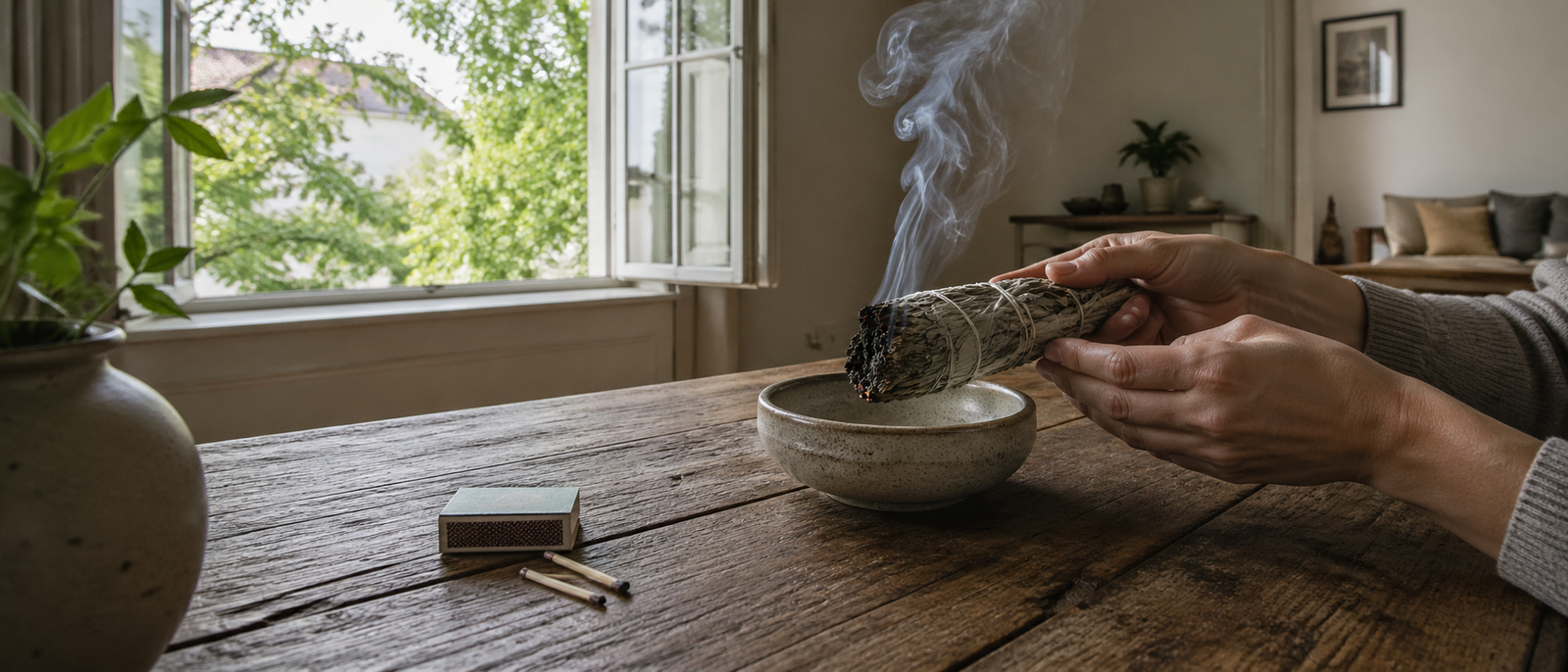
A good sage ritual is not complicated. The main trick is keeping the smoke controlled, giving the ritual a clear purpose, and putting the ember out properly.
Step 1. Open the room so smoke has somewhere to go
Open a window or door before lighting the bundle. A cracked window is better than a sealed room. Smoke needs an exit, and the room needs fresh air coming in.
This also gives the ritual a clean visual logic: the old feeling is being moved out, not trapped inside with you.
Step 2. Set one clear intention so the ritual has a job
Do not overthink the words. A sentence is enough.
- “I clear the heaviness from this room.”
- “I reset this space for rest.”
- “I release the tension from this week.”
- “I welcome calm, clarity, and steadiness here.”
A vague ritual can still feel nice, but a clear intention gives the mind something to aim at. It is the difference between wandering around with smoke and actually closing a chapter.
Step 3. Light the tip until it smolders instead of flames
Hold the end of the bundle to a flame until it catches for a few seconds. Then blow it out so the leaves smolder. You want a soft stream of smoke, not a flaming torch.
If it keeps flaming, blow it out again. If it will not catch at all, the bundle may be damp, too tightly wrapped, or not getting enough air.
Step 4. Move the smoke through the target area
For a room, move slowly around corners, doorways, windows, the bed area, the desk, or the spot that feels most charged. For an object, pass it through the smoke briefly or move the bundle around it without letting ash fall on it.
Three to five minutes is enough for many rooms. More smoke does not mean more cleansing. It often just means more smoke.
Step 5. Extinguish fully before you walk away
Press the burning end into sand, soil, ash, or a heatproof dish until there is no glow and no rising smoke. Do not drop a smoldering bundle into a drawer or onto a shelf. It sounds obvious, but this is the mistake that makes the whole ritual unsafe.
Step 6. Let the room settle
Keep the window open for a few minutes after the smoke pass. Then notice the room. Does it feel clearer, or just smoky? If it feels harsh, use less next time or choose a no-smoke method.
Common mistake: letting the bundle burn like a campfire in your hand. A sage stick should smolder. If flames keep coming back, pause and reset it.
White Sage, Blue Sage, Cedar, and Alternatives Compared by Use Case
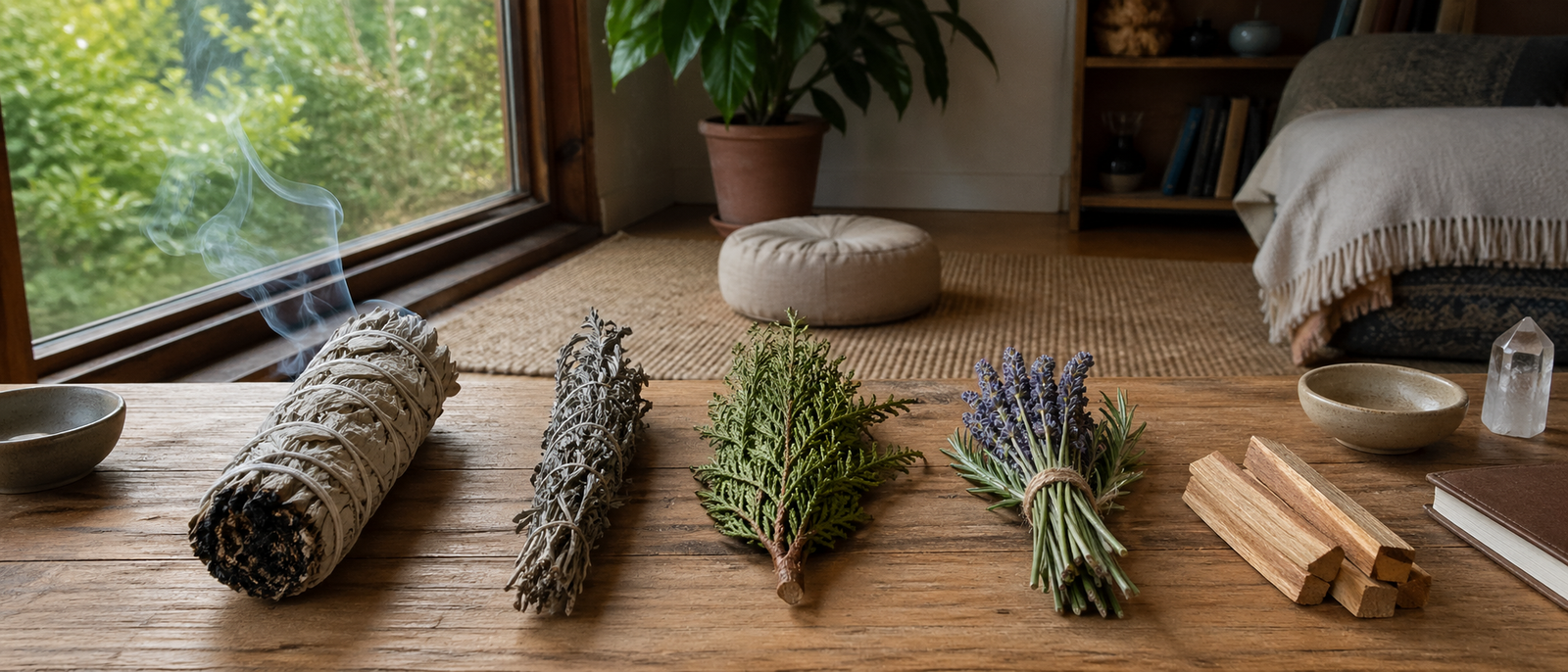
Not every smoke-cleansing herb feels the same. White sage has become the best-known option, but it is not automatically the best fit for every home or every mood.
| Option | Best fit | Smoke feel | Skip if… |
|---|---|---|---|
| White sage | Deep room reset, heavy energy, transition rituals | Strong | Sourcing is unclear or the room is tiny |
| Blue sage | Gentler cleansing, small rooms, lighter refresh | Medium | A strong ceremonial reset is the goal |
| Cedar | Protection, grounding, home blessing | Medium to strong | Woody smoke bothers you |
| Lavender or rosemary | Calm, softness, gentle reset | Light to medium | You want a very traditional sage ritual |
| Palo santo | Uplifting, warm, lighter cleansing rituals | Medium | Sourcing is vague or smoke is a poor fit |
Think of white sage as the heavy blanket of smoke-cleansing tools. Comforting in the right moment. Too much when all you needed was a cardigan.
If the goal is to compare sage types before choosing one, the guide to the best sage for cleansing negative energy goes deeper into white sage, blue sage, black sage, and other common options.
For most beginners, the smartest question is not “Which herb is strongest?” It is “Which herb fits this room, this household, and this reason?” A strong bundle in a small bedroom can feel heavy. A softer herb before journaling can feel more natural.
Cultural Respect and Ethical Sourcing Before You Burn
White sage is not just a trendy wellness prop. It is a plant with living cultural relationships, especially for Indigenous communities of Southern California and northern Baja.
The California Native Plant Society states that white sage, Salvia apiana, naturally occurs only in Southern California and northern Baja. That same resource warns that many purchased smudge sticks are poached or questionably sourced. That one fact changes the buying decision fast.
Native Governance Center also names “smudge kits” sold by non-Indigenous individuals as an example of cultural appropriation in wellness spaces, and it encourages people to ask where practices come from, who taught them, and whether the sacred meaning is being flattened into a product.
This does not mean every person who burns sage is trying to be disrespectful. Intent matters. So does impact. The more useful move is to slow down and get specific.
- Use “smoke cleansing” when the practice is personal and not part of a specific Indigenous ceremony.
- Choose cultivated sage over vague “wildcrafted” bundles when possible.
- Look for clear sourcing, not mystical copywriting.
- Support Indigenous-owned sellers or community-connected growers when that option is available.
- Avoid treating white sage like disposable decor for photos, party favors, or casual trend content.
Respect changes the practice: it affects what you buy, what you call the ritual, how much you burn, and whether you treat the plant like a tool or a relative with a story.
One more nuance: do not casually claim white sage is legally endangered. The better phrasing is that white sage faces serious poaching, sourcing, and cultural-use concerns. That is already enough reason to be careful.
When Sage Smudging Is the Wrong Fit for Your Home
Sometimes the most respectful sage ritual is the one you do not light.
Skip burning sage, or use a no-smoke alternative, when the room has poor airflow, when someone has asthma or chronic obstructive pulmonary disease, when pets are present, when children are nearby, when smoke alarms are sensitive, or when a lease bans smoke. Shared homes need consent too. A ritual stops being calming when someone else is coughing in the hallway.
Pets deserve special caution. Birds have delicate respiratory systems, and cats and dogs can be sensitive to smoke and strong scents. If animals live in the home, keep them out of the room during any smoke cleansing, ventilate well, and use less than you think.
No-smoke options can still feel intentional:
- Open the window and clap into the corners of the room.
- Ring a bell or singing bowl near doorways and corners.
- Wipe the main surface with a cloth while naming what you are clearing.
- Use prayer, meditation, or a short written release.
- Place a bowl of salt near the door for a day, then discard it.
- Use a gentle herbal spray only if fragrance is safe for the household.
If smoke is acceptable but sage feels too strong, incense may fit a lighter cleansing ritual. The guide to the best incense for cleansing can help compare smoke types without defaulting to the strongest option.
Common mistake: treating “natural” smoke as automatically gentle. Natural still burns. Burning still creates particles.
Mistakes That Make Sage Smudging Feel Harsh, Flat, or Risky
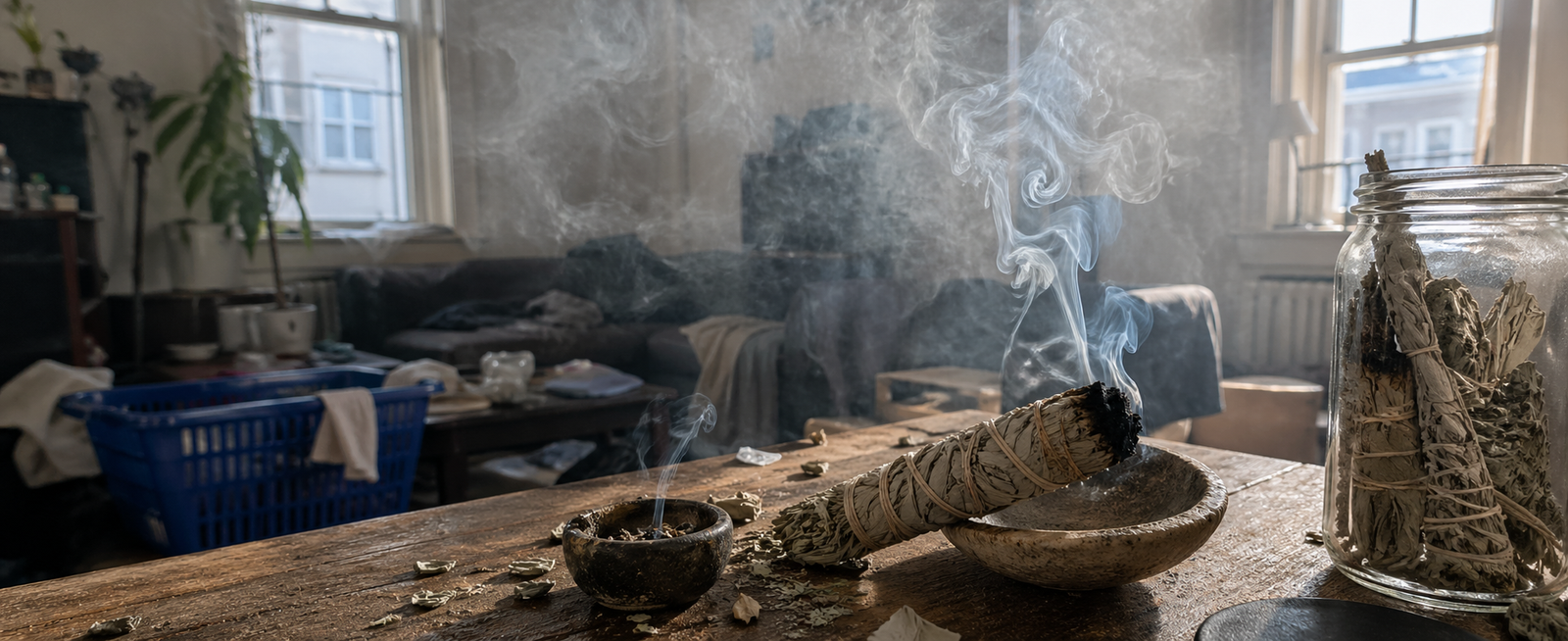
Most bad sage experiences come from one of three things: too much smoke, no clear purpose, or sloppy fire safety.
Here are the mistakes worth avoiding.
- Using too much smoke in a small space: a studio flat or tiny bedroom does not need a full dramatic sweep. One short pass can be enough.
- Skipping the intention: without a clear purpose, the ritual becomes scented pacing.
- Closing every window: this traps smoke and can make the room feel heavier, not clearer.
- Buying vague white sage bundles: if the seller cannot explain sourcing, that is a red flag.
- Leaving the ember alive: no visible glow, no rising smoke, no heat before storage.
- Using sage when the issue is physical clutter: a pile of dishes has very earthly energy. Wash the mugs first.
If a sage stick will not stay lit, do not keep fighting it for ten minutes. The bundle may be damp, too tight, or packed in a way that blocks airflow. Loosen the very end slightly, relight it, then give it air. Store unused bundles somewhere dry.
If the room feels worse after smudging, that usually means one of two things happened: the space got too smoky, or the ritual opened an emotional loop without closing it. Ventilate, sit down, drink water, and do one grounding action. Make the bed. Fold the blanket. Put the object back where it belongs. Small physical order helps.
A good test: if the ritual feels like arguing with a damp campfire, stop. The point is clarity, not winning a battle with herbs.
A Simple After-Ritual Reset So the Space Feels Different
The smoke is only the opening move. What you do after it decides whether the space feels meaningfully reset or just scented for twenty minutes.
Pick one small physical action after the sage is out:
- Open the curtains.
- Make the bed.
- Wipe the desk.
- Light a candle if smoke and flame are safe for the room.
- Place a crystal, photo, or meaningful object where it belongs.
- Write one sentence about what you are done carrying.
- Sit quietly for two minutes before picking up your phone.
This is the part many people skip. The body likes proof. A clean surface, fresh air, and one deliberate object placement tell your nervous system, “The room has changed.” Sage starts the reset, but a small action gives it somewhere to land.
For objects, keep the smoke pass short. Hold a tarot deck, piece of jewelry, or crystal near the smoke, not inside the ember. If crystals are part of the ritual, the guide on how do you cleanse your crystals covers smoke, sound, water-safe choices, and mistakes to avoid.
So, what are sage smudge sticks used for in the most practical sense? They are used to mark a reset. The smoke gives the moment a shape. The intention gives it meaning. The action after the ritual helps the change stick.
FAQ
Can sage smudge sticks be reused?
Yes. Put the bundle out fully, let it cool, and store it in a dry place. Before storing, check that there is no glowing ember, no rising smoke, and no heat at the tip.
Can regular kitchen sage be used instead of white sage?
Yes, garden sage can be used for a personal smoke-cleansing ritual, especially if it is grown at home or sourced clearly. It will not have the same scent, cultural context, or traditional associations as white sage, but it can still work as a personal ritual herb.
What should be said while burning sage?
Keep it short and specific. A simple phrase like “I clear the heaviness from this room and welcome calm, clarity, and steadiness” works better than a long script that feels borrowed or awkward.